 CryptoChain Blog

Introduction to ZK Tokenomics in 2026
Zero-knowledge (ZK) protocols have become central to privacy-preserving blockchains, enabling secure transactions without revealing sensitive data. As privacy-focused projects mature in 2026, analyzing their token economics through onchain metrics provides critical insights into sustainability and growth potential. This case study examines token distribution patterns, incentive structures, and velocity metrics specific to ZK ecosystems, offering readers practical frameworks for evaluation that go beyond surface-level observations.
Privacy chains leverage ZK rollups and zk-SNARKs to balance scalability with confidentiality. Onchain analytics tools reveal how token holders behave, helping investors and developers identify robust economic models versus speculative ones. In-depth analysis shows that projects with transparent vesting schedules and diversified incentives tend to exhibit stronger long-term retention rates compared to those relying heavily on short-term liquidity mining. The increasing regulatory focus on data protection worldwide further amplifies the importance of these metrics, as users seek networks that deliver both privacy and economic resilience.
Understanding ZK Rollup Models and Token Distribution
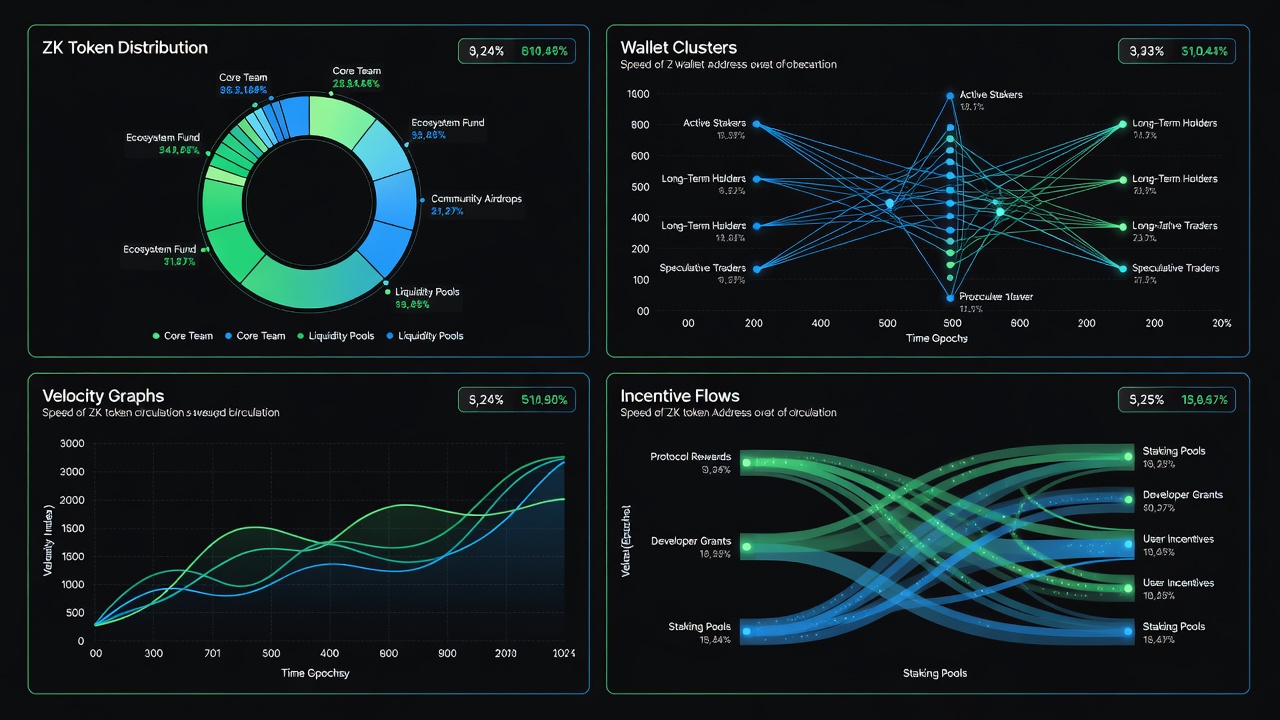
ZK rollups batch transactions off-chain while posting validity proofs on-chain. Leading models include optimistic versus validity-proof approaches, with the latter offering stronger privacy guarantees. Token distribution in these projects often allocates significant portions to ecosystem funds, team vesting, and community incentives. For instance, many protocols reserve 15-35% of supply for strategic partnerships and 25-45% for community-driven governance and liquidity pools.
Common patterns show 20-40% reserved for community governance and liquidity provision. Analyzing wallet clustering on explorers highlights concentration risks, where large holders can influence price stability. Sustainable projects distribute tokens gradually to avoid early dumps, often implementing cliff periods of 6-12 months followed by linear vesting. Readers should examine contract-level data to verify unlock schedules and cross-reference with holder distribution heatmaps. Variations across projects also include allocations for research grants and bug bounty programs, which help maintain technical integrity while distributing economic power more evenly across participants.
Incentive Structures and Their Impact on Velocity
Incentive mechanisms such as staking rewards and fee rebates drive network participation. Velocity metrics measure how quickly tokens circulate, indicating real utility versus hoarding. Lower velocity often signals strong holding behavior in privacy projects, as users value long-term confidentiality features. Projects that tie rewards to actual usage rather than pure speculation demonstrate healthier circulation patterns and reduced susceptibility to boom-bust cycles.
Step-by-step analysis starts with querying token transfer graphs, then correlating with active addresses. For example, projects with high staking ratios demonstrate reduced velocity, fostering stability. Practical examples include reviewing how fee-sharing models in ZK systems recycle value back into the ecosystem, encouraging repeated interactions without excessive sell pressure. Additional considerations involve examining how governance tokens integrate with privacy layers to reward long-term holders through voting power multipliers.
Evaluating Holder Behavior Through Blockchain Analytics
Blockchain analytics platforms allow tracking of holder behavior by monitoring wallet age, transaction frequency, and exchange flows. Privacy projects often see unique patterns, such as increased mixing activity post-distribution events. Advanced techniques involve segmenting holders into categories like long-term custodians, active traders, and liquidity providers to uncover nuanced behaviors that raw supply numbers may obscure.
- Identify dormant wallets accumulating tokens as a bullish signal indicating conviction among early participants.
- Monitor large transfers to centralized exchanges for potential sell pressure and timing risks that could affect short-term liquidity.
- Assess governance participation rates to gauge community engagement and decision-making health over multiple voting cycles.
- Track cross-chain bridge activity to understand capital flows between privacy networks and public chains, revealing integration strength.
- Analyze transaction timing patterns around major unlocks or airdrops to anticipate volatility windows.
Practical tips include cross-referencing multiple data sources to validate findings and avoiding over-reliance on single metrics. Analysts should also consider time-series data spanning at least six months to distinguish transient noise from structural trends that define project health.
Identifying Sustainable Economics Signals
Sustainable signals encompass consistent revenue from transaction fees funding token burns, balanced inflation rates, and diversified holder bases. Comparing across projects reveals that those with transparent onchain treasuries tend to outperform in long-term retention. Key indicators also include steady developer activity funded through token allocations and measurable adoption metrics such as daily active users interacting with privacy features. These signals collectively point to models where economic value accrues to the network rather than being extracted by short-term actors.
Comparison of Leading ZK Projects
Projects like zkSync and Polygon zkEVM exhibit differing models: one emphasizes broad airdrops for distribution, while others focus on developer grants. zkSync prioritizes ecosystem bootstrapping through targeted incentives, whereas Polygon emphasizes interoperability with existing Ethereum tooling. Readers should review official documentation for accurate breakdowns and compare onchain treasury transparency levels to identify which approach aligns best with their risk tolerance and investment horizon.
Step-by-Step Analysis Examples
1. Fetch token supply data from onchain contracts using public explorers and verify total versus circulating supply with historical snapshots.
2. Calculate velocity using 30-day transfer volumes divided by average token holdings to derive circulation speed and compare against industry benchmarks.
3. Map incentive flows via smart contract interactions, identifying reward distribution contracts and their recipients across multiple epochs.
4. Visualize holder distribution with clustering algorithms to detect whale concentration or retail spread and quantify Gini coefficients.
5. Correlate governance votes with token holdings to assess alignment between economic power and decision influence in privacy-focused DAOs.
6. Stress-test findings by simulating unlock events and observing projected impacts on velocity and concentration metrics.
These steps, when applied sequentially, provide a repeatable framework for comparing multiple privacy projects side-by-side and generating defensible investment theses.
Tools and Platforms for Onchain ZK Analysis
Effective analysis requires familiarity with specialized platforms that handle ZK-specific data. Popular options include Dune Analytics for custom queries on rollup activity, Nansen for wallet labeling and behavioral segmentation, and Arkham Intelligence for entity attribution in privacy environments. Combining these tools allows analysts to build comprehensive dashboards that track everything from proof generation costs to token movement across shielded pools. Beginners should start with free tiers and gradually incorporate paid features for deeper historical access.
Common Pitfalls and FAQs
FAQs address frequent mistakes when assessing ZK tokenomics. One common pitfall is overlooking vesting schedules, which can lead to sudden supply shocks if not modeled correctly. Another involves misinterpreting velocity without contextual factors such as network growth or external market conditions. Ignoring regulatory impacts on privacy tokens may also skew risk assessments, particularly in jurisdictions tightening rules around anonymous transactions.
Additional questions often include: How do onchain analytics tools handle privacy-preserving features without compromising user anonymity? What minimum data history is recommended for reliable conclusions? How should analysts account for token unlocks scheduled in the coming quarters? Always verify data timestamps and combine quantitative metrics with qualitative project fundamentals for accurate assessments. Cross-validation across at least two independent platforms is strongly advised to minimize errors.
Further reading is available at ethereum.org, web3.foundation, and polygon.technology for deeper technical context on ZK implementations and scaling approaches.
Conclusion
ZK tokenomics analysis using onchain data equips stakeholders with actionable insights for 2026 privacy projects. By focusing on distribution fairness, incentive alignment, and velocity trends, participants can better navigate this evolving sector and support economically sound initiatives that prioritize both privacy and sustainable growth.

No comments yet. Be the first!