 CryptoChain Blog

Introduction to DAO Governance in 2026
Decentralized Autonomous Organizations (DAOs) continue to reshape how communities and enterprises make decisions in Web3. By 2026, governance has moved far beyond simple token-weighted voting, embracing sophisticated systems that improve security, participation, and scalability. This evolution addresses enterprise needs for compliant, efficient operations while empowering grassroots communities to manage shared resources effectively. Search intent around Web3 innovations and decentralized scalability highlights the demand for practical insights into models that balance decentralization with real-world usability across diverse sectors such as finance, content creation, and supply chain management.
Organizations now seek governance frameworks that not only prevent centralization but also adapt to regulatory environments and technological advancements. The shift reflects broader Web3 maturation, where DAOs serve as foundational infrastructure for collaborative decision-making at scale.
The Evolution Beyond Token Voting
Early DAOs relied heavily on token voting, which often led to plutocracy and low engagement. In 2026, models incorporate reputation systems, quadratic voting, and conviction voting to distribute power more equitably. These approaches reduce whale dominance and encourage consistent participation from smaller token holders. Quadratic voting, for instance, allows voters to express intensity of preference by allocating multiple votes at increasing cost, fostering more nuanced outcomes. Reputation-based systems reward long-term contributors with influence that cannot be easily purchased, creating sustainable incentives aligned with organizational health.
Hybrid Governance Mechanisms
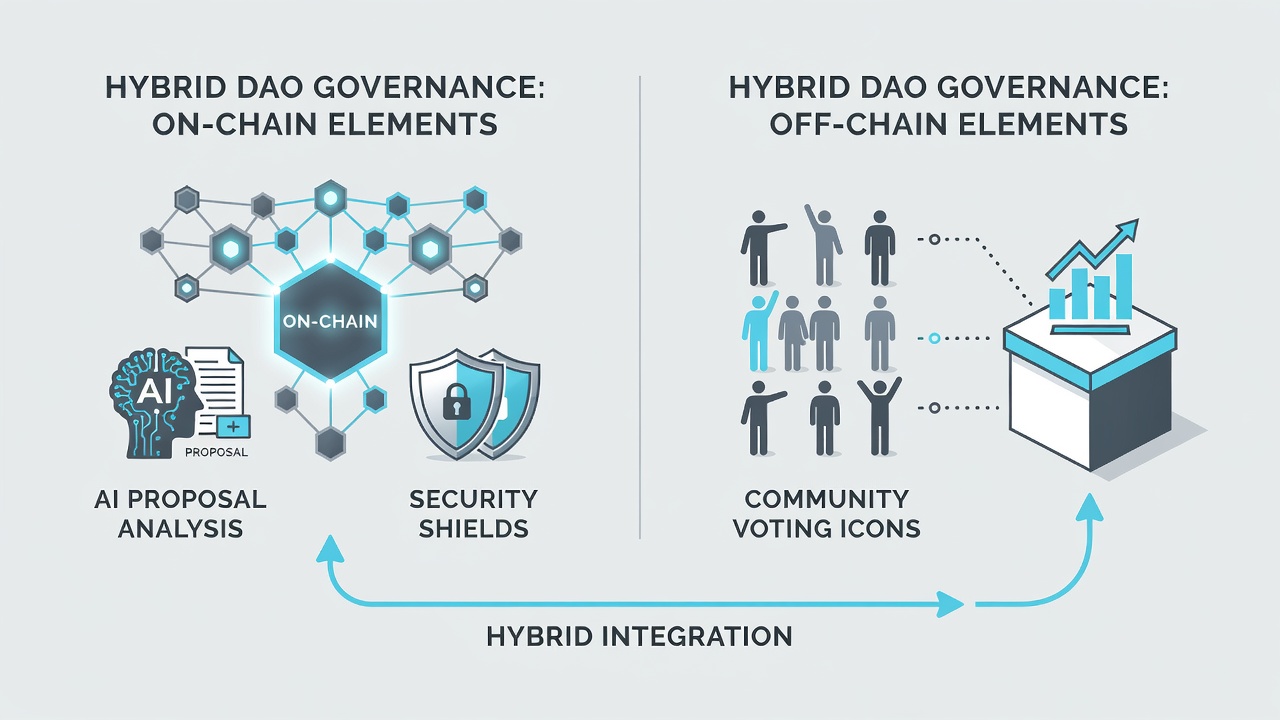
Hybrid systems combine on-chain execution with off-chain deliberation. Proposals undergo community discussion on forums before moving to blockchain votes. This structure enhances security by allowing thorough vetting while maintaining transparency through immutable records. Leading platforms integrate both layers to handle complex enterprise decisions without sacrificing speed. For example, a hybrid model might use Discord or dedicated forums for initial debate, followed by snapshot votes for signaling, and finally on-chain execution via smart contracts. This layered approach mitigates risks associated with purely on-chain rigidity while preserving the trustless benefits of blockchain.
AI-Assisted Proposals and Decision Support
Artificial intelligence now plays a pivotal role in drafting, analyzing, and predicting proposal outcomes. AI tools scan historical data, simulate voting scenarios, and flag potential risks before proposals reach the community. This assistance accelerates decision cycles and improves quality, particularly for large-scale DAOs managing significant treasuries. Machine learning models can identify patterns in past votes, suggest amendments based on similar successful proposals, and even generate natural language summaries for non-technical members. AI integration supports Web3 scalability by processing vast amounts of governance data that humans alone cannot manage efficiently, enabling DAOs to handle thousands of members without bottlenecks.
Real-World Case Studies from Leading DAOs
Case studies reveal practical applications. Uniswap DAO has refined its governance with temperature checks and on-chain votes, leading to smoother protocol upgrades and improved liquidity management. MakerDAO employs a hybrid approach with executive and governance polls, demonstrating resilience during market volatility by quickly adjusting stability fees and collateral requirements. Arbitrum DAO balances community input with foundation oversight for technical decisions, resulting in faster implementation of scaling solutions while maintaining broad consensus. Additional examples include Aave DAO, which uses AIPs (Aave Improvement Proposals) combined with risk assessment frameworks, and Compound DAO, where governance tokens enable protocol parameter changes that have sustained billions in borrowed assets. These cases illustrate how tailored governance supports both innovation and stability across DeFi ecosystems.
Security Challenges in Modern DAO Governance
Security remains paramount. Smart contract vulnerabilities, governance attacks like flash loan exploits, and proposal spam threaten operations. Mitigation strategies include multi-signature requirements, time delays, and formal verification of code. Regular audits and bug bounties further strengthen defenses, ensuring DAOs can scale without compromising integrity. Additional challenges involve sybil attacks where fake identities manipulate votes and oracle manipulation that affects data-dependent proposals. Solutions often incorporate identity verification layers or staking requirements to deter bad actors, alongside continuous monitoring tools that alert communities to suspicious activity in real time.
Voter Participation Strategies
Low turnout undermines legitimacy. Effective strategies include delegation mechanisms, incentive programs, and user-friendly interfaces. Education campaigns and mobile voting apps have proven successful in boosting engagement rates across diverse communities. Delegation allows experts to vote on behalf of others while retaining the ability to override at any time. Incentive programs might distribute additional tokens or NFTs for consistent voting activity. Clear proposal summaries, impact assessments, and visual dashboards reduce cognitive load, making participation accessible even to newcomers. Hosting regular AMAs, workshops, and gamified elements further sustains interest over time.
- Implement delegation to leverage expert voters and reduce information asymmetry
- Offer governance tokens as rewards for active participation with clear vesting schedules
- Provide clear proposal summaries and impact assessments using standardized templates
- Host regular AMAs, workshops, and interactive tutorials to build knowledge
- Integrate mobile-friendly apps with push notifications for upcoming votes
Comparing On-Chain and Off-Chain Systems
On-chain governance offers transparency and automatic execution but can be gas-intensive and rigid. Off-chain systems provide flexibility and lower costs yet risk centralization. The optimal choice depends on use case—enterprises often prefer hybrids for regulatory compliance and audit trails. On-chain excels in financial DAOs requiring immediate, trustless execution, while off-chain deliberation suits creative or strategic planning where nuance and discussion are critical. Hybrids combine the best of both, using off-chain signaling for broad input and on-chain for final binding decisions, which has become the dominant trend in 2026 for enterprise and community DAOs alike.
Practical Steps for Implementing Governance Upgrades
Upgrading governance requires careful planning. Begin with an audit of current processes, then pilot new mechanisms with a subset of members. Key steps include defining clear objectives aligned with organizational goals, selecting tools compatible with existing infrastructure, testing upgrades in a staging environment, communicating changes transparently to build buy-in, and monitoring metrics post-implementation for continuous iteration. Additional considerations involve stakeholder mapping to identify power dynamics, legal reviews for compliance in target jurisdictions, and phased rollouts that start with low-stakes proposals. Resources from the Ethereum Foundation and Web3 Foundation provide valuable frameworks, documentation, and best practices for these transitions, helping teams avoid common implementation pitfalls.
FAQ: Common Pitfalls in DAO Governance
What causes low voter turnout in DAOs?
Complex interfaces, lack of incentives, and unclear proposal impacts often deter participation. Simplifying processes, adding meaningful rewards, and providing educational resources helps overcome this barrier effectively.
How do hybrid models address security risks?
By separating deliberation from execution, hybrids allow extended time for review, community feedback, and risk assessment, reducing rushed decisions that could introduce vulnerabilities or unintended consequences.
Are AI tools reliable for governance proposals?
AI serves as a powerful assistant for analysis and drafting rather than a final decision-maker. Human oversight remains essential to validate outputs, ensure alignment with community values, and maintain core decentralization principles.
What are the main differences between on-chain and off-chain voting?
On-chain provides immutable records, automatic execution, and censorship resistance; off-chain offers greater speed, lower costs, and flexibility but requires trust in external platforms or moderators for coordination.
How can DAOs prevent governance attacks?
Implementing time locks, multi-sig controls, formal verification, and active monitoring combined with community education on threat vectors significantly reduces exposure to exploits like flash loans or proposal spam.
Conclusion
DAO governance trends in 2026 emphasize adaptability, security, and inclusivity. By adopting hybrid models, leveraging AI thoughtfully, focusing on participation strategies, and following structured upgrade processes, organizations can achieve scalable Web3 decision-making that serves both enterprise compliance needs and community-driven innovation effectively. These advancements position DAOs as robust vehicles for decentralized collaboration in the evolving digital economy.


No comments yet. Be the first!