 CryptoChain Blog

Introduction to Decentralized Compute in Web3
As Web3 projects scale toward 2026, decentralized compute networks offer compelling alternatives to traditional cloud providers. Platforms like Akash, Render, and iExec enable developers to access distributed resources for AI training, rendering, and smart contract execution without centralized control. This comparison examines their suitability for DeFi and gaming applications, focusing on performance, economics, and integration. Decentralized compute reduces reliance on single vendors while potentially lowering expenses through peer-to-peer marketplaces. Developers targeting high-throughput dApps benefit from these networks' ability to handle variable workloads efficiently. The shift toward these solutions addresses growing concerns over data sovereignty and vendor lock-in that plague centralized infrastructures.
In an era where blockchain applications demand elastic resources, understanding the nuances of each platform becomes essential. From GPU-heavy rendering tasks to secure off-chain computations, the right choice can dramatically impact project success rates and user experiences in 2026 and beyond.
Overview of Leading Platforms
Akash Network operates as a decentralized cloud marketplace, allowing providers to lease unused compute capacity. Render focuses on GPU-intensive tasks such as 3D rendering and machine learning inference. iExec provides a marketplace for off-chain computation with emphasis on verifiable execution for blockchain applications. Each platform leverages its native token for payments and incentives, creating distinct economic models that influence long-term project viability. Akash emphasizes broad accessibility for general workloads, while Render prioritizes visual and AI processing power. iExec stands out for its focus on confidential and attested computations that integrate seamlessly with existing blockchain ecosystems.
Performance Benchmarks and Latency
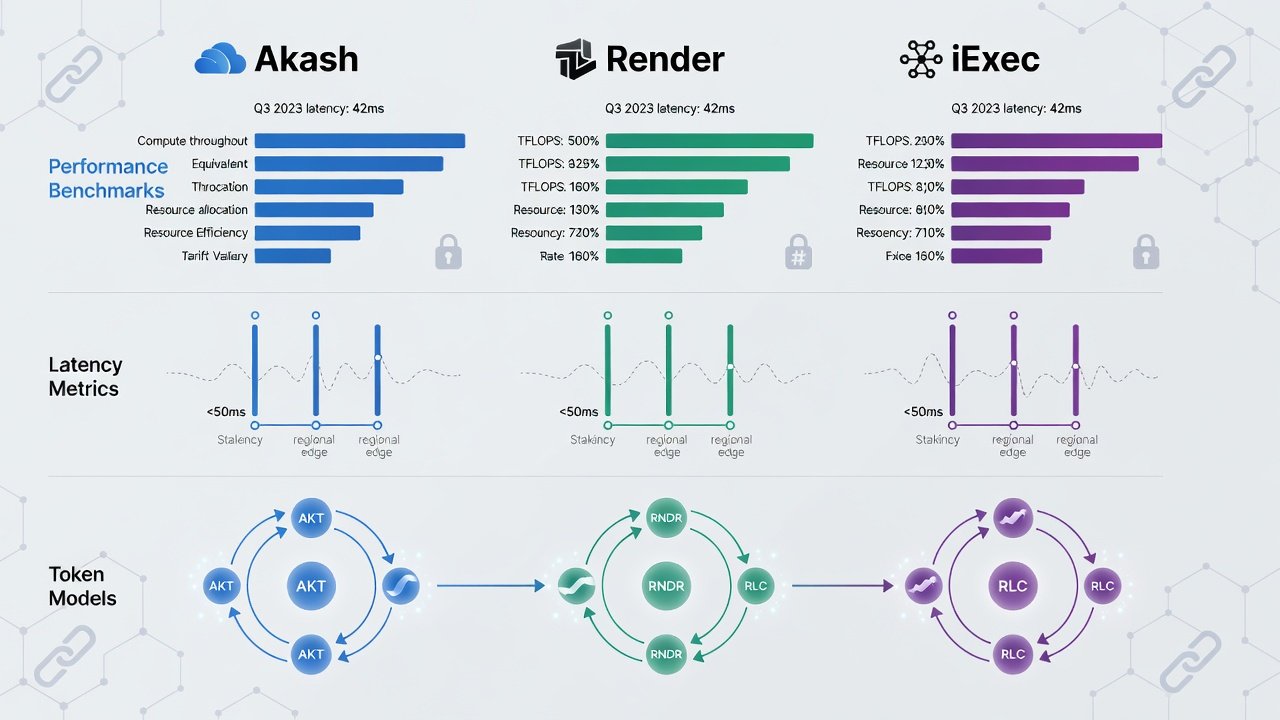
Benchmarks for 2026 projections highlight differences in throughput and latency. Akash excels in general-purpose CPU workloads with consistent uptime across global nodes. Render delivers superior GPU performance for graphics-heavy tasks, achieving lower render times in distributed environments. iExec emphasizes secure, attested computations that suit sensitive DeFi operations. Latency reductions are notable when nodes are geographically distributed, cutting response times by routing tasks to nearby providers. Real-world tests show these networks can match or exceed centralized options for many Web3 use cases, particularly in scenarios involving bursty traffic patterns common in gaming and DeFi protocols.
Further analysis reveals that Akash achieves high reliability through its Kubernetes-based orchestration, making it ideal for containerized microservices. Render's network demonstrates significant speed advantages in parallel processing environments, while iExec's use of trusted execution environments ensures both performance and data integrity. These metrics position decentralized options as viable for production-grade applications heading into 2026.
Token Economics and Cost Considerations
Token models drive participation and sustainability. Akash uses AKT for staking and payments, aligning incentives between providers and users. Render's RNDR token facilitates GPU rentals with mechanisms for quality assurance. iExec employs RLC tokens to govern computation orders and oracle services. Compared to centralized clouds, these networks deliver qualitative savings through competitive bidding and excess capacity utilization. Developers should evaluate token volatility when planning budgets for 2026 projects. Staking rewards and slashing mechanisms further shape the economic landscape, encouraging long-term provider commitment and network stability.
Integration Steps with dApps
Integrating these platforms involves several practical steps. First, connect via SDKs or APIs provided by each network. For Akash, deploy workloads using their CLI tools and Kubernetes compatibility. Render integration requires submitting render jobs through their marketplace dashboard. iExec offers confidential computing modules that link directly to Ethereum smart contracts. Testing involves deploying sample tasks, monitoring resource allocation, and verifying output integrity. Documentation from ethereum.org supports smart contract interactions common across these platforms. Additional guidance can be found via resources at web3.foundation, which outlines best practices for decentralized infrastructure adoption.
Step-by-step migration often begins with workload assessment, followed by provider selection based on geographic proximity and hardware specs. Developers should implement monitoring dashboards early to track metrics like job completion rates and error logs. This phased approach minimizes disruptions during transitions from centralized services.
Real-World Case Studies
In DeFi, protocols have used iExec for private oracle feeds that enhance trading accuracy without exposing data. Gaming applications leverage Render for on-demand asset generation, enabling dynamic worlds that scale with player demand. Akash has supported blockchain node hosting for projects requiring resilient infrastructure during peak loads. These examples demonstrate measurable improvements in scalability and cost efficiency for production dApps. One notable DeFi case involved integrating iExec to handle complex risk calculations off-chain, resulting in faster transaction finality and reduced on-chain congestion. Gaming studios using Render reported smoother user experiences during high-traffic events such as NFT drops or live tournaments.
Security Considerations
Security remains paramount. Akash employs container isolation and provider reputation systems. Render uses proof-of-render mechanisms to validate completed work. iExec incorporates trusted execution environments for verifiable off-chain results. Developers must audit node providers and implement encryption layers. Future roadmaps include enhanced zero-knowledge proofs to further bolster trust. Additional layers such as multi-signature approvals and regular security audits help mitigate risks associated with distributed environments.
Future Scalability Roadmaps
Each platform outlines expansions for 2026 and beyond. Akash plans broader hardware support and improved orchestration. Render targets AI-specific workloads with expanded GPU pools. iExec focuses on cross-chain compatibility and decentralized governance upgrades. These developments position decentralized compute as a core Web3 infrastructure layer. Anticipated features include better interoperability standards and automated resource optimization tools that will further lower barriers for new entrants.
Decision Framework for Choosing Providers
When selecting a platform, consider workload type first: general compute favors Akash, GPU tasks suit Render, and secure off-chain execution points to iExec. Evaluate token liquidity, community support, and integration complexity next. Pilot projects on multiple networks before committing resources.
- Assess current dApp performance bottlenecks
- Compare provider availability in target regions
- Review token utility and staking rewards
- Test security features with sample data
- Project long-term roadmap alignment
- Evaluate community governance participation
- Analyze historical uptime statistics
Common Mistakes to Avoid
Many teams overlook token volatility during initial budgeting, leading to unexpected expenses. Another frequent error involves insufficient testing of latency in target user regions. Rushing full migrations without pilot phases can expose vulnerabilities in security configurations. Always prioritize gradual rollouts and comprehensive logging to catch issues early.
Conclusion
Decentralized compute networks like Akash, Render, and iExec present robust options for 2026 Web3 scalability. By understanding their strengths in performance, economics, and security, developers can build more resilient and efficient applications. Migration planning and ROI analysis through pilot testing will maximize benefits as adoption grows. The future of Web3 infrastructure increasingly relies on these distributed systems to deliver the scalability demanded by next-generation decentralized applications.
FAQs on Migration and ROI
How do I migrate existing workloads? Start with containerized applications and use platform-specific deployment guides for seamless transition. Begin with non-critical components to validate processes before full-scale moves.
What ROI can be expected? Qualitative gains include reduced vendor lock-in and flexible scaling; calculate based on workload volume and provider rates over time. Long-term savings often emerge from competitive marketplaces and reduced overhead.
Are there migration risks? Address latency variances and data consistency through phased rollouts and monitoring tools. Regular audits and fallback plans help manage potential disruptions effectively.
How do token economics affect ongoing costs? Fluctuations in native tokens require hedging strategies or stablecoin pairings where available to stabilize budgeting for sustained operations.
No comments yet. Be the first!