 CryptoChain Blog

Introduction to Decentralized Identity in Web3
Decentralized identity is rapidly emerging as a foundational innovation in Web3, shifting control of personal data from centralized corporations back to individuals. In 2026, this trend empowers users with self-sovereign identity (SSI) solutions that enhance privacy, security, and interoperability across decentralized applications. Unlike traditional systems reliant on single points of failure, decentralized approaches leverage blockchain technology to create verifiable, portable digital identities that users fully own and manage through cryptographic keys.
Search intent for this topic centers on forward-looking insights into secure, user-centric solutions for the decentralized web. This article dives deep into key technologies, real-world examples, comparisons between systems, implementation guidance for developers, regulatory considerations, adoption metrics, and integration challenges to provide actionable value. By examining these elements comprehensively, readers gain a clear understanding of how decentralized identity addresses longstanding issues in data ownership and online trust.
Core Technologies Powering Decentralized Identity
Three primary technologies underpin decentralized identity systems: Decentralized Identifiers (DIDs), verifiable credentials, and zero-knowledge proofs. DIDs are unique, persistent identifiers that users control without intermediaries, registered on distributed ledgers such as Ethereum or specialized networks. They function as the foundational layer, allowing resolution to public keys and service endpoints for authentication and verification purposes.
Verifiable credentials allow issuers like universities, employers, or governments to attest to attributes like age, qualifications, or membership status in a tamper-proof digital format that can be cryptographically validated. These credentials are stored in user-controlled wallets rather than centralized databases. Zero-knowledge proofs enable verification without revealing underlying data, preserving privacy during transactions or access requests. For example, a user can prove they are over 18 without disclosing their exact birthdate or full identity details.
Real-world projects illustrate these advancements effectively. The Sovrin Network demonstrates SSI at scale through its public permissioned ledger designed specifically for identity management. Similarly, projects on Ethereum integrate DIDs for seamless authentication in DeFi protocols and NFT marketplaces, reducing reliance on traditional login methods. The W3C standards provide the foundational specifications for DIDs and verifiable credentials, ensuring global interoperability and consistent implementation across platforms. Additional frameworks like Hyperledger Indy further support enterprise-grade deployments with focus on privacy-preserving features.
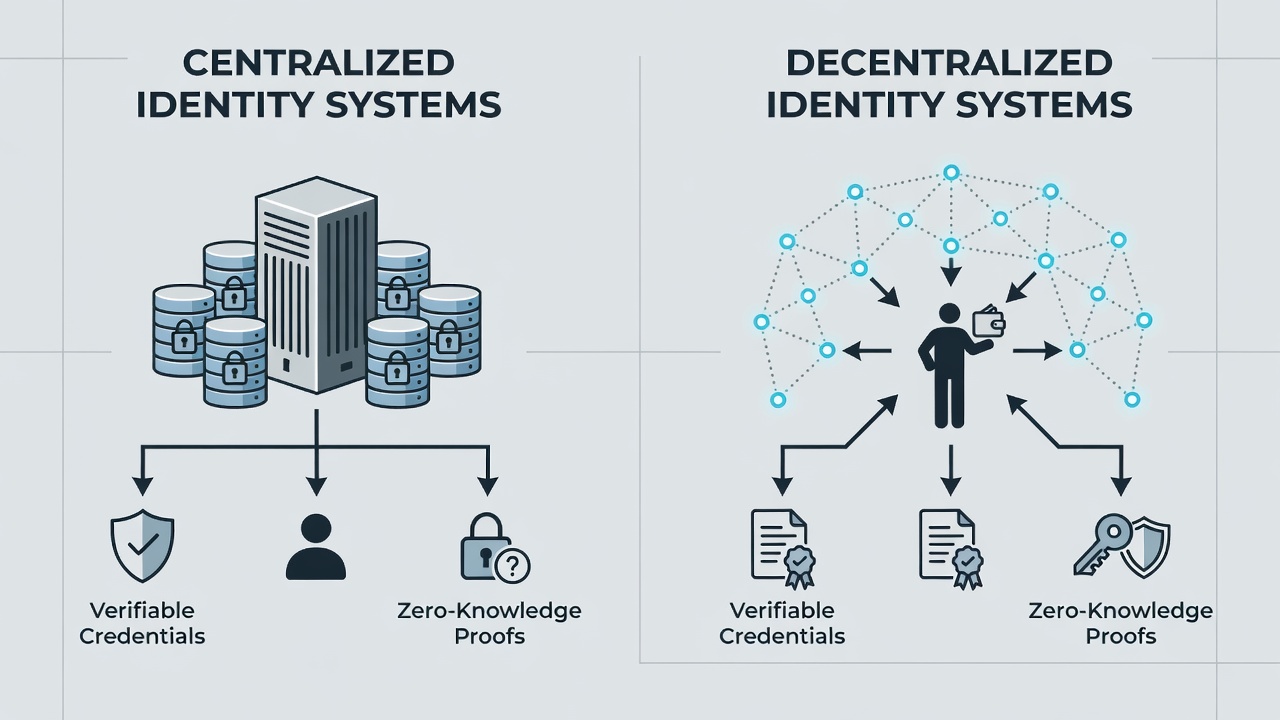
Centralized vs Decentralized Identity Systems
Centralized identity systems, such as those managed by social media giants or government databases, store user data in silos controlled by single entities. This creates risks including large-scale data breaches, surveillance concerns, limited user portability, and dependency on the provider's continued existence. Users often have little recourse when accounts are suspended or data is misused. In contrast, decentralized systems distribute control across networks, allowing users to manage their own keys and selectively disclose only necessary information through cryptographic methods.
Key differences include control, where centralized entities own and monetize data while decentralized models give users true sovereignty; security, with single points of failure in centralized setups versus cryptographic resilience and distributed consensus in decentralized ones; privacy, enabling full data exposure risks centrally but minimal disclosure via zero-knowledge proofs decentrally; and interoperability, often fragmented across providers centrally but seamless across platforms and blockchains decentrally. Additional distinctions involve revocation mechanisms, auditability, and resilience to censorship. Adoption metrics from 2026 show growing momentum, with decentralized solutions gaining traction in enterprise pilots as organizations seek to reduce compliance burdens, lower breach costs, and enhance user trust through transparent, user-owned data models.
Practical Implementation Steps for Developers
Developers can integrate decentralized identity into Web3 projects through structured, repeatable steps that emphasize security and standards compliance. First, choose a DID method compatible with your target blockchain, such as did:ethr for Ethereum-based solutions or did:sov for Sovrin integrations. This decision impacts scalability and ecosystem fit. Second, implement verifiable credential issuance and verification using established libraries like Veramo for JavaScript environments or Hyperledger Aries for more robust agent-based architectures.
Third, incorporate zero-knowledge proof frameworks such as zk-SNARKs or zk-STARKs for privacy-preserving verifications that maintain performance on public networks. Fourth, test interoperability thoroughly with standards from the Ethereum Foundation and W3C working groups to ensure credentials work across wallets and dApps. Fifth, deploy secure wallet integrations that allow users to store, manage, and present credentials with intuitive interfaces, including support for mobile and hardware key storage. Finally, conduct thorough audits and user testing focused on key recovery processes.
Integration challenges often involve educating users on key management best practices, handling credential revocation in dynamic environments, and ensuring scalability on public networks without excessive gas fees. Addressing these early prevents common pitfalls and leads to more robust applications.
Regulatory Hurdles and Adoption Considerations
Regulatory landscapes pose significant hurdles for decentralized identity adoption. Frameworks like GDPR in Europe emphasize data minimization and user rights that decentralized systems naturally support through selective disclosure. However, varying global standards require careful navigation around data residency requirements, liability for credential issuers, and cross-border data flows. Projects must balance rapid innovation with compliance to avoid legal pitfalls, often involving legal experts early in development cycles. In regions with stricter data localization laws, hybrid approaches combining on-chain verification with off-chain storage may be necessary.
Adoption continues to accelerate through strategic collaborations between technology firms, standards bodies, and regulators, fostering environments where self-sovereign identities can thrive while meeting evolving compliance needs.
Real-World Case Studies and Future Outlook
Examining specific deployments reveals practical impacts. In supply chain applications, decentralized identity enables verifiable provenance tracking without exposing proprietary business data. Healthcare pilots use verifiable credentials for patient-controlled health records that integrate with blockchain audit trails. Looking ahead to late 2026 and beyond, convergence with AI-driven verification and expanded support in major wallets promises broader mainstream adoption, positioning decentralized identity as essential infrastructure for the next generation of Web3 services.
Frequently Asked Questions
What is self-sovereign identity?
Self-sovereign identity allows individuals to own and control their digital identities without relying on centralized authorities, using cryptographic tools and distributed ledgers for verification and management.
How do zero-knowledge proofs enhance privacy?
They enable mathematical proof of information validity without exposing the actual underlying data, which is crucial for secure and private Web3 interactions such as age verification or membership checks.
Are there risks with decentralized identity?
Primary risks include user error in key management leading to permanent loss of access and evolving regulatory uncertainties across jurisdictions, both mitigated through comprehensive education, user-friendly tooling, and proactive compliance strategies.
How does decentralized identity improve interoperability?
By adhering to open standards like those from W3C, identities and credentials become portable across different blockchains, applications, and service providers without custom integrations or data migrations.
Conclusion
Decentralized identity trends are set to redefine Web3 by 2026, delivering unprecedented user empowerment alongside robust security and privacy protections. By understanding the core technologies, system comparisons, detailed implementation paths, regulatory factors, and real-world applications outlined here, stakeholders can position themselves effectively at the forefront of this transformative evolution in the decentralized web.


No comments yet. Be the first!