 CryptoChain Blog

Introduction to Decentralized Storage in Web3
As Web3 applications and NFTs continue to evolve in 2026, choosing the right decentralized storage solution is critical for developers building dApps that require reliable, censorship-resistant data handling. Traditional centralized servers pose risks of single points of failure, data breaches, and arbitrary takedowns, while protocols like IPFS, Filecoin, Arweave, and Sia offer distributed alternatives tailored to blockchain ecosystems. These solutions leverage peer-to-peer networks to store files across thousands of nodes, ensuring redundancy and resilience against outages or attacks.
This comparison examines these leading options across key metrics including permanence, retrieval speed, and overall suitability for NFT marketplaces and decentralized applications. Real-world examples from 2026 projects illustrate practical implementations, helping developers understand migration paths and integration challenges. Search intent often focuses on practical decision-making factors such as ongoing maintenance costs, security implications, and long-term viability in a rapidly changing regulatory landscape.
Overview of Leading Protocols
IPFS: The Foundation for Content Addressing
IPFS provides a peer-to-peer hypermedia protocol that identifies content by its hash rather than location. It serves as the backbone for many Web3 storage setups, enabling efficient distribution of files across nodes. Developers commonly use it for hosting static assets, metadata for NFTs, and decentralized websites. Learn more on the official IPFS site. Its content-addressable nature means files remain accessible as long as at least one node pins them, though native permanence requires additional services.
Filecoin: Incentivized Storage Marketplace
Built on IPFS, Filecoin adds economic incentives through its blockchain, allowing users to rent storage space from providers worldwide. It excels in handling large-scale data with verifiable deals and cryptographic proofs that confirm data integrity over time. Explore Filecoin's official resources. This market-driven approach makes it suitable for projects needing scalable, auditable storage without relying on centralized providers.
Arweave: Permanent Data Archiving
Arweave focuses on one-time payments for perpetual storage, making it ideal for immutable records and NFTs that must remain accessible indefinitely without ongoing fees. Its blockweave structure incentivizes miners to store data forever, creating a truly archival network. Visit the Arweave foundation site for technical documentation and ecosystem updates.
Sia: Privacy-Focused Decentralized Cloud
Sia emphasizes end-to-end encryption and user control, functioning as a decentralized alternative to traditional cloud storage with competitive performance for private data. Hosts compete on price and uptime, giving users granular control over redundancy levels. Check Sia’s official website for client downloads and host statistics.
Performance Benchmarks and Trade-offs
Benchmarks from 2026 evaluations highlight distinct strengths across simulated Web3 workloads. IPFS offers fast local retrieval but depends on node availability for global access, often achieving sub-second responses when content is cached nearby. Filecoin provides robust redundancy through its market but may incur variable retrieval times ranging from seconds to minutes depending on deal parameters and geographic distribution. Arweave ensures permanence yet can have slower initial uploads due to its consensus requirements. Sia delivers strong privacy with solid speeds for encrypted files, frequently matching or exceeding centralized options in latency tests for smaller payloads.
Security trade-offs include IPFS's lack of native encryption (requiring additional layers like IPFS-Cluster or third-party tools), Filecoin's reliance on storage providers' reliability verified through proofs, Arweave's emphasis on immutability that limits future edits or deletions, and Sia's strong encryption that adds minor computational overhead during uploads and downloads. Sustainability angles favor protocols using efficient consensus mechanisms, reducing energy consumption compared to proof-of-work systems by leveraging proof-of-replication and proof-of-spacetime.
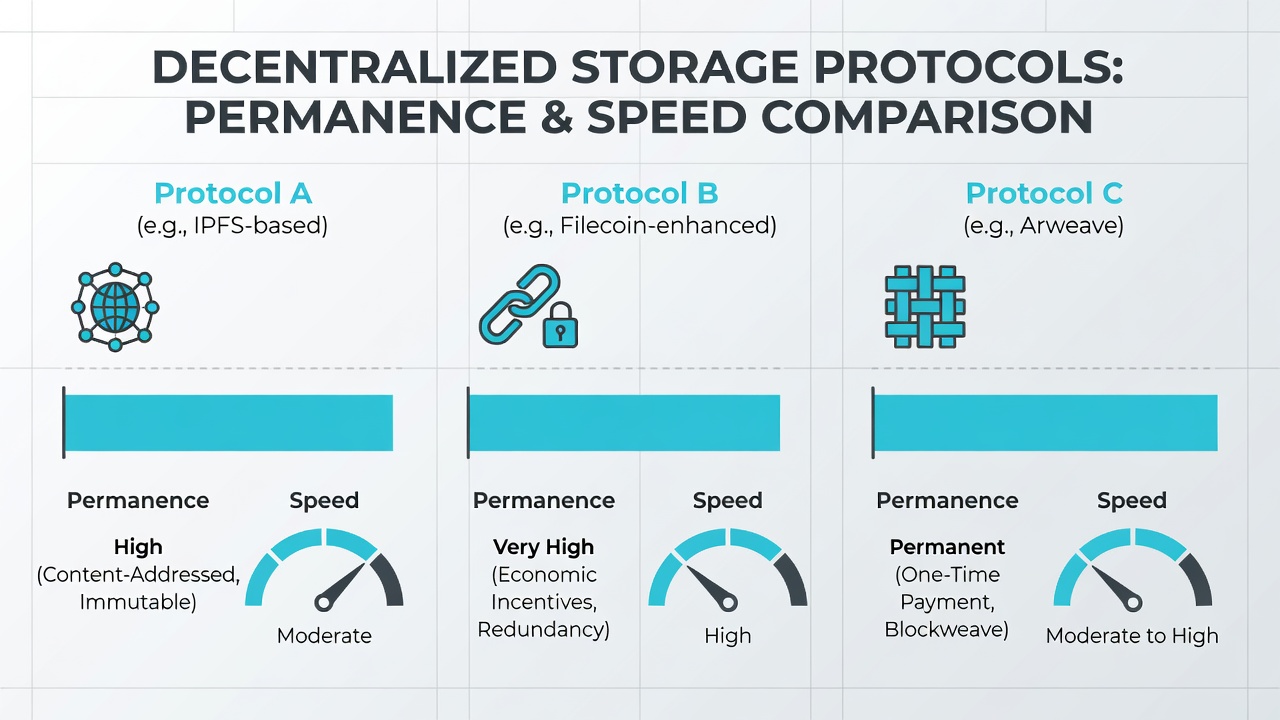
Side-by-Side Comparison Table
| Protocol | Permanence | Speed | Cost Model | Best For |
|---|---|---|---|---|
| IPFS | High with pinning | Fast local | Free + pinning services | Content distribution |
| Filecoin | High via deals | Variable retrieval | Market-based | Large datasets |
| Arweave | Permanent | Moderate | One-time payment | NFTs and archives |
| Sia | High with redundancy | Competitive | Subscription-like | Private storage |
Step-by-Step Integration Guides
For migrating to IPFS, start by installing the IPFS desktop client or CLI on your development machine. Add files using the ipfs add command, then use pinning services to ensure availability across the network. Next, integrate via JavaScript libraries such as ipfs-http-client in your dApp frontend, updating NFT metadata URIs to point to IPFS gateways. Test retrieval under simulated node failures to verify resilience before production deployment.
Filecoin integration involves setting up a Lotus node or using hosted APIs, creating storage deals through the market with specified duration and replication factors, and verifying proofs on-chain via smart contracts. Developers often combine it with IPFS for seamless content addressing while leveraging Filecoin's incentives for long-term hosting. Real 2026 examples include oracle networks that store historical price feeds off-chain with cryptographic verification.
Arweave requires generating an AR token wallet, uploading via the Arweave gateway or official SDKs in languages like JavaScript and Python, and paying once for lifetime access. Integration with NFT contracts typically involves storing JSON metadata permanently and referencing transaction IDs in smart contracts. Projects handling regulatory-compliant records have adopted this approach for its simplicity and guaranteed availability.
Sia users install the Sia client or use community SDKs, fund a wallet with siacoins, and rent contracts with hosts for encrypted uploads. Configure redundancy settings based on file importance, then integrate retrieval endpoints into dApp backends. Privacy-centric applications such as decentralized identity platforms frequently choose Sia for its built-in encryption during migration from centralized databases.
Case Studies of 2026 Implementations
A prominent NFT platform migrated its metadata to Arweave in early 2026, achieving zero downtime and full permanence for over 500,000 assets. The team reported simplified compliance audits because every file carried an immutable timestamp and hash. A DeFi dApp leveraged Filecoin for off-chain data oracles, reducing costs while maintaining auditability through verifiable storage proofs that smart contracts could query directly.
Another project combined IPFS with Sia for hybrid privacy needs, demonstrating seamless retrieval speeds in production environments for user-generated content. This hybrid setup allowed public assets on IPFS and sensitive user data on Sia, resulting in improved user trust metrics and lower infrastructure overhead compared to previous centralized hosting.
Sustainability and Future Outlook
Decentralized storage contributes to a greener web by distributing load and incentivizing efficient hardware use across global participants. Future innovations may include enhanced cross-protocol interoperability, AI-driven optimization for data placement, and tighter integration with layer-2 scaling solutions for even faster access patterns. As Web3 matures, expect more standardized benchmarks and tooling that simplify multi-protocol deployments.
FAQs
- What are common migration pitfalls? Underestimating pinning requirements or ignoring provider reputation can lead to data loss. Always test with small datasets first and implement monitoring for deal expirations.
- How do costs compare qualitatively? Arweave offers predictable one-time fees ideal for static assets, while Filecoin varies with market dynamics and Sia provides flexible recurring options based on host competition.
- Which suits high-speed dApps best? IPFS combined with caching layers often wins for frequent access, especially when paired with content delivery networks that front the decentralized network.
- Are there regulatory considerations in 2026? Projects should evaluate data residency requirements and ensure chosen protocols support compliance features like selective disclosure where needed.
Developers should evaluate project needs against these trade-offs to select the optimal solution for long-term Web3 success. Thorough testing across multiple protocols remains the best path to informed decisions.


No comments yet. Be the first!