 CryptoChain Blog

Introduction to Quantum Threats in Web3
Quantum computing poses an existential risk to current blockchain cryptography. Algorithms like Shor’s can break elliptic curve cryptography (ECC) and RSA, which underpin most Web3 protocols including Ethereum and Bitcoin. As we approach 2026, developers must prioritize quantum resistance to maintain the integrity of decentralized systems. This guide examines advanced techniques, post-quantum standards, and actionable integration paths for securing the decentralized web against emerging computational threats that could undermine digital asset ownership and smart contract execution.
The decentralized nature of Web3 amplifies the urgency. Unlike centralized systems that can patch vulnerabilities quickly, blockchain networks require consensus across thousands of nodes for any cryptographic upgrade. Delaying action risks permanent loss of funds or protocol integrity once quantum supremacy is achieved in cryptanalysis. Early preparation ensures continuity and positions forward-thinking projects ahead of regulatory and competitive pressures.
Understanding the Quantum Computing Threat Landscape
Current public-key cryptography relies on mathematical problems that classical computers solve slowly. Quantum machines, however, exploit superposition and entanglement to solve these problems exponentially faster. A sufficiently powerful quantum computer could derive private keys from public addresses, enabling theft of digital assets and compromise of smart contracts. Research indicates that cryptographically relevant quantum computers may emerge within the next decade, making proactive migration essential for Web3 projects seeking long-term viability.
Quantum threats extend beyond simple key recovery. They could also disrupt zero-knowledge proofs, multi-signature schemes, and cross-chain bridges that depend on classical assumptions. The timeline for these threats is debated among physicists and cryptographers, yet the consensus is that preparation must begin immediately to avoid a rushed, error-prone transition later.
Key Vulnerabilities in Existing Protocols
- Elliptic Curve Digital Signature Algorithm (ECDSA) used in Bitcoin and Ethereum signatures
- RSA-based key exchanges in some layer-2 solutions and oracle networks
- Hash-based commitments that remain relatively safe but require augmentation with quantum-resistant primitives
- Elliptic Curve Diffie-Hellman key exchanges in wallet-to-wallet communications
Transitioning now prevents future catastrophic failures and positions projects as leaders in secure innovation while maintaining user trust in volatile markets.
Post-Quantum Cryptography Algorithms Explained
The National Institute of Standards and Technology (NIST) has standardized several post-quantum algorithms after years of evaluation. These form the foundation for quantum-resistant Web3 implementations and offer developers concrete options beyond experimental research.
Lattice-Based Cryptography
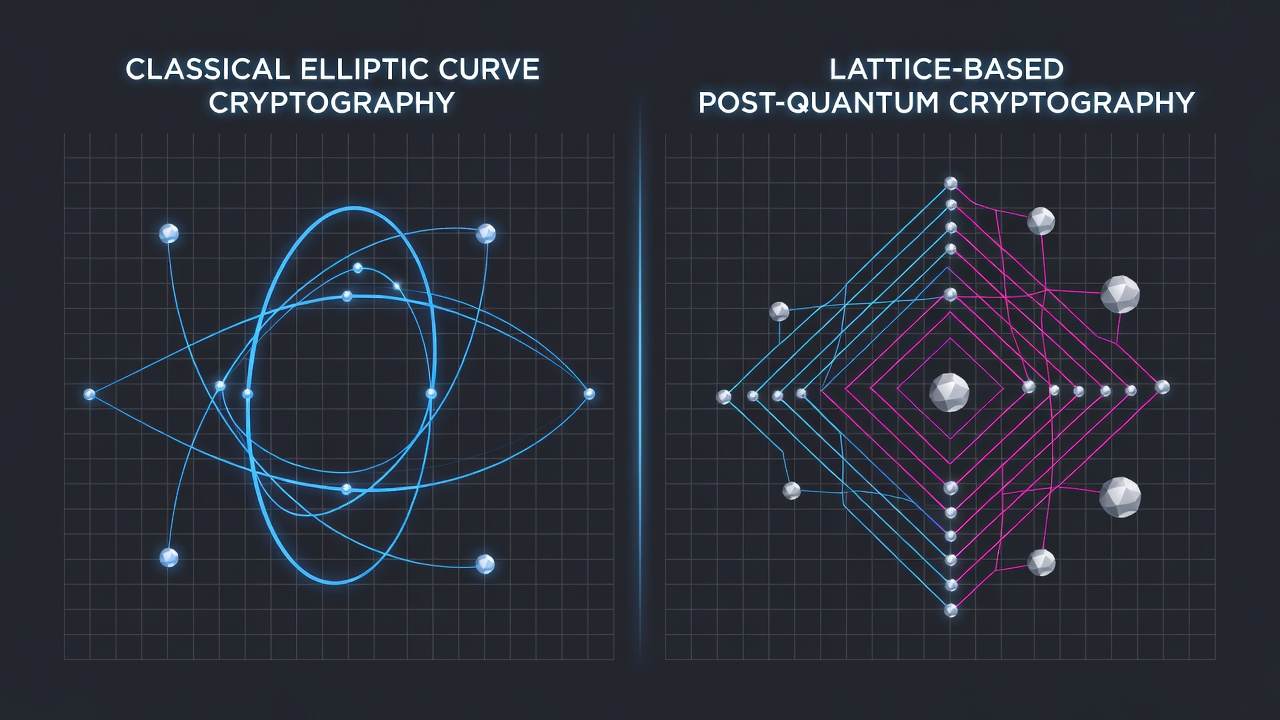
Lattice-based schemes such as CRYSTALS-Kyber (key encapsulation) and CRYSTALS-Dilithium (digital signatures) offer strong security with reasonable performance. They rely on the hardness of lattice problems, which quantum computers cannot efficiently solve. Kyber provides efficient key exchange suitable for blockchain transaction signing, while Dilithium offers compact signatures ideal for on-chain verification. These algorithms balance security levels with computational overhead, making them practical for high-throughput networks.
Hash-Based and Alternative Approaches
Hash-based signatures like SPHINCS+ provide conservative security but larger signatures, suitable for low-frequency operations such as governance votes. Code-based and multivariate schemes offer alternatives but often trade off efficiency. Developers should evaluate trade-offs between signature size, verification speed, and security margins when selecting algorithms for specific Web3 use cases like DeFi lending or NFT marketplaces.
NIST Post-Quantum Cryptography Project provides detailed specifications and reference implementations. Additional guidance is available directly from NIST official resources.
Step-by-Step Integration for Existing Web3 Protocols
Migrating to quantum-resistant cryptography requires careful planning to avoid disrupting live networks and user funds. A phased approach minimizes downtime and allows iterative testing.
- Audit current cryptographic primitives and identify all ECC/RSA dependencies across smart contracts, wallets, and node software.
- Select hybrid schemes combining classical and post-quantum algorithms during transition to maintain compatibility while adding protection.
- Update wallet software and node clients to support new signature schemes, ensuring backward compatibility for existing addresses.
- Test on testnets to measure gas costs and transaction throughput impacts under realistic network conditions.
- Deploy via hard forks or gradual rollout with backward compatibility layers that allow legacy nodes to coexist temporarily.
- Monitor performance and conduct security audits with quantum threat models, including side-channel and implementation attack vectors.
Real-World Examples of Quantum-Resistant Adoption
Several projects have begun implementing post-quantum solutions. The Quantum Resistant Ledger (QRL) uses XMSS hash-based signatures as its core mechanism, demonstrating full-chain migration feasibility. Other initiatives include experimental branches of Ethereum exploring Dilithium integration for future hard forks and research from standards organizations on post-quantum TLS for decentralized applications. Additional pilots appear in layer-2 scaling solutions and enterprise blockchain consortia focused on long-term data integrity. These early adopters demonstrate that performance overhead remains manageable with optimized implementations and careful parameter selection.
Comparisons: Current Solutions vs Emerging Standards
Traditional ECC offers fast verification and small signatures but zero quantum resistance. Post-quantum alternatives provide future-proofing at the cost of modestly larger signatures and slightly higher computational requirements. Hybrid approaches deliver the best of both worlds for 2026 deployments, allowing seamless upgrades as quantum hardware advances. When comparing options, teams should weigh on-chain storage costs against long-term security guarantees and user experience impacts.
Mistakes to Avoid During Migration
Common pitfalls include selecting unvetted algorithms without peer review, neglecting hybrid transition periods, and underestimating gas cost increases on congested networks. Another frequent error is failing to update off-chain components such as mobile wallets and hardware security modules. Thorough documentation and community coordination prevent fragmentation and loss of interoperability across the ecosystem.
Practical Advice for Web3 Developers
Focus on modular cryptographic libraries that allow algorithm swapping without full redeployment. Participate in standards bodies and open-source working groups to stay aligned with evolving specifications. Prioritize education on quantum threat timelines through regular review of academic papers and NIST updates. Start pilot implementations on non-critical components before full protocol upgrades, and establish clear metrics for success such as signature verification latency and storage overhead.
Frequently Asked Questions
What is the timeline for quantum computers breaking current crypto?
Estimates vary, but conservative projections suggest viable threats could appear before 2035. Early migration reduces risk significantly and allows gradual community adoption without panic-driven changes.
How do hybrid schemes work in practice?
Hybrid schemes sign transactions with both classical and post-quantum signatures, ensuring security even if one algorithm is broken while preserving compatibility with existing infrastructure during rollout.
Are there performance penalties?
Yes, but optimized lattice-based implementations add only 20-50% overhead in typical Web3 scenarios, acceptable for most applications when balanced against security gains.
Which projects should prioritize migration first?
High-value DeFi protocols, custody solutions, and identity systems handling sensitive data should lead the transition due to the high cost of potential breaches.
What resources help with implementation challenges?
Reference implementations from NIST, open-source libraries supporting Kyber and Dilithium, and community testnets provide practical starting points for developers tackling integration hurdles.
Conclusion
Quantum resistance is no longer theoretical—it is a critical Web3 innovation for 2026 and beyond. By understanding post-quantum algorithms, following structured integration steps, and learning from early adopters, developers can build resilient decentralized systems that withstand future computational advances. Proactive adoption safeguards user assets and strengthens the entire ecosystem against an evolving threat landscape.


No comments yet. Be the first!