 CryptoChain Blog
Introduction to 2026 Altcoin Narratives
As the cryptocurrency landscape evolves into 2026, altcoin enthusiasts are moving beyond surface-level layer-1 comparisons toward deeper, forward-looking narratives. Solana and Avalanche (AVAX) continue to stand out as leading L1 blockchains thanks to their distinct advantages in transaction speed, scalability, and growing ecosystem maturity. This comprehensive outlook examines five emerging themes that are shaping their trajectories this year, supported by real-time data examples, shifts in investor sentiment, and practical tools for identifying opportunities ahead of the curve. Whether you are a seasoned trader or a newcomer exploring altcoin differentiation, understanding these narratives provides a strategic edge in a competitive market.
The search intent behind topics like this centers on actionable insights rather than recycled comparisons. Investors want to know how modular architectures, institutional adoption, and technological integrations will drive value in the coming months. By exploring concrete examples from each chain and including decision-useful checklists, this guide delivers depth that helps readers time entries more effectively and avoid common pitfalls associated with hype-driven narratives.
Theme 1: Modular Scaling Experiments
Both Solana and Avalanche are actively testing modular architectures that decouple execution, settlement, and data availability layers. On Solana, the Firedancer validator client upgrade continues to demonstrate impressive throughput improvements in test environments, enabling the network to handle complex workloads such as real-time gaming and high-frequency AI inference without congestion. Avalanche’s Avalanche9000 upgrade, meanwhile, enhances subnet customization, allowing developers to launch specialized chains optimized for specific use cases like enterprise data processing or DeFi liquidity pools. These experiments matter because they address the classic blockchain trilemma more elegantly than monolithic designs. Real-time monitoring of testnet performance metrics shows reduced latency and higher transaction finality rates, positioning both networks for next-generation applications that demand sub-second confirmations. Early adopters who track these upgrades through official channels often position themselves before mainstream awareness peaks.
Theme 2: Institutional DeFi Inflows
Institutional capital is increasingly flowing into compliant DeFi protocols built on these L1s. Avalanche has secured multiple partnerships with traditional finance entities exploring tokenized real-world assets, while Solana’s ecosystem has seen accelerated growth in permissioned liquidity venues and regulated stablecoin issuance. On-chain analytics reveal steady increases in total value locked within institutional-grade vaults and lending pools, reflecting maturing infrastructure that meets regulatory expectations around custody and transparency. This narrative differentiates both chains from purely retail-focused alternatives because it signals durable capital inflows rather than speculative cycles. Investors monitoring wallet clustering and large transfer patterns can spot these inflows early, providing a leading indicator of sustained price support and protocol revenue growth.
Theme 3: Real-Time Data Oracles and AI Integration
The fusion of advanced oracles with AI models represents a high-potential narrative for both networks. Solana’s sub-second block times allow seamless streaming of oracle data into AI-driven trading agents and predictive analytics platforms. Avalanche subnets, by contrast, enable isolated environments where heavy AI computation can occur without impacting the main network. Practical examples include oracle-fed machine learning models that optimize yield strategies in real time or autonomous agents that rebalance portfolios based on on-chain sentiment signals. These integrations create new utility layers that extend beyond simple token transfers, attracting developers from adjacent technology sectors. Monitoring pilot announcements and developer grant programs reveals which projects are gaining traction fastest.
Theme 4: Sustainable Yield Mechanisms
Both ecosystems are refining yield mechanisms to emphasize sustainability over inflationary rewards. Protocols are shifting toward revenue-sharing models where yields derive primarily from actual transaction fees and protocol usage rather than token emissions. Dashboards such as DefiLlama provide transparent tracking of these revenue metrics, helping investors distinguish between fleeting APY spikes and durable yield sources. This maturation reduces the risk of sudden collapses seen in earlier DeFi cycles and appeals to risk-averse participants seeking steady returns. Practical observation of fee-to-reward ratios across major protocols offers a clear signal of which yield farms are likely to remain viable through 2026.
Theme 5: Enhanced Cross-Chain Interoperability
Interoperability continues to accelerate, with improved bridges and messaging protocols unlocking liquidity across ecosystems. Avalanche’s cross-subnet communication framework and Solana’s Wormhole integrations facilitate seamless asset movement, enabling multi-chain strategies that were previously cumbersome. This narrative supports composability between DeFi applications and expands the addressable market for developers. Real-time bridge volume data and cross-chain transaction counts serve as useful indicators of adoption momentum. Projects leveraging these bridges for liquidity aggregation or arbitrage are demonstrating measurable efficiency gains, further validating the narrative’s strength.
Investor Sentiment Shifts in 2026
Sentiment analysis across social platforms and on-chain activity shows growing optimism around these differentiated narratives. Community discussions increasingly highlight Solana’s speed advantages alongside Avalanche’s subnet flexibility rather than pitting them directly against Ethereum. Whale accumulation patterns and rising active address counts on both networks suggest institutional and sophisticated retail participants are accumulating exposure ahead of broader narrative recognition. However, sentiment can shift quickly on technical setbacks, so cross-referencing social volume with fundamental metrics remains essential.
Comparison Table of Narrative Strength
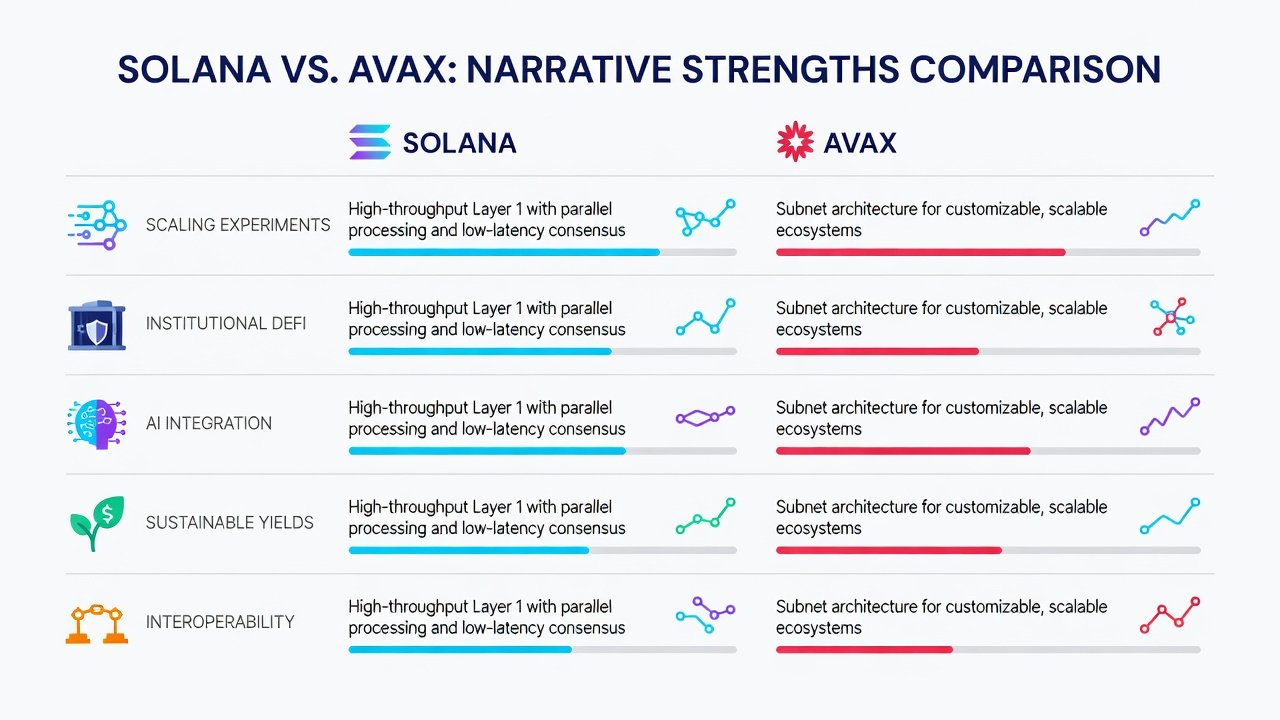
| Narrative | Solana Strength | AVAX Strength |
|---|---|---|
| Modular Scaling | High (Firedancer focus) | Medium-High (Subnet flexibility) |
| Institutional DeFi | High (Tokenization growth) | High (TradFi partnerships) |
| AI/Oracle Integration | Very High (Speed advantage) | Medium (Subnet specialization) |
| Sustainable Yields | Medium | High |
| Interoperability | High | Very High |
Checklist for Spotting Early Signals
Use this expanded checklist to identify narrative momentum before it becomes consensus:
- Monitor official developer forums, GitHub repositories, and testnet announcements for scaling or interoperability updates, noting any performance benchmarks released.
- Track institutional wallet movements and large stablecoin flows using public on-chain explorers to detect early capital deployment.
- Analyze week-over-week TVL changes and fee revenue in DeFi protocols via reliable dashboards to confirm sustainable yield trends.
- Follow AI integration pilots and oracle partnerships announced through ecosystem grant programs or developer calls.
- Review monthly bridge volume reports and cross-chain activity statistics to gauge interoperability adoption.
- Assess community governance proposals focused on emission reductions or revenue sharing for signs of yield sustainability improvements.
- Compare active developer counts and code commit frequency across both chains to validate long-term technical health.
FAQ on Timing Entries into These Trends
When is the best time to enter modular scaling plays?
Early signals typically appear during public testnet launches and major upgrade governance votes. Confirm momentum by reviewing post-upgrade network performance metrics and developer adoption rates rather than relying solely on price action.
How do institutional inflows affect entry timing?
Watch for official announcements regarding new custody integrations, tokenized asset pilots, or regulatory-compliant product launches. These events often precede significant capital deployment and provide higher-conviction entry points.
Should investors diversify across both chains?
Yes. The complementary strengths—Solana in raw speed and AI oracle use cases, Avalanche in subnet customization and interoperability—reduce single-chain concentration risk while capturing multiple narrative tailwinds.
What metrics best indicate narrative maturation?
Focus on sustained increases in daily active addresses, protocol fee revenue, and developer grant applications rather than short-term social hype metrics.
Conclusion
These five narratives offer clear differentiation for Solana and AVAX throughout 2026. By applying the detailed checklist and monitoring real-time indicators from authoritative sources such as Solana and Avalanche, altcoin enthusiasts can position themselves ahead of broader market adoption. Continuous observation of on-chain data, governance activity, and ecosystem announcements will help capitalize on these trends responsibly while managing downside risks associated with rapid narrative shifts.

No comments yet. Be the first!