 CryptoChain Blog

Introduction to Smart Contract Auditing on Solana and AVAX
As altcoin ecosystems mature in 2026, securing decentralized applications on high-performance Layer 1 blockchains like Solana and Avalanche (AVAX) has become essential. Developers and security professionals must address architecture-specific risks that differ from Ethereum. This guide provides actionable steps for auditing smart contracts on these platforms, including real-world examples and proven workflows that help teams identify and fix issues before mainnet deployment.
Effective audits combine automated scanning with manual review to identify issues before deployment. Whether you are protecting DeFi protocols or NFT marketplaces, understanding chain-unique vulnerabilities helps prevent exploits that could drain funds or compromise user data. The growing complexity of altcoin projects means that generic Ethereum-focused audit approaches often fall short on Solana and AVAX, requiring specialized knowledge of each chain's runtime and account models.
Architectural Differences Impacting Audits
Solana uses a unique account model and Rust-based programs with parallel execution via Sealevel runtime. This design boosts throughput but introduces risks around account ownership and reentrancy patterns not seen on EVM chains. Avalanche employs a subnet architecture and EVM-compatible smart contracts written in Solidity, requiring focus on cross-subnet communication and gas optimization. These differences mean auditors must adapt their approach. For Solana, emphasis falls on ownership checks and PDA (Program Derived Address) validation. For AVAX, standard EVM vulnerabilities persist alongside subnet-specific consensus risks.
Understanding these foundations allows auditors to prioritize the right checks. Solana programs interact with accounts passed as parameters, making every call site a potential attack vector if validation is incomplete. On AVAX, the EVM compatibility brings familiar issues but adds layers when subnets communicate across the primary network.
Common Vulnerabilities on Solana
Solana contracts frequently suffer from missing signer checks, improper account validation, and integer overflows in custom logic. A classic example involves failing to verify the authority on an account update, allowing unauthorized modifications. Another frequent issue arises during cross-program invocations where the wrong program ID is used, enabling malicious programs to intercept calls.
Consider this simplified Rust snippet for a token transfer program:
if !account.is_signer { return Err(ProgramError::MissingRequiredSignature); }Auditors should always trace every account passed to the program and confirm ownership invariants. Additional pitfalls include unchecked arithmetic that can lead to token supply manipulation and failure to close accounts properly, which may cause rent-exempt violations over time.
Common Vulnerabilities on AVAX
On Avalanche C-Chain, reentrancy attacks, unchecked external calls, and improper access control remain prevalent. Subnet deployments add complexity with cross-chain messaging that can be exploited if message verification is weak. Auditors must also watch for delegatecall risks in upgradeable contracts and front-running opportunities in time-sensitive functions.
An example vulnerable Solidity function might allow recursive calls without state updates first:
function withdraw(uint amount) external { (bool success, ) = msg.sender.call{value: amount}(""); require(success); balances[msg.sender] -= amount; }Manual review must verify state changes occur before external interactions. Additional AVAX-specific concerns include improper handling of native AVAX transfers in subnet bridges and insufficient validation of validator set changes that could affect contract assumptions.
Recommended Tools for Static Analysis and Fuzzing
Static analyzers like Solana's official tooling and Anchor framework linters help catch common issues early. For AVAX, combine Slither and Mythril with Hardhat plugins tailored for Avalanche. Fuzzers such as Echidna or custom Solana fuzzers using cargo-fuzz uncover edge cases in program logic. Integrating these into CI pipelines provides continuous security coverage and reduces the chance of regressions after each code change.
Teams should also explore property-based testing frameworks and symbolic execution tools where available. Regular updates to these tools are important because new vulnerability patterns emerge as the ecosystems evolve.
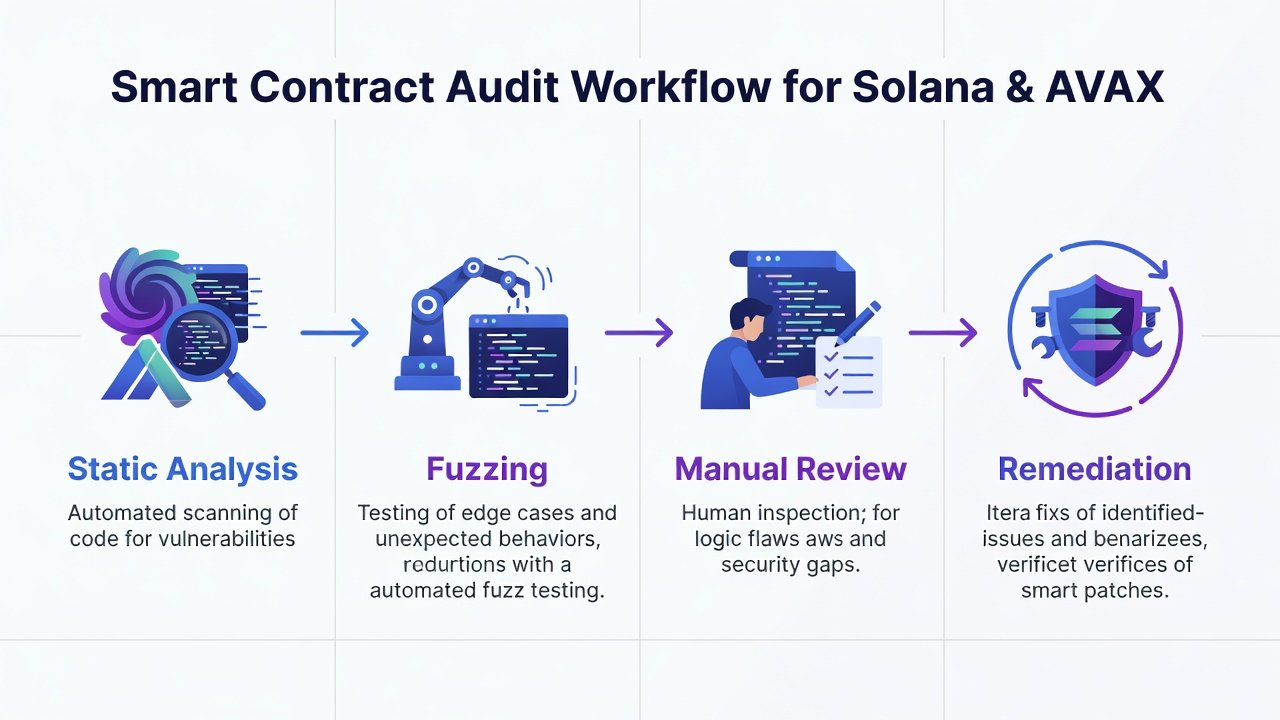
Step-by-Step Audit Workflow
- Scope definition and threat modeling: Identify all entry points, external dependencies, and high-value assets.
- Automated scanning with static tools: Run multiple analyzers in parallel and triage results by severity.
- Manual code review focusing on architecture risks: Examine account flows on Solana and call graphs on AVAX.
- Fuzz testing and property-based verification: Generate thousands of inputs to stress test invariants.
- Remediation tracking and re-audit: Document fixes and confirm no new issues were introduced.
Comparison Checklist: Solana vs AVAX Audits
- Account model validation: Critical for Solana, less relevant for AVAX
- Reentrancy protection: Primary concern on AVAX, secondary on Solana
- Cross-program invocation checks: Unique to Solana
- Subnet messaging security: Specific to AVAX
- Gas and compute unit optimization: Important on both but implemented differently
- Upgradeability patterns: More common in AVAX contracts using proxy patterns
- Rent and account lifecycle management: Solana-specific requirement
Sample Audit Timeline
A typical engagement for a mid-sized protocol spans 3-4 weeks. Week 1 focuses on scoping, initial automated scans, and threat modeling workshops with the development team. Week 2 dives into deep manual review of core contracts and integration points. Week 3 covers intensive fuzzing sessions, documentation of findings, and preliminary reporting. The final days are reserved for remediation verification and a final sign-off meeting. Larger or more complex projects may extend this timeline by an additional week to allow for thorough coverage of all modules.
Automated vs Manual Review Processes
Automated tools excel at pattern matching but miss business-logic flaws that only surface under specific conditions. Manual review by experienced auditors catches subtle issues like flawed incentive mechanisms or incorrect assumptions about transaction ordering. Best practice combines both for comprehensive coverage. Many teams now run automated scans on every pull request while scheduling full manual audits at major milestones.
Post-Audit Remediation Tips
Prioritize findings by severity and potential financial impact. Implement fixes with clear comments explaining the change and re-run full test suites plus the original audit toolset. Maintain an audit trail for transparency with stakeholders and future upgrades. Schedule follow-up reviews after significant protocol changes to ensure ongoing security posture remains strong.
FAQ: Regulatory Considerations in 2026
How do emerging regulations affect smart contract audits? Auditors must now document compliance with evolving global standards around financial disclosures and data privacy for altcoin projects.
Are there specific requirements for Solana and AVAX deployments? Projects should reference guidance from bodies like the Avalanche Foundation and Solana ecosystem security councils to align with 2026 reporting expectations.
What documentation should teams prepare before an audit? Comprehensive architecture diagrams, threat models, test coverage reports, and previous audit findings help auditors work efficiently and reduce overall engagement time.
How often should protocols schedule audits? Leading projects conduct full audits before every major upgrade and lighter reviews quarterly to stay ahead of new attack vectors.
Conclusion
Auditing smart contracts on Solana and AVAX demands tailored strategies that respect each chain's architecture. By following structured workflows, leveraging the right tools, and staying informed on regulatory shifts, development teams can build more resilient dApps. Regular audits remain a cornerstone of trust in the altcoin space and directly contribute to long-term project success.
No comments yet. Be the first!