 CryptoChain Blog

Introduction to 2026 SOL and AVAX Narratives
The cryptocurrency landscape continues evolving rapidly, with Solana (SOL) and Avalanche (AVAX) emerging as key players in altcoin investing. This playbook examines fresh narratives shaping these ecosystems in 2026, emphasizing investor perspectives such as modular scaling and institutional capital inflows rather than basic tokenomics. Investors seeking alpha must understand these shifts to navigate opportunities effectively. Beyond simple price speculation, the focus lies on how these blockchains adapt to real-world demands through technological advancements and capital movements. Solana's emphasis on speed and low costs pairs with Avalanche's flexibility in custom deployments, creating complementary yet distinct investment theses. This analysis draws on ecosystem developments to provide actionable insights for portfolio construction.
Five Emerging Themes Driving Growth
Five key themes stand out for 2026: modular blockchain scaling, institutional adoption waves, expanded DeFi utilities, ecosystem maturation metrics, and refined risk management approaches. Each offers distinct advantages for SOL and AVAX holders while presenting unique challenges that require careful evaluation.
1. Modular Scaling Solutions
Both networks advance modular architectures to handle increased throughput without centralization risks. Solana leverages its high-speed base layer with emerging appchains that allow developers to offload specific functions while maintaining interoperability. This approach reduces congestion during peak usage and supports complex applications like decentralized exchanges or gaming platforms. Avalanche, on the other hand, focuses on subnet customization for specialized use cases such as private enterprise networks or sector-specific chains. Investors benefit from these developments because they enable sustainable growth, attracting more users and developers over time. Comparisons reveal Solana's edge in raw transaction speed while Avalanche provides greater customization for compliance-heavy environments. Understanding these technical evolutions helps investors anticipate which ecosystem may capture larger market segments in payments or supply chain applications.
2. Institutional Flows and Capital Influx
Institutional interest grows through tokenized assets and enterprise integrations that bridge traditional finance with decentralized systems. AVAX subnets attract traditional finance players for private chains handling real estate or securities settlement, offering controlled environments with high throughput. SOL benefits from payment-focused protocols drawing corporate treasury allocations due to its established developer tools and low fees. These flows signal maturing infrastructure that reduces volatility over time as larger entities commit capital. Monitoring wallet movements and partnership announcements provides early indicators of sustained demand. Institutional participation also brings regulatory clarity, potentially stabilizing prices during broader market fluctuations.
3. DeFi Utility Expansions
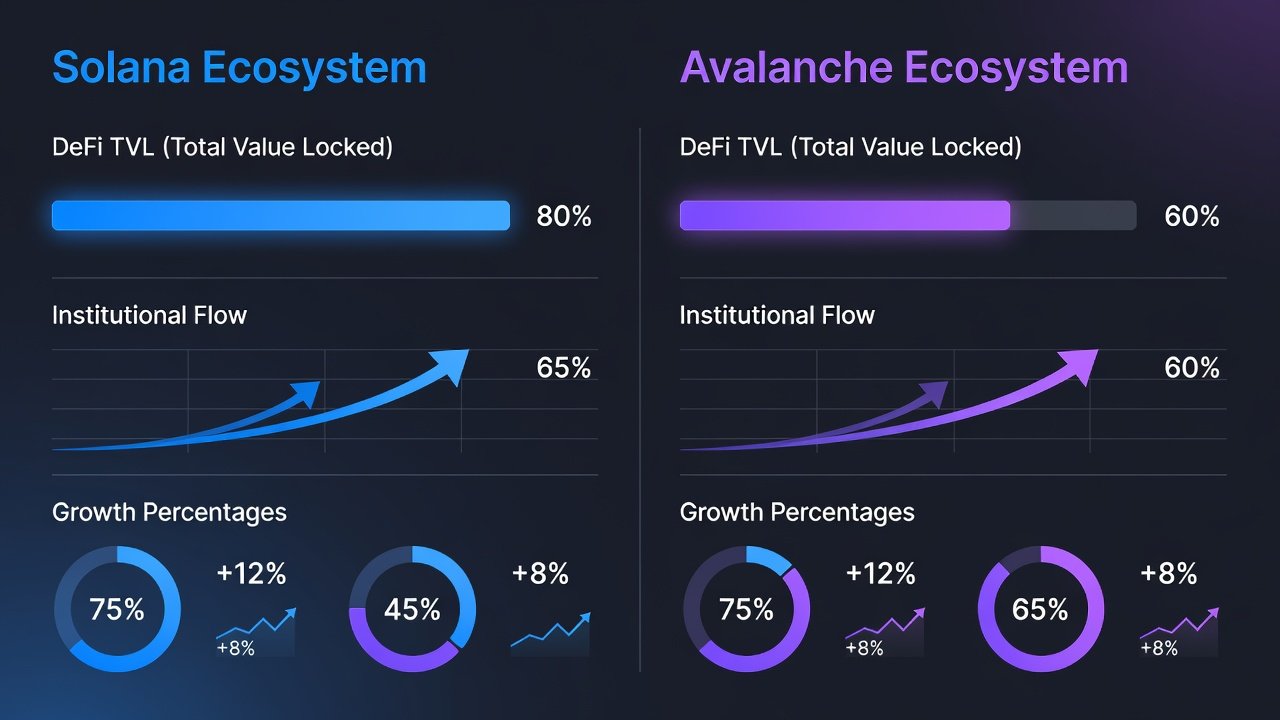
Decentralized finance on these chains moves beyond basic lending to real-world asset integration and cross-chain composability. On Solana, protocols enable seamless trading of tokenized equities or commodities with minimal slippage. Avalanche excels in yield optimization through subnet-specific strategies that cater to institutional risk profiles. Data comparisons show Solana's TVL leadership in certain segments while Avalanche gains traction in customized deployments for insurance and derivatives. These expansions create multiple revenue streams for token holders via staking and governance participation. Investors should evaluate utility depth by examining active addresses and transaction diversity rather than headline TVL figures alone.
4. Ecosystem Growth Comparisons
Recent metrics highlight Solana's developer activity surge alongside Avalanche's enterprise partnerships. Side-by-side analysis reveals Solana leading in transaction volume and NFT marketplace activity, with Avalanche gaining in customized deployments for sectors like healthcare and logistics. Growth indicators include rising daily active users, increased smart contract deployments, and expanding validator sets. Solana's community-driven initiatives foster rapid iteration, whereas Avalanche's corporate ties provide steady, long-term adoption. These differences inform allocation decisions, with balanced exposure capturing strengths from both networks. Tracking public dashboards and on-chain analytics helps investors stay ahead of narrative shifts.
5. Risk Factors and Mitigation
Network outages, smart contract vulnerabilities, and regulatory uncertainties remain primary concerns for both ecosystems. Solana has addressed past performance issues through client diversification, while Avalanche mitigates risks via its robust consensus mechanism. Investors mitigate exposure through diversification across subnets and monitoring on-chain governance signals for proactive adjustments. Additional risks include liquidity fragmentation in newer modular components and competition from other layer-1 solutions. A disciplined approach involves setting allocation limits per theme and using stablecoin reserves for opportunistic entries during corrections.
Practical Portfolio Allocation Steps
Building a resilient portfolio requires methodical planning tailored to individual goals. Begin by assessing overall risk tolerance and market outlook, then proceed with targeted allocations. Step one involves dedicating a core position to SOL for its liquidity and ecosystem vibrancy, typically forming the foundation. Step two focuses on AVAX for exposure to specialized institutional use cases that offer differentiated returns. Step three allocates portions to high-potential projects within each ecosystem, such as decentralized exchange aggregators or lending platforms, while maintaining strict position sizing. Step four establishes rebalancing protocols based on quarterly reviews of key performance indicators like user growth and partnership velocity. Step five incorporates hedging strategies using options or stable assets to protect against downside scenarios. This structured method balances growth potential with capital preservation.
Real Project Examples
Notable implementations include Solana's integration with payment networks for seamless cross-border transfers and Avalanche's collaboration with financial institutions via custom subnets for compliant asset tokenization. Additional cases feature DeFi protocols on both chains tracked via public analytics platforms. For instance, liquidity provision on Solana-based perpetual futures exchanges demonstrates high capital efficiency, while Avalanche's decentralized oracle integrations support accurate pricing for complex derivatives. Gaming projects leveraging Solana's speed attract user bases seeking responsive experiences, and Avalanche's enterprise-focused chains enable supply chain transparency solutions adopted by logistics firms. These examples illustrate how narrative themes translate into tangible applications, guiding investors toward projects with proven traction and scalable models. Diversifying across such initiatives within the two ecosystems enhances resilience.
Decision Framework for Investors
Successful navigation of 2026 narratives demands a clear decision framework. Evaluate each opportunity against criteria including technological uniqueness, institutional backing, and measurable user adoption. Prioritize projects demonstrating consistent development activity and community engagement. Avoid over-concentration in single themes by spreading exposure across scaling, DeFi, and institutional angles. Regular review of ecosystem roadmaps ensures alignment with evolving priorities. This framework supports informed choices amid rapid innovation.
FAQ on Timing Entries
When is the optimal entry for SOL in 2026?
Monitor modular upgrades and institutional partnership news for potential accumulation windows during market dips, combined with analysis of transaction volume trends for confirmation signals.
How do AVAX narratives affect timing?
Focus on subnet launches and enterprise deals; entries often align with major announcement cycles that catalyze broader ecosystem interest and capital inflows.
What data points signal strong entry opportunities?
Track ecosystem TVL growth, developer commits, and on-chain institutional wallet activity for confirmation, while cross-referencing with external market sentiment indicators.
Should investors time entries around specific events?
Yes, major network upgrades or partnership reveals frequently precede sustained rallies, but always maintain dollar-cost averaging to mitigate timing errors.
How do risk factors influence entry timing?
Heightened regulatory scrutiny periods may warrant caution, favoring gradual positions over lump-sum investments until clarity emerges.
Conclusion
2026 presents compelling opportunities for SOL and AVAX investors through these narrative shifts. By applying structured allocation, monitoring key themes, and leveraging real-world project examples, participants can position portfolios for sustained growth amid evolving market dynamics. Continuous education and disciplined execution remain essential for long-term success in this dynamic sector.


No comments yet. Be the first!