 CryptoChain Blog

Introduction to 2026 SOL and AVAX DeFi Yield Opportunities
Experienced altcoin investors in 2026 are moving beyond basic staking to explore sophisticated DeFi yield strategies on Solana and Avalanche. Both Layer 1 blockchains offer distinct token utilities that influence staking mechanics, liquidity provision rewards, and integration with emerging protocols. This analysis examines how SOL and AVAX holders can optimize returns while accounting for inflation, burn mechanisms, and risk-adjusted calculations. The focus remains on actionable tactics for long-term holders seeking sustainable yields in a maturing DeFi landscape. As networks scale, understanding the interplay between tokenomics and protocol incentives becomes critical for maximizing compounded returns without excessive exposure to volatility or smart contract risks.
SOL Token Utility and Staking Mechanics
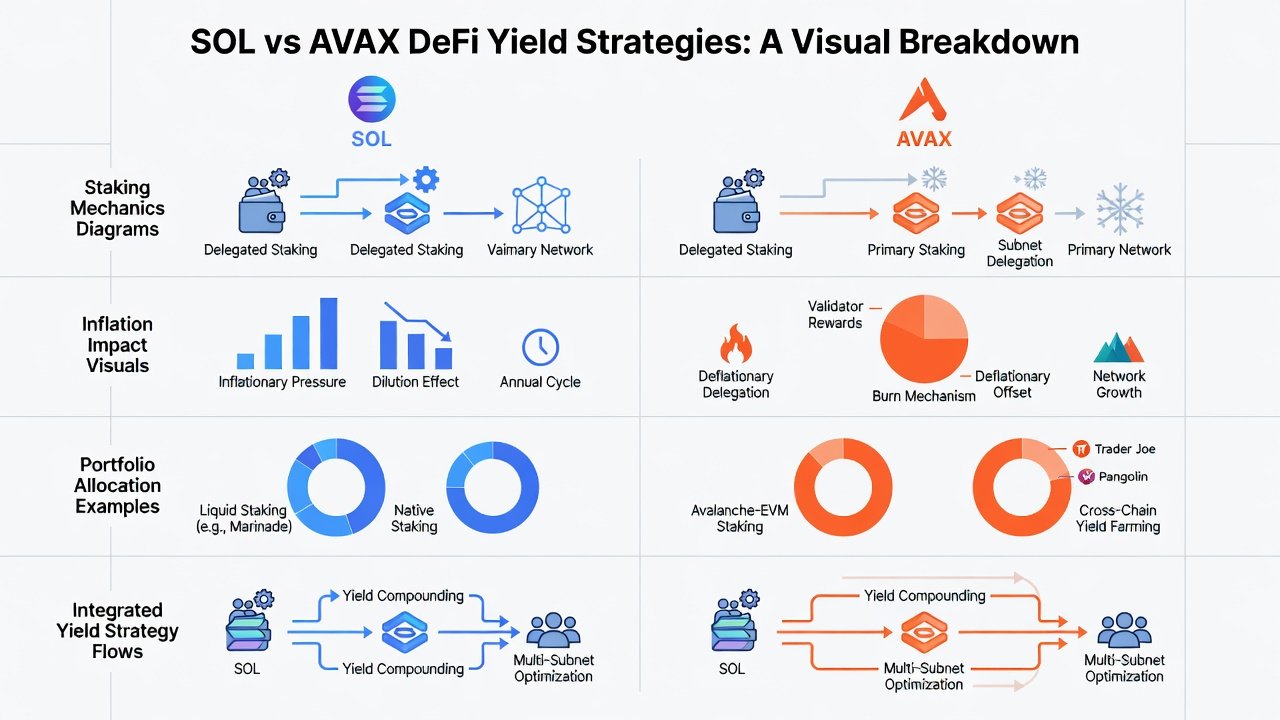
Solana's native token powers transaction fees and governance within its high-throughput ecosystem. Staking SOL contributes to network security through delegated proof-of-stake, with validators earning rewards from inflationary emissions and transaction fees. In 2026, integration with protocols such as Jito and Marinade enables liquid staking derivatives that unlock additional yield layers without sacrificing liquidity. Advanced users often split stakes across multiple validators to mitigate slashing risks and optimize for performance metrics like skip rate and commission fees. Furthermore, Solana's emphasis on parallel processing allows for faster reward distribution cycles compared to many competitors, though this speed introduces unique considerations around priority fees during peak network usage. Holders can leverage these mechanics by combining native staking with restaking opportunities on platforms that support SOL derivatives, creating multi-layered income streams that adapt to changing market conditions.
AVAX Token Utility and Staking Mechanics
Avalanche's AVAX token serves as the backbone for its three-chain architecture, facilitating subnet creation, transaction fees, and staking. The primary staking model requires a minimum lock-up period, delivering rewards from a fixed inflationary schedule. Emerging integrations with protocols like Benqi and Trader Joe allow users to combine staking with lending or liquidity mining for compounded returns. Subnet-specific staking opportunities further differentiate AVAX utility by enabling customized yield profiles tied to particular application chains. Investors frequently evaluate validator uptime and geographic distribution to enhance resilience, especially as Avalanche expands its support for institutional-grade subnets. This flexibility supports tailored strategies where AVAX is staked directly on primary chains while derivatives facilitate additional DeFi interactions across lending markets and automated market makers.
Liquidity Provision Rewards Across Both Chains
Providing liquidity in decentralized exchanges generates trading fee revenue plus incentive tokens. On Solana, concentrated liquidity positions in Orca and Raydium pools often deliver higher fee capture due to lower costs, while Avalanche's Trader Joe and Pangolin emphasize broader pair availability with cross-chain bridges. Advanced strategies involve impermanent loss hedging through options overlays and dynamic rebalancing based on volatility metrics observed in late 2026 market conditions. Participants must also consider pool depth and token pair correlations to avoid excessive divergence losses. Real examples include pairing major assets like USDC with SOL or AVAX in stable pools that maintain tighter ranges, thereby reducing exposure while still capturing meaningful fee shares from high-volume trading activity.
Inflation Impacts and Burn Mechanisms
Solana's inflation rate continues its scheduled decline, offset partially by fee burns that reduce circulating supply over time. Avalanche maintains a more predictable issuance model with burns tied to transaction activity on its primary chains. These dynamics directly affect net yields, requiring investors to model real returns after accounting for token supply changes. For instance, increased on-chain activity can accelerate burn rates, effectively boosting holder value even as new tokens enter circulation through staking rewards. Monitoring these metrics through on-chain dashboards helps refine allocation decisions, particularly when comparing the two ecosystems side by side for balanced exposure.
Risk-Adjusted Return Calculations with Protocol Examples
Calculating risk-adjusted yields involves metrics such as Sharpe ratios applied to historical protocol performance. For instance, SOL staked through liquid derivatives paired with lending on Kamino Finance has shown favorable profiles when volatility is factored in. AVAX strategies leveraging Aave integration demonstrate resilience during subnet growth phases. Investors should stress-test allocations against scenarios including network outages or smart contract exploits. Additional layers of analysis incorporate drawdown periods and correlation with broader crypto market movements to ensure portfolios withstand prolonged downturns. Practical application often includes scenario modeling tools that simulate yield outcomes under varying inflation and adoption rates.
Step-by-Step Portfolio Allocation Tactics
- Assess current holdings and define target yield thresholds based on personal risk tolerance, incorporating factors such as overall portfolio size and time horizon for liquidity needs.
- Allocate 40-60% to core staking positions on both chains for baseline security, selecting validators with proven track records in uptime and low commission structures.
- Deploy 20-30% into liquidity pools with established protocols, monitoring for impermanent loss through regular position adjustments and hedging instruments where available.
- Reserve 10-20% for emerging integrations such as restaking or yield aggregators, focusing on audited platforms with transparent governance mechanisms.
- Rebalance quarterly using on-chain analytics tools to maintain optimal exposure, accounting for shifts in protocol incentives and network performance data.
- Implement stop-loss or hedging mechanisms during high-volatility periods to protect accumulated yields from sudden market reversals.
Comparative Yield Scenarios and Case Studies
Examining specific 2026 scenarios reveals how different allocations perform under real conditions. A balanced SOL-AVAX portfolio with 50% staking, 30% liquidity provision, and 20% in emerging protocols can generate diversified income streams that buffer against single-chain disruptions. Case studies from active DeFi users highlight successful combinations, such as using SOL liquid staking tokens as collateral in lending markets while simultaneously providing AVAX liquidity in cross-chain pools. These examples underscore the value of continuous performance tracking and adaptive reallocation.
Tools and Resources for Monitoring Yields
Effective strategy execution relies on reliable data sources. Platforms offering real-time staking analytics, pool performance tracking, and inflation calculators enable precise decision-making. Cross-referencing multiple dashboards ensures accuracy when evaluating net returns after fees and potential losses. Regular review of governance proposals on both networks also informs adjustments to long-term holdings.
Common Mistakes to Avoid
- Over-concentrating in single-protocol liquidity without diversification across chains and asset pairs.
- Ignoring validator or node performance metrics that erode base staking yields over extended periods.
- Neglecting tax implications from frequent reward compounding across chains and jurisdictions.
- Chasing short-term incentive tokens without evaluating long-term sustainability and protocol fundamentals.
- Failing to account for bridge or cross-chain risks when moving assets between Solana and Avalanche ecosystems.
FAQ
How do SOL and AVAX staking rewards compare in 2026?
Rewards vary with network activity and inflation schedules, but SOL typically offers more flexible liquid staking options while AVAX provides structured subnet yields that can be customized for specific use cases.
What risks are associated with liquidity provision?
Primary risks include impermanent loss, smart contract vulnerabilities, and fluctuating trading volumes that affect fee revenue, all of which require ongoing monitoring and mitigation strategies.
Can yields be sustained long-term?
Sustainability depends on protocol adoption, fee burn efficiency, and broader market conditions; diversification across staking and liquidity remains essential for resilience.
How should investors handle inflation impacts?
Model net yields by factoring in both reward emissions and supply reduction mechanisms, adjusting allocations as network usage patterns evolve throughout the year.
What role do emerging protocols play in yield enhancement?
They enable layered strategies such as restaking and automated compounding, but demand thorough due diligence on security audits and governance structures before deployment.
Conclusion
Optimizing SOL and AVAX token utility in 2026 requires a balanced approach combining staking fundamentals with advanced DeFi techniques. By understanding inflation dynamics, burn impacts, and risk metrics, experienced holders can construct resilient yield portfolios. Continuous monitoring of protocol developments on Solana and Avalanche alongside data from DeFiLlama supports informed decision-making and long-term success.


No comments yet. Be the first!