 CryptoChain Blog
Introduction to SOL and AVAX Tokenomics in 2026
Solana (SOL) and Avalanche (AVAX) continue to rank among the leading layer-1 blockchains, each with distinct tokenomic designs that influence supply dynamics and holder value. As we move into 2026, understanding burn rates, fee mechanisms, and staking rewards becomes essential for investors seeking sustainable returns amid volatility. Both networks use token burns to offset inflationary pressures from new issuance, creating potential for long-term value accrual when network usage grows. This analysis examines how these mechanisms work in practice, drawing on network data examples to project supply scenarios and outline actionable holding strategies for different market conditions.
The core appeal lies in their utility models. SOL supports high-throughput applications with low fees, while AVAX enables customizable subnets for specialized use cases. Token burns act as a counterbalance, reducing circulating supply during periods of high activity. Staking further ties holders to network security, distributing rewards that can compound over time. By comparing these elements side by side, investors gain clarity on which asset aligns with their risk tolerance and time horizon.
SOL Tokenomics: Inflation Schedule, Fee Burns, and Staking Dynamics
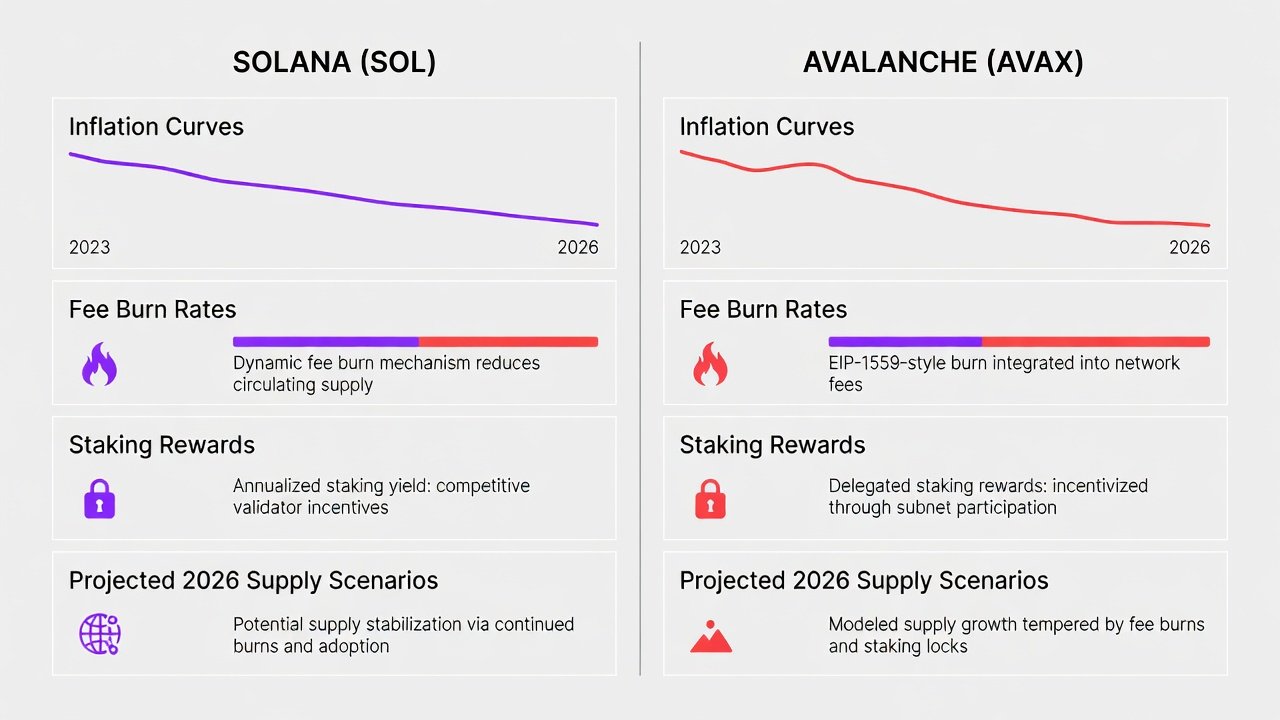
Solana's tokenomics feature a declining inflation rate that starts high and decreases over time, combined with a fee burn mechanism that removes a portion of transaction costs from circulation. This creates deflationary pressure when usage spikes, such as during DeFi surges or NFT mints. Staking rewards come from both remaining inflation and a share of fees, encouraging long-term participation. Real network examples show that during high-traffic events, daily burns can noticeably slow net supply growth, supporting price stability for holders who stake consistently.
Delegation to validators is straightforward, with no minimum lock-up beyond the staking period itself. Rewards vary based on overall participation rates, so monitoring validator performance and network metrics helps optimize yields. Common tactics include spreading stakes across multiple validators to reduce risk and reinvesting rewards to accelerate compounding. These dynamics make SOL attractive for users who value speed and scalability in their chosen blockchain.
AVAX Tokenomics: Inflation Schedule, Fee Burns, and Staking Dynamics
Avalanche employs a similar burn model where transaction fees on its primary network are partially destroyed, offsetting new token issuance. Its inflation schedule is more front-loaded compared to SOL, with rewards decreasing as the network matures. Staking involves validating the primary network or participating in subnets, which can offer differentiated yields depending on demand for custom blockchains. On-chain data from past periods illustrates how elevated activity on popular subnets accelerates burns, tightening supply and enhancing value for committed holders.
AVAX staking requires a longer commitment in some cases, particularly for subnet operators, but provides exposure to ecosystem growth. Holders can delegate to existing validators or run their own nodes for higher control. Practical examples include using AVAX in decentralized finance protocols built on its C-Chain, where fees contribute directly to burns. This setup rewards participants who engage deeply with the network's unique features rather than treating it as a passive asset.
Side-by-Side Comparison of Key Tokenomic Metrics
Understanding the differences requires a clear comparison of inflation, burns, and staking. The following table summarizes core elements based on current network designs heading into 2026:
| Metric | SOL | AVAX |
|---|---|---|
| Inflation Trend | Declining over years | Front-loaded with steady reduction |
| Fee Burn Rate | Portion of all fees burned | Portion of primary network fees burned |
| Staking Flexibility | Easy delegation, variable APY | Subnet options with potential premium yields |
| Supply Impact | High usage drives faster burns | Subnet growth accelerates contraction |
These contrasts highlight trade-offs. SOL may suit investors prioritizing liquidity and broad adoption, while AVAX appeals to those interested in specialized applications. Both benefit from increased on-chain activity that amplifies burn effects.
Case Studies of Past Burn Events and Their Impact
Examining historical burn events provides concrete lessons. During Solana's 2024 memecoin frenzy, elevated transaction volumes led to sustained daily burns that offset a significant portion of new issuance, contributing to supply stabilization. Similarly, Avalanche saw notable fee destruction during subnet launches and DeFi booms, where activity on custom chains translated into measurable supply reduction. These cases demonstrate that burns serve as an automatic stabilizer, rewarding holders who remain staked through volatile periods rather than exiting prematurely.
Another example involves network upgrades that improved efficiency and throughput. On both chains, such improvements indirectly boosted burns by enabling higher volumes without congestion. Investors can track these patterns using public explorers to time entry points or adjust staking allocations based on usage trends.
Projected Supply Scenarios for 2026
Forward projections depend on adoption rates, DeFi expansion, and upgrade implementations. Under moderate growth assumptions, both networks could see burns offsetting 40-60% of inflation, resulting in slower net supply increases. In high-usage scenarios driven by mainstream applications, net deflation becomes possible in select quarters, enhancing scarcity for long-term holders. Conservative models factor in potential competition from newer chains, suggesting diversified exposure across SOL and AVAX as a prudent approach.
Key variables include transaction fee adjustments and governance decisions that could alter burn percentages. Staying informed through official documentation helps refine these scenarios as new data emerges.
Investor Strategies for Holding Through Volatility
Successful long-term holding combines staking with disciplined accumulation. Start by establishing a core position through dollar-cost averaging during dips, then delegate to reliable validators. Reinvest rewards automatically where possible to maximize compounding. During high volatility, avoid panic selling by focusing on fundamental metrics like daily active addresses and burn volumes rather than short-term price swings.
Portfolio allocation might involve 60% SOL for its established ecosystem and 40% AVAX for subnet upside, adjusting based on personal risk profile. Regular reviews of validator performance and network health reports prevent underperformance. These steps create resilience against market cycles while capturing value from burns and staking yields.
DeFi Participation Tactics for Enhanced Returns
Beyond basic staking, integrating with DeFi protocols can boost overall returns. On Solana, liquidity provision in established pools paired with staking creates dual income streams, though users must account for impermanent loss. Avalanche offers similar opportunities through its C-Chain, where subnet-related projects may provide additional incentives. Begin with small positions, use hardware wallets for security, and monitor total fees generated to estimate burn contributions. Yield aggregators simplify management but require due diligence on smart contract risks.
Practical first steps include reviewing protocol audits, calculating net yields after fees, and setting alerts for significant network activity spikes that could accelerate burns.
Mistakes to Avoid for Long-Term Holders
Common errors include concentrating stakes with a single validator, ignoring governance proposals that impact tokenomics, and chasing unsustainable yields without understanding underlying risks. Another pitfall is neglecting tax implications of staking rewards across jurisdictions. Diversification and ongoing education mitigate these issues effectively.
FAQ: Common Questions from Long-Term Holders
How do burns affect long-term token value?
Burns reduce supply, potentially increasing scarcity and supporting price appreciation when demand remains steady or grows, especially when paired with consistent staking.
What staking risks should SOL and AVAX holders consider?
Slashing events, network downtime, and changing reward rates represent primary risks; diversification and monitoring validator performance help mitigate them over multi-year horizons.
Are there optimal times to enter or exit positions?
Timing aligns with network metrics like transaction volume and burn rates rather than short-term price swings, favoring gradual accumulation during lower activity periods.
How do subnet dynamics influence AVAX burns?
Subnets that attract high usage generate additional fees, amplifying burn effects and creating differentiated value accrual compared to the primary network alone.
Conclusion
SOL and AVAX tokenomics in 2026 offer compelling utility models centered on burns and staking. By applying data-driven strategies and understanding these mechanisms, investors position themselves for sustained value accrual. Learn more about Solana and Avalanche fundamentals directly from official sources to stay informed on evolving network parameters.
No comments yet. Be the first!