 CryptoChain Blog
Introduction to 2026 SOL and AVAX Tokenomics
As the crypto landscape evolves into 2026, investors are increasingly focused on the underlying tokenomics of major altcoins like Solana (SOL) and Avalanche (AVAX). Understanding burn rates, fee dynamics, and yield optimization is essential for those seeking sustainable returns amid inflation pressures and network growth. Tokenomics encompasses the economic models governing supply issuance, token burns, staking incentives, and fee redistribution, all of which directly impact long-term value accrual for holders.
This guide delivers a practical examination of supply schedules, real yield opportunities, and DeFi integration points. Readers will find actionable strategies to balance potential rewards against risks. By dissecting these elements, altcoin investors can move beyond surface-level overviews toward informed decision-making that accounts for both network fundamentals and market cycles.
Comparing SOL and AVAX Supply Schedules
Solana's tokenomics feature a disinflationary model with ongoing token burns tied to transaction fees. The network issues new SOL at a declining rate over time, with validator rewards funded partly through inflation that tapers as adoption increases. Avalanche employs a similar burn mechanism on its C-Chain, reducing circulating supply over time through a portion of transaction fees being permanently removed from circulation.
Both networks prioritize long-term scarcity while supporting high throughput. Key differences emerge in issuance rates and validator rewards. SOL relies on a fixed schedule with periodic adjustments based on governance proposals, whereas AVAX incorporates dynamic elements based on network activity levels and subnet deployment. These structures influence how each asset responds to adoption surges, with SOL often seeing faster supply adjustments during peak usage periods and AVAX benefiting from modular chain economics that can isolate fee burns across multiple subnets.
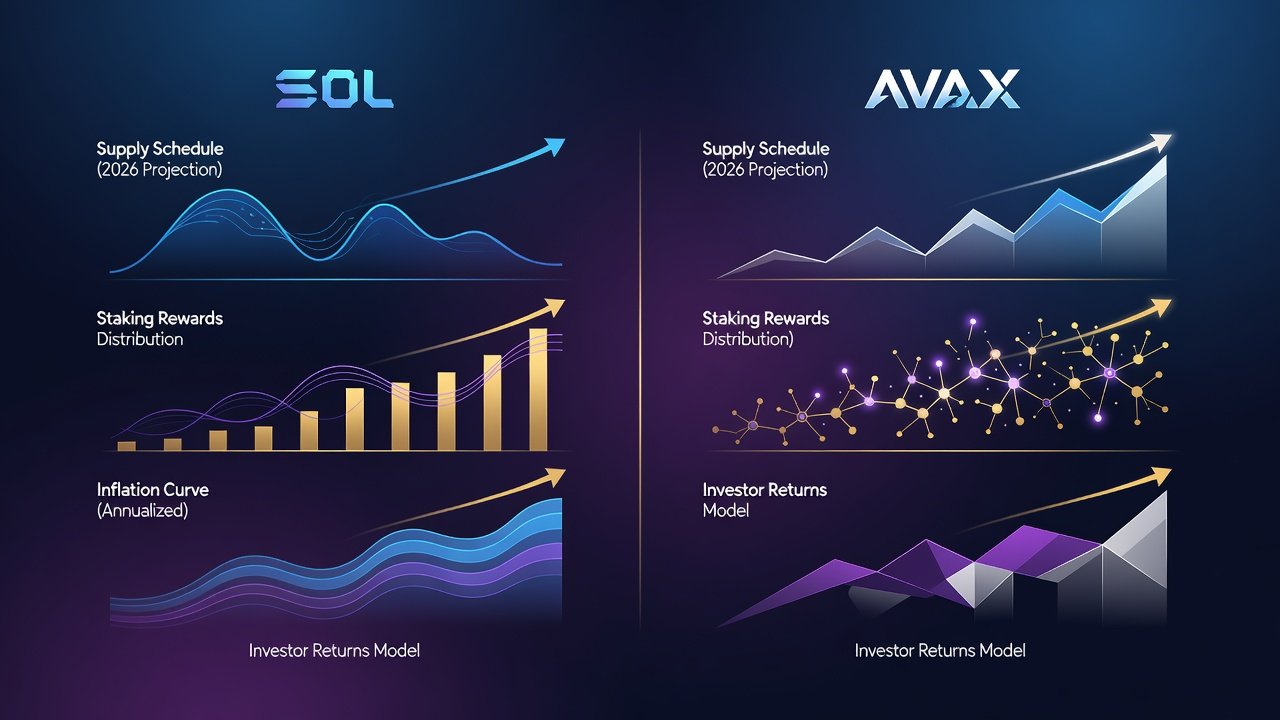
Investors should monitor total supply metrics and inflation curves closely, as these determine the net deflationary or inflationary pressure on holdings over multi-year horizons.
Burn Mechanisms and Fee Dynamics
Transaction fees on Solana are partially burned, creating deflationary pressure during periods of high usage. This mechanism activates whenever users pay for compute resources, with a percentage of each fee destroyed rather than redistributed. Avalanche applies a base fee burn plus tips to validators, ensuring that even modest activity levels contribute to supply reduction across its primary chain and custom subnets.
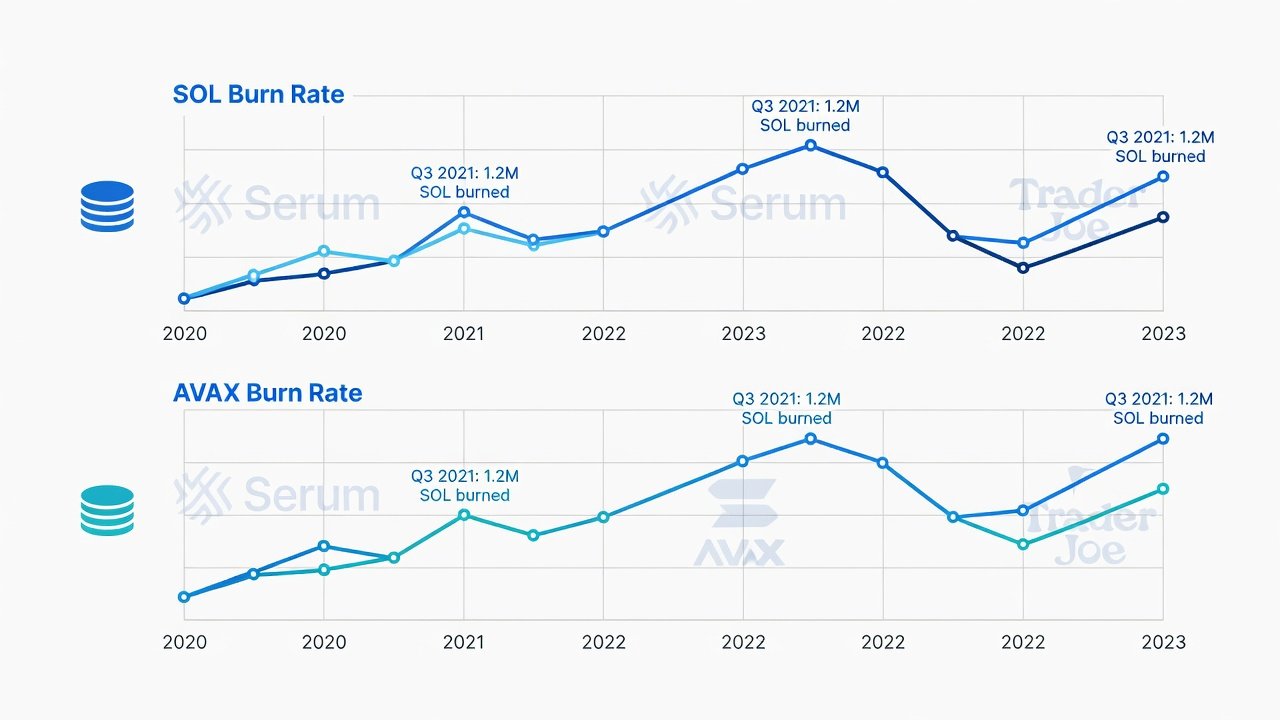
Historical burn impact can be visualized through charts showing cumulative tokens removed from circulation. Such data highlights how network activity directly correlates with supply contraction, particularly during DeFi booms or NFT minting events. For example, sustained high transaction volumes have historically accelerated burn rates on both chains, offsetting issuance and enhancing scarcity for long-term holders. Understanding these patterns allows investors to anticipate how protocol upgrades or ecosystem expansions might amplify or dampen burn effects in 2026 and beyond.
Real Yield Sources and DeFi Integration
Yield on SOL and AVAX stems from staking rewards funded by inflation and fees. Integration with leading DeFi protocols on each chain offers additional layers of return through liquidity provision and lending markets. On Solana, protocols enable composable yield farming where staked positions can be leveraged across multiple applications simultaneously. Avalanche's subnet architecture allows tailored yield strategies within isolated environments that reduce systemic risk.
Practical integration points include bridging assets between chains for cross-ecosystem opportunities and participating in governance to influence fee parameters. These integrations create diversified income streams beyond base staking, though they introduce smart contract and liquidity risks that must be evaluated case by case.
Practical Strategies for Maximizing Returns
Step-by-step optimization begins with selecting secure validators, then layering positions across protocols. Always assess smart contract risks and impermanent loss before committing capital. Here is a detailed framework:
- Begin by staking core holdings directly on official networks to capture baseline yields while monitoring inflation schedules through explorer dashboards.
- Deploy portions into top liquidity pools on established DeFi platforms, rebalancing quarterly to capture fee revenue and avoid concentration in single assets.
- Use governance tokens from integrated protocols to vote on fee structures that favor long-term holders and sustainable tokenomics adjustments.
- Track burn metrics monthly using on-chain analytics tools to adjust exposure based on net supply trends and anticipated network upgrades.
- Implement risk controls such as position sizing limits and regular audits of validator performance to prevent overexposure during volatile periods.
Managing Inflation Risks
Both assets carry inflationary components that dilute holdings if not offset by burns or yields. Diversifying across staking and DeFi while maintaining a core position helps mitigate this. Common mistakes include over-leveraging in volatile pools or ignoring validator performance metrics. Regular portfolio reviews prevent these pitfalls and ensure alignment with evolving network economics.
Additional considerations involve stress-testing portfolios against scenarios where transaction volumes drop sharply, reducing burn offsets. Investors can counter this by prioritizing protocols with proven fee generation and by maintaining liquidity reserves for opportunistic rebalancing.
Case Study: Long-Term Holder Portfolio
Consider a hypothetical investor who allocated across SOL and AVAX in early 2025. By combining native staking with selective DeFi exposure, the portfolio achieved compounded growth while burns reduced effective supply. This approach demonstrates resilience during market cycles through disciplined rebalancing and focus on high-activity subnets or programs.
The case illustrates how consistent monitoring of fee dynamics and strategic layering of yields can transform inflationary headwinds into net positive outcomes over a multi-year holding period. Key lessons include starting with conservative allocation sizes and scaling only after validating protocol security and yield sustainability.
Beginner-Friendly FAQ on Staking Choices
What is the difference between native staking and liquid staking?
Native staking locks tokens directly with validators for rewards. Liquid staking issues derivative tokens that can be used elsewhere while still earning yields, offering greater flexibility for DeFi participation.
How do I choose a validator for SOL or AVAX?
Evaluate commission rates, uptime history, and community reputation. Start with well-established options listed on official network explorers and diversify across multiple validators to reduce single-point risks.
Are there tax implications for staking rewards?
Rewards are typically treated as income in many jurisdictions. Consult local regulations or a tax professional for guidance specific to your location and holding period.
What factors affect real yield sustainability?
Real yield depends on fee generation, burn rates, and protocol usage. Sustainable strategies prioritize networks with growing adoption over those relying solely on inflationary rewards.
Conclusion
Mastering SOL and AVAX tokenomics in 2026 requires attention to burns, yields, and risk management. By applying the strategies outlined, investors can position themselves for informed participation in these ecosystems. For further reading, explore Solana's official resources and Avalanche network documentation.

No comments yet. Be the first!