 CryptoChain Blog
Introduction to SOL and AVAX Tokenomics in 2026
As blockchain ecosystems mature into 2026, tokenomics have become the cornerstone for evaluating long-term holder value across major Layer 1 networks. Solana (SOL) and Avalanche (AVAX) continue to differentiate themselves through sophisticated supply management strategies that blend deflationary pressure with practical utility. This comprehensive analysis explores how mechanisms such as transaction fee burns, fee redistribution models, and effective supply caps work in tandem to foster scarcity. It also examines inflation schedules, the role of staking in modulating token velocity, and direct comparisons with competing L1 projects. Readers will find data-driven projections, real DeFi yield examples, actionable holder strategies, governance considerations, and risk assessments to support informed portfolio decisions.
Tokenomics ultimately determine whether a network can sustain growth while rewarding participants. SOL and AVAX both incorporate responsive deflationary tools that activate during periods of high network usage, creating a dynamic balance between issuance and removal of tokens from circulation.
Core Deflationary Mechanisms in SOL and AVAX
Solana implements a fee burn model where a percentage of every transaction fee is permanently destroyed, directly reducing the total supply over time. This process intensifies during network congestion or high DeFi activity, turning routine usage into a deflationary force. Avalanche employs a comparable approach through its dynamic fee structure, where portions of fees are burned while the remainder supports validator rewards and ecosystem development. These mechanisms differ from purely inflationary models by prioritizing scarcity when demand rises.
Beyond simple burns, both networks feature redistribution elements that return value to stakers and liquidity providers. For SOL holders, this creates compounding effects when tokens are staked, as reduced supply amplifies the impact of rewards. AVAX benefits from similar dynamics within its subnet architecture, where usage fees contribute to ongoing supply contraction. The result is a system that rewards active participation rather than passive holding alone.
Inflation Schedules and Staking Impacts Compared
Staking serves as both a security mechanism and a tool for managing inflation in these ecosystems. Solana’s inflation schedule gradually decreases over time, offset by burn rates that can render net supply changes deflationary during peak periods. Stakers receive rewards proportional to network activity, encouraging long-term commitment. Avalanche maintains a more variable issuance model tied to validator performance and subnet utilization, allowing staking yields to adjust based on real usage metrics.
Practical staking examples include delegating SOL to high-performance validators for consistent rewards while simultaneously providing liquidity in decentralized exchanges. This dual approach maximizes utility. AVAX holders often stake within the primary network and then deploy tokens across subnets for additional yield opportunities in lending protocols or automated market makers. Such strategies illustrate how staking transforms potential inflation into a value accrual engine when paired with ecosystem engagement.
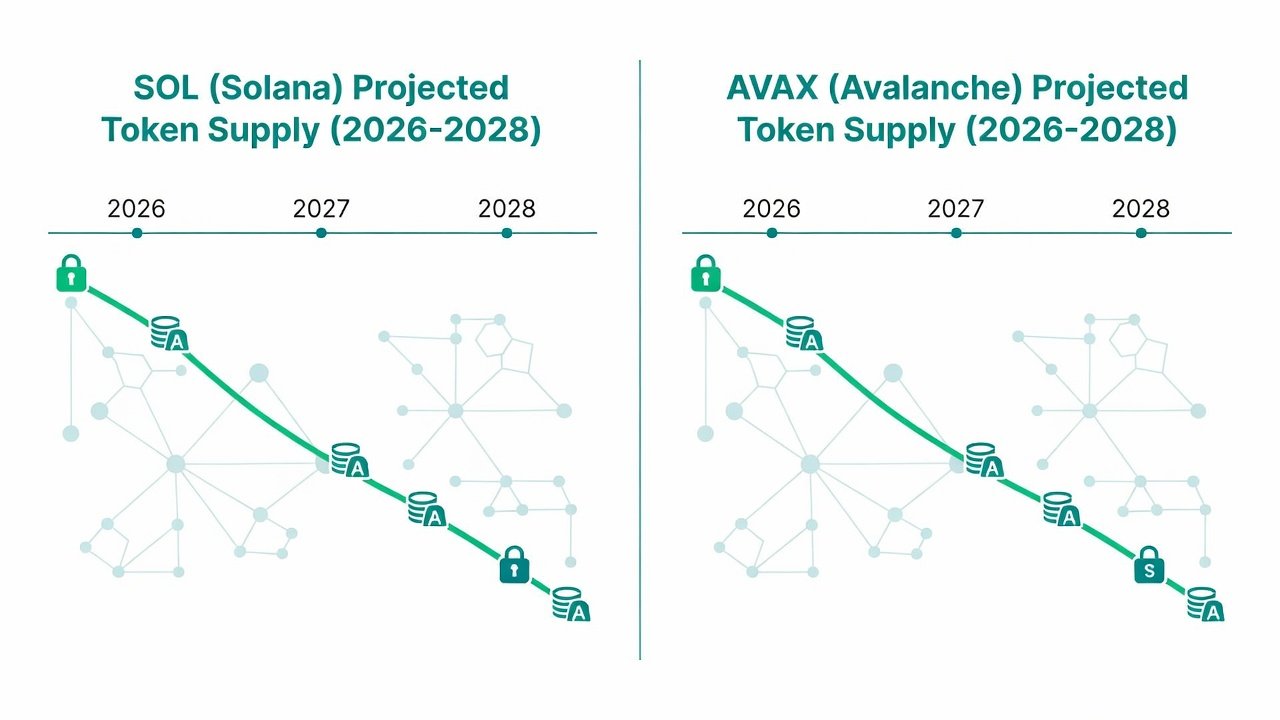
Projected Supply Changes Through 2028
Supply projections help investors model scarcity scenarios. The following table outlines expected trajectories assuming continued network growth and moderate-to-high transaction volumes.
| Year | SOL Projected Supply Trend | AVAX Projected Supply Trend |
|---|---|---|
| 2026 | Moderate net reduction driven by transaction burns during high activity | Stabilization with consistent fee burns offsetting issuance |
| 2027 | Further deflation possible if DeFi and NFT volumes rise | Continued scarcity trends as subnet adoption increases |
| 2028 | Potential net decrease if burns outpace remaining inflation | Supply cap nearing influence with stronger deflationary pressure |
These estimates highlight the sensitivity of both tokens to usage patterns. Sustained ecosystem expansion could accelerate supply contraction, enhancing holder value through genuine scarcity rather than artificial caps alone.
Real-World DeFi Yield Strategies for Holders
Maximizing utility requires moving beyond basic staking. SOL holders can allocate portions of their holdings to liquidity pools on established decentralized exchanges, earning trading fees alongside staking rewards. A practical step-by-step approach involves selecting a reputable wallet, delegating to a validator with strong uptime, then bridging a percentage of tokens to DeFi platforms for leveraged yield farming. Similar tactics apply to AVAX, where subnet participation can unlock specialized lending markets with competitive rates.
- Monitor governance proposals that adjust fee parameters or burn rates to stay ahead of supply changes
- Utilize cold storage for core holdings while delegating staking rights to maintain security and rewards
- Diversify across multiple DeFi strategies such as lending, liquidity provision, and options protocols to mitigate single-point risks
- Regularly rebalance positions based on network activity metrics and projected burn volumes
These methods turn token ownership into an active income stream while reinforcing the deflationary benefits built into the protocols.
Governance Voting Power and Associated Risks
Token holdings directly translate into voting influence on protocol upgrades for both SOL and AVAX. Community proposals often address fee structures, staking parameters, and new feature implementations. Active participation allows holders to steer the network toward policies that enhance scarcity and utility. However, risks include unintended consequences from upgrades, such as temporary increases in inflation or shifts in validator centralization.
Delegation to trusted representatives offers a balanced approach for those unable to monitor every vote. Holders should review proposal details, historical voting patterns, and potential impacts on supply dynamics before committing influence.
Comparison to Competing L1 Tokenomics
Relative to other Layer 1 networks with rigid inflationary schedules, SOL and AVAX stand out for integrating responsive deflationary tools. Faster transaction finality on Solana supports higher throughput and more frequent burns, while Avalanche’s subnet flexibility drives diverse usage that feeds into its burn mechanisms. These advantages position both tokens favorably for scarcity-focused investors seeking alternatives to networks reliant on continuous issuance.
Conclusion and Portfolio Considerations
SOL and AVAX tokenomics in 2026 emphasize deflation through burns and staking synergies that create measurable scarcity. When combined with thoughtful governance involvement and diversified DeFi strategies, these features support long-term holder value. Investors should assess personal risk tolerance, monitor network metrics, and maintain diversified allocations across multiple assets.
FAQ
How do burns affect long-term SOL and AVAX value?
Burns permanently remove tokens from circulation, which can increase scarcity and support price stability or appreciation during periods of growing demand and network adoption.
What risks come with protocol upgrades?
Upgrades may alter fee structures, staking rewards, or governance rules, potentially affecting supply dynamics and requiring ongoing monitoring of community proposals and their economic implications.
Is staking sufficient for maximizing holder utility?
Staking provides foundational yields, yet combining it with DeFi participation such as liquidity provision often delivers superior compounded returns for engaged users who actively manage positions.
How should investors approach portfolio allocation between SOL and AVAX?
Allocation depends on individual risk profiles, with many spreading exposure across both to capture differing strengths in speed versus subnet flexibility while monitoring deflationary trends in each ecosystem.

No comments yet. Be the first!