 CryptoChain Blog
Introduction to 2026 Tokenomics for Yield Investors
As blockchain ecosystems mature into 2026, yield-focused investors are turning to Layer-1 protocols like Solana (SOL) and Avalanche (AVAX) for sustainable returns. Tokenomics—the study of token supply, distribution, utility, and incentives—directly influences staking rewards, inflation control, and long-term value accrual. This analysis examines both networks through the lens of yield generation, contrasting their mechanisms while offering actionable portfolio strategies. Understanding these dynamics helps investors navigate evolving DeFi landscapes where passive income and active participation intersect.
Solana Tokenomics Overview
Solana's high-throughput design supports robust DeFi activity with its unique proof-of-history consensus mechanism. Its native SOL token features a dynamic inflation schedule that decreases over time, paired with staking rewards distributed to validators and delegators. Utility extends to transaction fees, governance proposals, and collateral in decentralized lending protocols. The network's focus on speed and low costs makes SOL attractive for frequent yield operations such as automated compounding through smart contracts.
Avalanche Tokenomics Overview
Avalanche employs a three-chain architecture where AVAX serves as the primary token for staking, fees, and subnet creation. Its tokenomics emphasize deflationary pressures through fee burns while rewarding participants in the Primary Network for securing the system. The platform's subnet flexibility allows customized blockchains that can integrate AVAX for governance and yield-bearing activities across multiple virtual machines.
Inflation Schedules and Staking APYs Compared
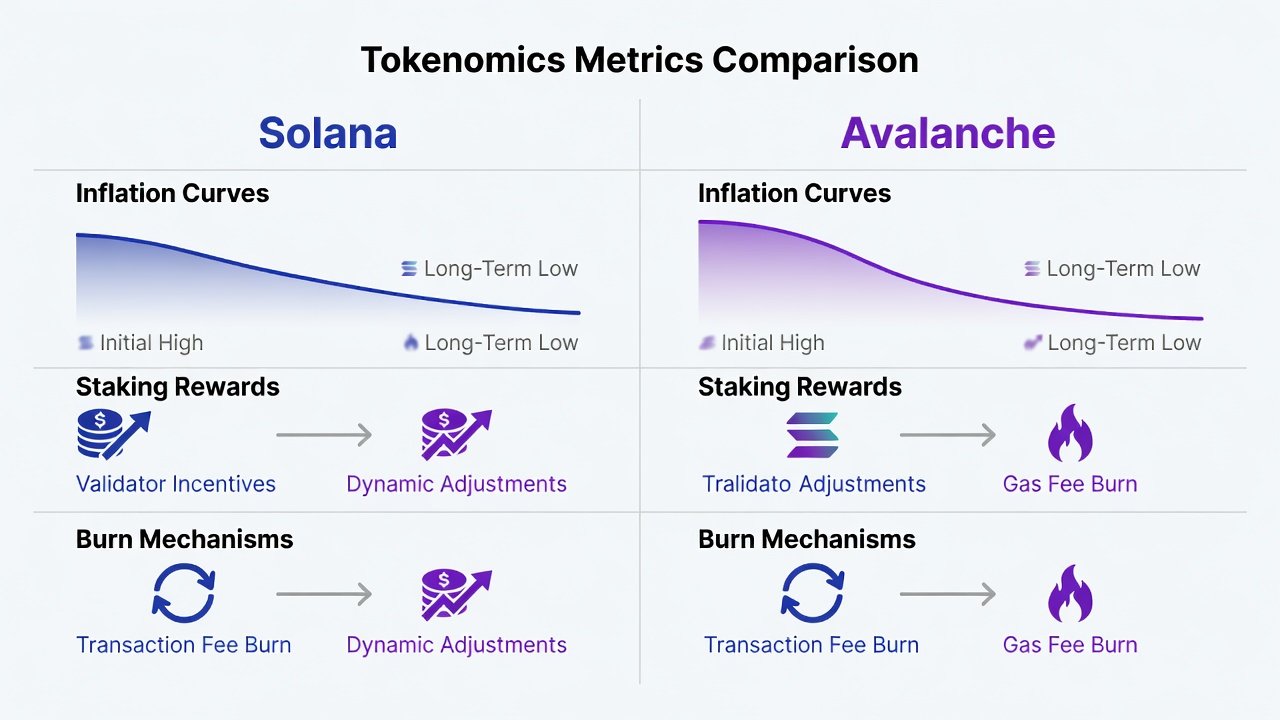
Both networks use staking to secure consensus, yet their inflation curves differ significantly. Solana's rate tapers gradually, creating predictable yield environments that reward long-term delegators. Avalanche balances issuance with burns to stabilize supply and potentially increase token value over time. Investors should monitor validator performance and delegation pools to maximize returns while minimizing dilution from inflation. Detailed comparisons reveal how Solana's inflationary tail supports growth while Avalanche's burn rate offers counterbalancing scarcity effects.
Burn Mechanisms and Evolving Utility in DeFi and Governance
Fee burns on both chains reduce circulating supply, potentially enhancing scarcity and supporting price stability. In DeFi, SOL and AVAX power liquidity provision, perpetual futures, and yield aggregators that allow users to earn additional returns on top of base staking rewards. Governance roles allow token holders to vote on upgrades, treasury allocations, and protocol parameters, adding utility beyond pure yield. These features create multiple revenue streams for holders who actively participate in ecosystem decisions.
Practical Steps for Optimizing Staking Portfolios
Optimizing a staking portfolio requires careful planning and ongoing management. Start by researching validator uptime, commission rates, and stake distribution to avoid concentration risks that could lead to network centralization issues. Divide holdings across multiple validators on each chain for diversification and resilience against single-point failures. Rebalance quarterly based on network upgrade announcements and DeFi yield opportunities that emerge from new protocols. Use liquid staking derivatives to maintain liquidity while earning base rewards, allowing seamless movement into higher-yield DeFi positions without unstaking. Track performance metrics regularly through official dashboards and adjust allocations as market conditions shift.
Real-World Examples of Reward Compounding
Consider an investor delegating SOL to a high-performing validator and automatically reinvesting rewards through a DeFi vault. Over multiple epochs, compounding accelerates growth compared to manual claims, turning modest base yields into substantial portfolio increases. Similar strategies on Avalanche involve using AVAX in liquidity pools after staking, though smart contract risks must be evaluated through audits and historical performance data. Another example includes cross-chain bridging where yields from one network fund positions on the other, creating diversified income streams while managing exposure.
Risk Factors Including Network Upgrades
Protocol upgrades can alter reward structures or introduce temporary instability that affects staking returns. Slashing events, governance attacks, and macroeconomic shifts also affect yields and token values. Investors should track official documentation from Solana and Avalanche for timely information on upcoming changes. Additional risks include smart contract vulnerabilities in DeFi integrations and liquidity fluctuations during high-volatility periods.
Long-Term Holding vs Active Yield Farming
Passive holding emphasizes staking for baseline yields with lower operational overhead and reduced exposure to complex interactions. Active yield farming across both L1s can amplify returns through leveraged positions and cross-chain strategies but increases exposure to impermanent loss and smart contract vulnerabilities. A hybrid approach often suits moderate risk tolerance by combining core staking with selective farming opportunities. Key differences include time commitment, required technical knowledge, and potential for higher but more variable returns in active strategies.
Additional Considerations for Sustainable Yield
Beyond core mechanics, investors must evaluate ecosystem growth metrics such as total value locked, developer activity, and partnership announcements. Both Solana and Avalanche continue to expand DeFi tooling, which can create new yield vectors over time. Monitoring these indicators helps anticipate shifts in token demand and reward sustainability.
Conclusion
Tokenomics in 2026 favor disciplined yield strategies on Solana and Avalanche when investors understand inflation dynamics, utility expansion, and risk management. Continuous monitoring and diversified execution remain essential for sustainable outcomes in an evolving market.
FAQ
Are SOL and AVAX staking rewards sustainable long-term?
Both networks design inflation to decrease while burns and usage fees support sustainability. Outcomes depend on adoption and validator economics that evolve with network usage.
What tax implications apply to altcoin staking rewards?
Rewards are typically taxed as income upon receipt in many jurisdictions, with subsequent capital gains on sales. Consult local regulations and professionals for compliance as rules vary widely.
How do network upgrades affect yields?
Upgrades may adjust inflation rates, introduce new utilities, or change staking mechanics. Review release notes from core teams before major changes to adjust strategies accordingly.
What are common mistakes when starting with SOL or AVAX yield strategies?
Over-concentrating in single validators, ignoring smart contract risks in DeFi, and failing to rebalance during market shifts are frequent pitfalls that can erode returns.
No comments yet. Be the first!