 CryptoChain Blog
Introduction to 2026 SOL and AVAX Tokenomics
In 2026, investors evaluating Solana (SOL) and Avalanche (AVAX) must look beyond headline staking yields to understand the underlying token economics. This analysis examines token supply dynamics, inflation trajectories, burn mechanisms, and real-world utility in DeFi and governance. Both networks continue to evolve their economic models to balance network security with long-term holder incentives, making it essential to track how issuance interacts with actual usage.
Understanding these mechanics helps holders assess whether inflationary pressures are offset by genuine usage and value accrual. We compare side-by-side metrics, explore practical yield scenarios, and provide an actionable evaluation checklist. Tokenomics decisions in 2026 require examining not just reward rates but also how burns, governance, and ecosystem incentives shape net outcomes for long-term holders. This deeper dive goes beyond surface-level APY figures to deliver concrete insights for portfolio construction.
SOL Token Supply and Inflation Model
Solana maintains a disinflationary schedule with a long-term target inflation rate approaching 1.5 percent. The network uses a combination of staking rewards and transaction fee burns to manage supply. As adoption grows, fee burns can meaningfully reduce net inflation for holders, turning high activity into a tailwind rather than a neutral factor. Validator rewards are funded by new issuance, yet the priority fee burn mechanism introduced in earlier upgrades creates a dynamic where higher network activity directly benefits token holders through reduced effective supply growth.
Key considerations for 2026 include monitoring the ratio of burned fees to newly issued tokens. When transaction volumes rise during periods of DeFi activity or NFT minting, the burn rate can offset a larger portion of inflation. Holders benefit when they stake consistently because rewards compound while the overall supply growth slows. This model rewards participation in the network's security while aligning incentives with usage growth.
AVAX Token Supply and Inflation Model
Avalanche employs a fixed maximum supply cap with ongoing issuance allocated to staking rewards and ecosystem incentives. The subnet architecture allows for tailored economic models per chain, but the primary network token still follows a predictable issuance curve tied to staking participation. Unlike uncapped models, AVAX issuance is designed to taper as the network matures, with a portion of fees potentially directed toward burns or treasury mechanisms depending on governance decisions.
In 2026, subnet growth represents a key variable. Each new subnet that gains traction can increase demand for AVAX as a staking and fee token, potentially amplifying utility beyond the primary network. Holders should track how governance votes allocate emissions between validation rewards and ecosystem development funds, as these choices directly affect dilution rates over multi-year horizons.
Side-by-Side Inflation and Burn Comparison
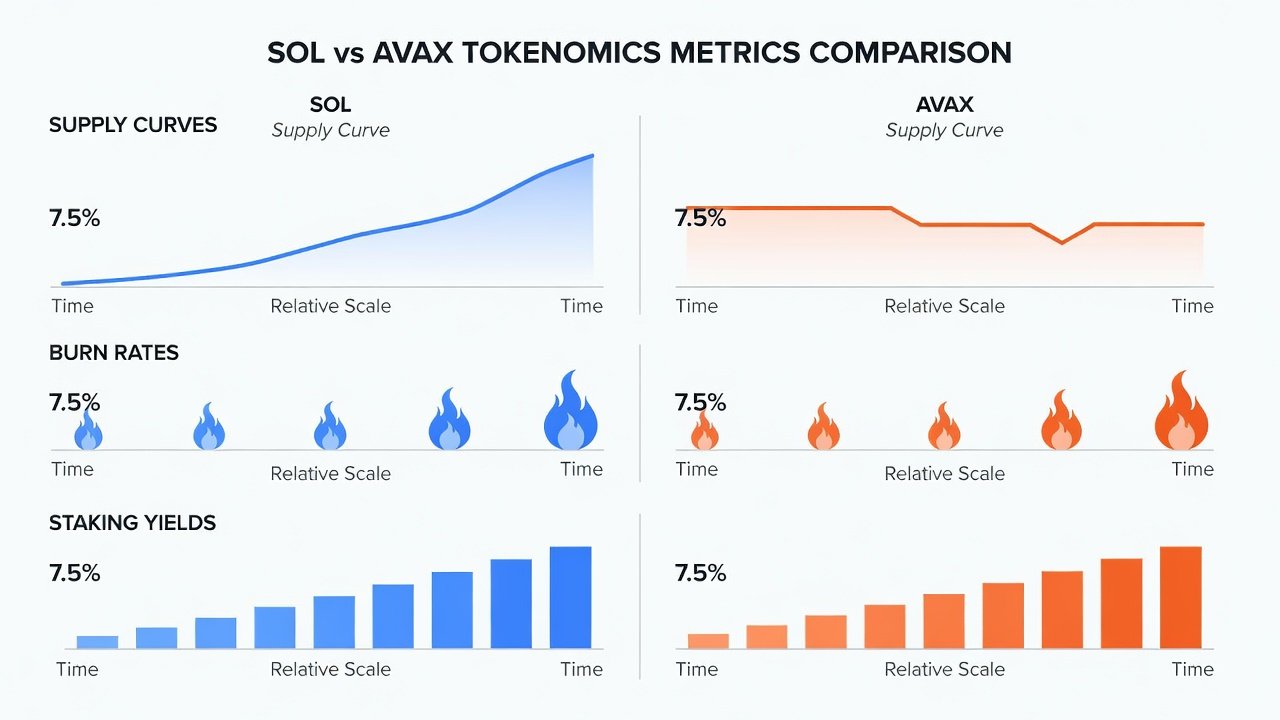
Both chains use staking to secure the network while employing burns to counteract issuance. SOL benefits from high throughput driving fee burns, while AVAX relies more on governance-controlled parameters and subnet economics. Holders should monitor actual net inflation rates, which fluctuate with usage rather than remaining static. Comparing the two reveals trade-offs: Solana's burn mechanism scales with raw transaction count, whereas Avalanche's approach emphasizes structured incentives that can adapt to specific use cases such as institutional subnets or gaming ecosystems.
Practical evaluation involves reviewing on-chain dashboards for real-time burn versus issuance data. When Solana experiences sustained high activity, net inflation can drop noticeably below target levels. Avalanche holders may see steadier but potentially lower burn impacts unless governance implements broader fee redirection. These differences influence whether a holder prefers one chain's volatility in supply dynamics over the other's more controlled approach.
Utility in DeFi, Staking, and Ecosystem Incentives
SOL serves as gas for high-speed transactions and collateral across lending, perpetuals, and liquid staking protocols. AVAX powers subnets that can customize fee structures and tokenomics, creating differentiated utility cases. Governance participation on both networks allows holders to influence reward emissions and upgrade paths. Staking remains the primary utility driver. SOL stakers earn from issuance plus MEV opportunities, while AVAX stakers participate in primary network validation with potential additional yields from subnet activity.
Beyond basic staking, ecosystem incentives include liquidity provision rewards and developer grants that indirectly support token demand. In 2026, holders benefit from understanding which DeFi primitives on each chain generate the most sustainable fee revenue. For example, perpetual futures platforms on Solana often drive significant volume, while Avalanche subnets focused on tokenized assets can create recurring AVAX demand through custom fee models.
Practical Yield Scenarios and Portfolio Examples
Consider a balanced allocation approach. An investor might allocate 60 percent to established blue-chip assets, 25 percent to SOL for high-throughput DeFi exposure, and 15 percent to AVAX for subnet diversification. Within each position, staking the majority while keeping a liquid portion for governance votes or opportunistic DeFi strategies can optimize returns. Yield scenarios depend on network activity levels. Higher transaction volumes on Solana amplify burn effects, while Avalanche subnet growth can increase demand for AVAX as a staking and fee token.
Always stress-test assumptions against varying adoption rates. A sample scenario might involve allocating additional capital to liquid staking derivatives during periods of expected network upgrades, then reallocating to native staking when governance proposals signal emission changes. Portfolio examples should also account for correlation risks between the two assets during broader market movements, ensuring diversification remains effective rather than illusory.
Governance Participation and Common Pitfalls
Active governance lets holders steer inflation parameters and incentive programs. However, many investors overlook voting power concentration or fail to account for lock-up periods when calculating net yields. Common mistakes include chasing headline APYs without modeling net inflation after burns, ignoring smart contract risks in liquid staking derivatives, and failing to rebalance as subnet or DeFi ecosystems evolve.
Another frequent pitfall is neglecting validator performance metrics. Poor uptime or high commission rates can erode staking returns faster than inflation differences between chains. Holders are advised to diversify across multiple validators and review delegation strategies quarterly rather than treating staking as a set-and-forget activity.
Evaluation Checklist for SOL and AVAX Holders
- Review current net inflation rate versus transaction volume trends on official dashboards
- Assess staking participation rate and its impact on reward dilution across both networks
- Evaluate DeFi TVL growth and fee burn contribution using transparent on-chain data
- Check governance proposals affecting tokenomics parameters and emission schedules
- Model portfolio allocation under different adoption scenarios including bear and bull markets
- Verify validator performance and slashing risks before delegating significant holdings
- Monitor subnet or DeFi protocol launches that could shift utility demand
- Track correlation between SOL and AVAX price movements for rebalancing decisions
Steps to Monitor Tokenomics Effectively
- Set up alerts for key metrics such as daily burn amounts and staking ratios
- Review quarterly governance summaries from both communities
- Compare historical net inflation data over rolling 90-day periods
- Simulate yield outcomes using different usage assumptions before committing capital
Conclusion
SOL and AVAX offer distinct tokenomic profiles in 2026. Solana emphasizes high-throughput burns to offset issuance, while Avalanche focuses on capped supply and subnet flexibility. Holders who combine staking with active monitoring of burns, governance, and ecosystem usage position themselves for sustainable value accrual. Use the checklist and monitoring steps above to make informed decisions aligned with your risk tolerance and investment horizon.
FAQ
How does SOL inflation change with higher network usage? Increased activity raises fee burns, which can lower net inflation below the long-term target and improve outcomes for stakers.
Does AVAX have a maximum supply? Yes, AVAX features a fixed cap with issuance tapering over time through its economic design and governance controls.
Should holders stake 100% of their tokens? Maintaining some liquid holdings supports governance participation and opportunistic DeFi strategies without sacrificing all flexibility.
What resources provide official tokenomics data? Visit solana.com and avax.network for the latest parameters and documentation.
How often should tokenomics be reviewed? Quarterly reviews aligned with governance cycles and major network upgrades provide sufficient frequency for most holders.
No comments yet. Be the first!