 CryptoChain Blog
Introduction to 2026 SOL and AVAX Tokenomics
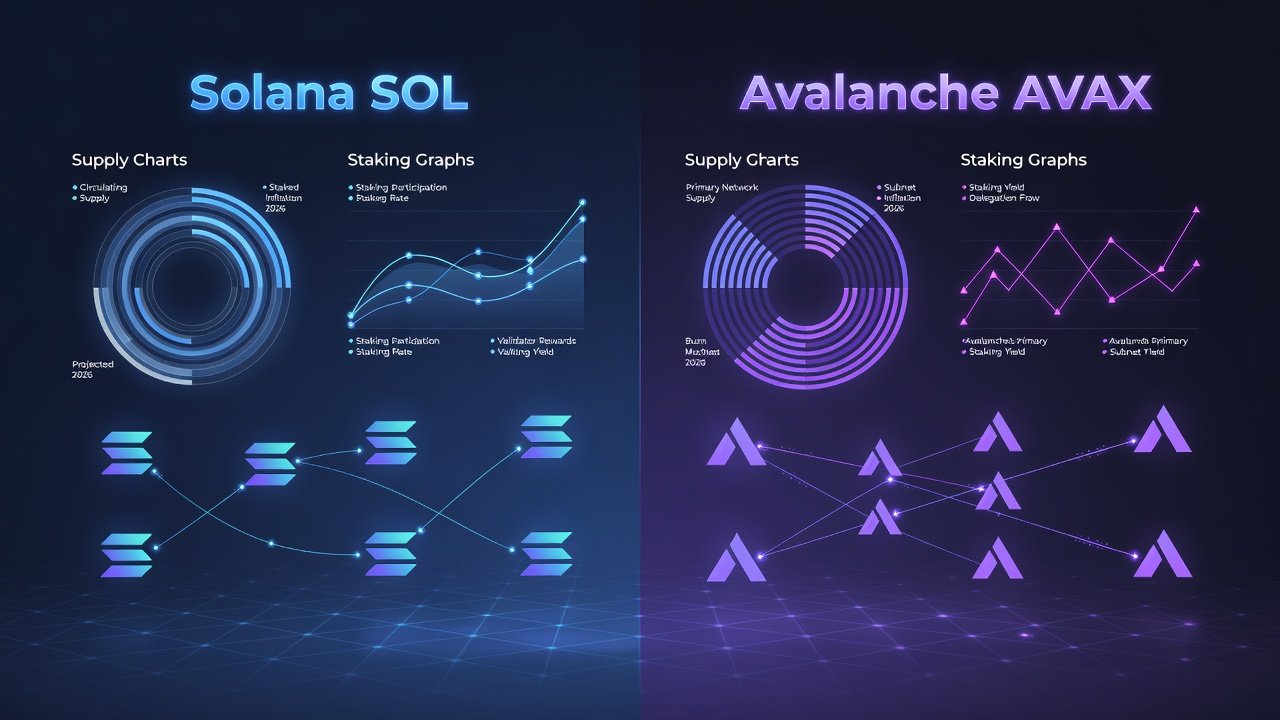
Long-term investors in Layer 1 blockchains increasingly focus on tokenomics as the foundation for sustainable value creation. Solana (SOL) and Avalanche (AVAX) represent two leading ecosystems with distinct supply dynamics, inflation schedules, and staking mechanisms that directly influence holder returns. This analysis examines their utility models through 2026, highlighting how each captures value in DeFi, payments, and governance while projecting circulating supply and reward trends. Understanding these elements helps investors evaluate resilience against competitors like Ethereum and other high-throughput chains. Both networks emphasize scalability, yet their approaches to token utility differ significantly in emission curves, burn mechanics, and real-world adoption patterns. By breaking down inflation tapering, staking APY trajectories, and ecosystem-specific use cases, this guide provides the concrete data needed for informed allocation decisions over multi-year horizons.
Solana (SOL) Token Supply Dynamics and Inflation Schedule
Solana operates with a disinflationary model where the inflation rate decreases over time according to a predefined schedule. The network's native token SOL supports transaction fees, staking security, and governance participation. As of the latest protocol parameters, the inflation rate follows a schedule that tapers annually by a fixed percentage, promoting scarcity as adoption grows. Circulating supply projections for 2026 anticipate steady growth from staking rewards and validator incentives, balanced by token burns from transaction fees. This mechanism aligns with long-term holder interests by reducing net issuance while network activity scales. Investors should monitor validator concentration and fee market evolution, as higher throughput directly amplifies burn pressure. Historical data shows Solana's supply growth moderating even during periods of high usage, creating a favorable backdrop for value accrual if ecosystem demand continues expanding.
Staking Reward Structures for SOL
Staking on Solana delivers competitive APY through delegation to validators who maintain network consensus. Reward trends through 2026 point to stabilization around sustainable levels as the network matures, with emphasis on uptime, performance metrics, and commission rates. Investors benefit from compounding rewards that enhance holdings over multi-year periods, especially when delegating to high-performing nodes with low commissions. Practical examples include delegations to infrastructure providers that offer additional services such as MEV optimization. The structure encourages broad participation while penalizing underperforming validators through reduced rewards, fostering a healthy and decentralized validator set. Long-term stakers also gain governance influence proportional to their stake.
Avalanche (AVAX) Token Supply Dynamics and Inflation Schedule
Avalanche employs a capped supply model with a maximum of 720 million tokens, creating built-in scarcity from the outset. AVAX facilitates fees, staking, and subnet creation across its primary and custom chains. Its inflation schedule rewards validators and delegators while gradually shifting toward fee-based sustainability as emissions decline. Projections indicate controlled circulating supply expansion through 2026, driven primarily by staking emissions offset by network usage and burns. This structure supports value accrual as ecosystem activity increases, particularly in subnets that require AVAX collateral. The hard cap differentiates AVAX from uncapped inflationary peers and provides clearer scarcity signals for long-term holders evaluating token velocity and demand drivers.
Staking Reward Structures for AVAX
AVAX staking offers dynamic APY based on participation rates and subnet performance across its three-chain architecture. Trends through 2026 suggest rewards will remain attractive for long-term stakers, with mechanisms encouraging consistent network security and growth. Delegators can allocate to primary network validators or participate in subnet-specific incentives that boost effective yields. Real ecosystem examples include institutional validators running multiple subnets, where AVAX staking secures both the core platform and customized application chains. This dual-layer reward system provides diversified income streams compared to single-chain staking models.
Comparing Utility Mechanisms: DeFi, Payments, and Governance
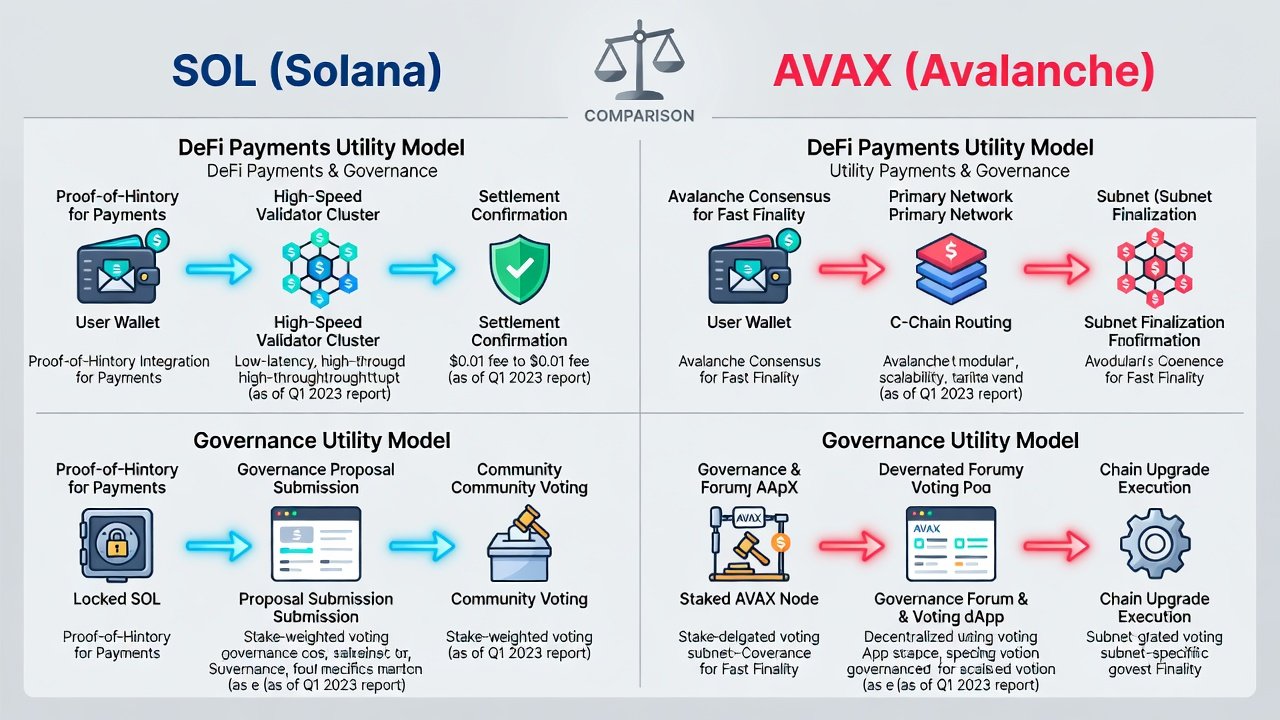
Both tokens power diverse use cases, yet execution varies across verticals. In DeFi, SOL enables high-speed lending and trading on platforms like Serum and Raydium, while AVAX supports decentralized exchanges and lending via Trader Joe and Aave deployments on its C-Chain. For payments, Solana excels in low-cost, high-throughput transactions ideal for micropayments and remittances, with real-world integrations in merchant terminals and cross-border solutions. Avalanche provides similar efficiency with added subnet customization for enterprise payment rails, allowing tailored compliance and settlement rules. Governance differs notably: SOL holders participate in on-chain proposals through the Solana Foundation, whereas AVAX uses a more granular model tied to its three-chain architecture for protocol upgrades and subnet governance. Official Solana resources and Avalanche documentation offer deeper technical breakdowns of these utilities and developer tools.
Value Capture in Layer 1 Ecosystems Versus Competitors
SOL captures value through fee burns and staking that secures the network, outperforming many competitors in throughput efficiency and cost per transaction. AVAX differentiates via its subnet model, allowing customized chains that drive AVAX demand for creation, operation, and collateralization. Compared to Ethereum's gas token economics, both offer lower barriers for users while maintaining security through proof-of-stake variants. Ethereum foundation materials detail contrasting approaches to issuance and burns. Long-term investors should note how each ecosystem's token velocity and demand drivers influence price stability, particularly when subnets or high-frequency applications increase token lock-up periods. Practical comparisons reveal Solana's edge in consumer-facing speed and Avalanche's strength in institutional customization.
Practical Checklist for Evaluating Tokenomics Health
- Review inflation schedules and projected supply curves through 2026, including emission halving events and burn rates.
- Assess staking APY sustainability and validator distribution to avoid centralization risks.
- Analyze utility adoption in DeFi, payments, and governance with real transaction data and active address growth.
- Compare value capture mechanisms against Layer 1 peers using on-chain metrics such as fees burned versus new issuance.
- Evaluate token burn rates relative to network activity and fee market maturity.
- Check for governance participation metrics, proposal success rates, and upgrade roadmaps with clear timelines.
- Monitor subnet or app-chain creation trends that increase native token demand.
- Review historical staking participation rates and reward distribution fairness.
FAQ on SOL and AVAX Tokenomics for Investors
What drives SOL token value in 2026?
Value stems from network usage fees, staking participation, and ecosystem growth in high-speed applications across payments and DeFi.
How does AVAX inflation compare to SOL?
AVAX features a hard cap with declining emissions, while SOL uses a tapering inflation rate without a fixed maximum supply.
Are staking rewards expected to decline?
Both networks project stabilizing APYs as adoption increases and emissions adjust to usage, with potential upside from higher fee burns.
Which offers better long-term utility?
It depends on investor focus: Solana for speed-focused payments and DeFi scalability, Avalanche for customizable subnets and institutional-grade flexibility.
What risks should tokenomics evaluators watch?
Key risks include validator centralization, sudden changes in emission schedules, and competition from newer Layer 1s with more aggressive incentives.
Conclusion
Evaluating 2026 SOL and AVAX tokenomics reveals strong foundations for long-term value when paired with robust utility adoption. Investors prioritizing sustainable staking and ecosystem-specific use cases will find both compelling, provided they apply rigorous checklist analysis to ongoing developments and maintain diversified exposure across complementary Layer 1 models.
No comments yet. Be the first!