 CryptoChain Blog

Introduction to AI and Layer 1 Blockchain Convergence in 2026
The fusion of artificial intelligence with layer 1 blockchains is reshaping decentralized applications in 2026. Solana and Avalanche (AVAX) stand out as leading altcoins enabling sophisticated AI-driven dApps that demand high throughput and low latency. This evolution moves beyond basic token transfers to support real-time inference, on-chain model training, and autonomous agents that operate independently across distributed networks.
Developers are increasingly drawn to these chains for their ability to handle AI workloads that Ethereum-based solutions struggle with at scale. As adoption grows, understanding the unique strengths of each ecosystem becomes essential for builders targeting the next wave of intelligent applications. Forward-looking projects are already demonstrating how AI can optimize everything from predictive analytics in DeFi to dynamic content generation in gaming and social platforms.
Market observers note that the intersection of these technologies is accelerating innovation cycles, with new protocols emerging monthly that combine machine learning models directly with blockchain consensus mechanisms. This creates opportunities for more efficient, transparent, and adaptive decentralized systems that respond intelligently to user behavior and market conditions.
Real-World AI dApp Examples on Solana
Solana's high-speed architecture has attracted several pioneering AI projects by mid-2026. One notable example is projects leveraging parallel transaction processing for decentralized machine learning marketplaces. These platforms allow users to contribute compute resources and earn tokens while models run inference directly on-chain, enabling seamless collaboration among global participants without intermediaries.
Another standout involves AI-powered trading agents that analyze on-chain data in real time, executing strategies with sub-second finality. These agents use reinforcement learning to adapt to volatility patterns, providing users with automated portfolio management that outperforms traditional rule-based bots. Solana's ecosystem also hosts generative AI tools for NFT creation, where models fine-tune outputs based on user prompts stored immutably on the ledger for verifiable provenance.
Additional examples include AI-driven oracle networks that aggregate sensor data from IoT devices for supply chain applications and autonomous governance bots that propose and vote on protocol upgrades using natural language processing to interpret community sentiment. These implementations showcase Solana's capacity to support complex, multi-step AI workflows at scale.
Innovative AI Integrations Within the Avalanche Ecosystem
Avalanche's subnet architecture provides customizable environments ideal for AI-specific workloads. In 2026, several subnets are dedicated to federated learning protocols, enabling privacy-preserving model updates across distributed nodes without central servers. This approach allows organizations to train shared models on sensitive datasets while maintaining compliance with data regulations.
Projects on AVAX include AI oracle networks that feed verified predictions into DeFi protocols and autonomous governance systems using reinforcement learning agents. These implementations benefit from Avalanche's rapid consensus, making them suitable for applications requiring frequent model updates and real-time decision making in volatile environments.
Further integrations feature AI-enhanced cross-chain bridges that predict liquidity needs and optimize routing dynamically, as well as decentralized data labeling platforms where contributors earn rewards for annotating training datasets used by on-chain models. Avalanche official site highlights ongoing subnet developments that support these advanced use cases, emphasizing the chain's focus on modular scalability for emerging technologies.
Performance Advantages for AI Workloads
Both chains offer distinct edges over slower networks. Solana excels in raw transaction speed, supporting thousands of AI inference calls per second with minimal fees. This enables applications like live video analysis or high-frequency trading simulations that require immediate responses. Avalanche provides flexible subnet isolation, reducing congestion for compute-intensive tasks like model fine-tuning and allowing dedicated resources for specific AI verticals.
These advantages translate to practical gains: faster agent decision loops, scalable data marketplaces, and cost-efficient training simulations that were previously limited to centralized cloud providers. Performance metrics from 2026 show consistent improvements in handling bursty AI traffic, with both ecosystems implementing upgrades that further enhance parallel processing capabilities for neural network operations.
Developer Migration Considerations for 2026
Teams migrating from other chains should evaluate tooling maturity. Solana offers robust Rust and TypeScript SDKs optimized for AI data pipelines, while Avalanche provides EVM-compatible environments with added subnet customization for isolated AI experiments. Considerations include compatibility with popular frameworks like TensorFlow or PyTorch through oracle bridges.
Key factors include existing smart contract libraries for model verification and community support for AI-specific primitives. Testing on testnets remains critical to assess gas predictability under AI traffic spikes. Migration often involves auditing data flows to ensure model integrity across chains and optimizing for each network's unique fee structures and finality times.
Side-by-Side Feature Comparison
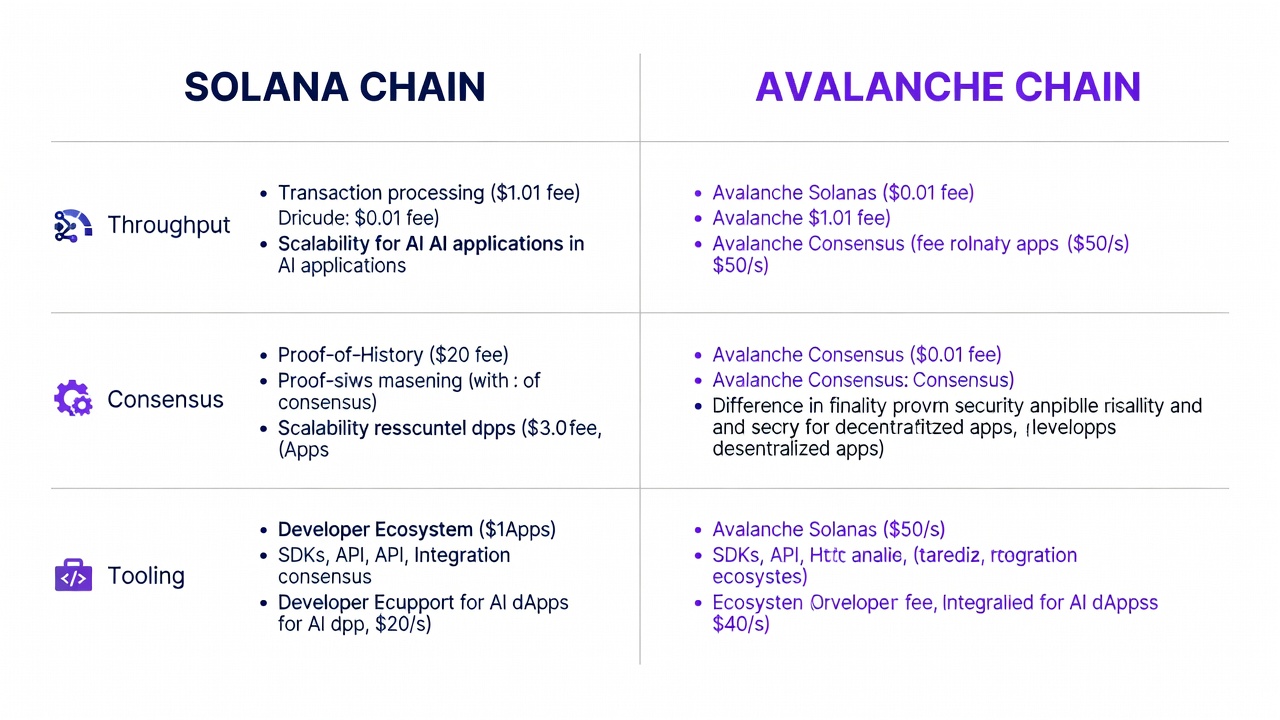
- Throughput: Solana leads with higher TPS for parallel AI tasks; Avalanche offers consistent performance via subnets tailored to specific workloads.
- Consensus: Solana uses Proof of History for speed; Avalanche employs Snowball for rapid finality and high security guarantees.
- AI Tooling: Both support Python integrations via oracles, but Solana edges in native parallel compute while Avalanche excels in customizable execution environments.
- Cost Efficiency: Qualitative advantages favor both over legacy chains for high-volume inference, with predictable economics supporting sustained AI operations.
- Developer Experience: Solana provides comprehensive documentation for high-performance apps; Avalanche offers easier onboarding for Ethereum developers transitioning to subnets.
- Scalability for AI: Subnet isolation on Avalanche reduces interference; Solana's single-state architecture maximizes speed for unified AI marketplaces.
Practical Steps for Launching an AI dApp
Follow these steps to build and deploy an AI-powered decentralized application on either chain:
- Define the AI model requirements and select compatible oracles for data feeds, ensuring low-latency sources for real-time inference.
- Choose the chain based on workload: Solana for speed-critical inference or Avalanche for isolated training environments with custom subnets.
- Develop smart contracts handling model inputs/outputs using official SDKs, incorporating verification logic to prevent malicious model tampering.
- Integrate decentralized storage solutions for large model weights and training datasets to maintain decentralization.
- Implement security measures such as multi-signature controls and regular audits focused on AI-specific vulnerabilities.
- Test extensively on devnets, focusing on latency, cost under load, and edge cases like model drift over time.
- Optimize for gas efficiency by batching AI calls and leveraging off-chain computation where appropriate.
- Deploy to mainnet and monitor with analytics tools tailored to AI metrics such as prediction accuracy and user engagement.
- Iterate based on on-chain feedback, using community governance to refine model parameters.
Resources from Solana's developer portal provide detailed guides for these processes, complemented by Avalanche's extensive subnet tutorials.
FAQ: Common Concerns on Scalability and Costs
How scalable are these chains for growing AI dApp usage?
Both Solana and Avalanche demonstrate strong scalability in 2026 through architectural upgrades, handling increasing inference volumes without proportional slowdowns. Subnet expansions and protocol optimizations continue to push boundaries for enterprise-grade AI deployments.
What cost considerations apply to AI workloads?
Transaction fees remain competitive and usage-based, supporting sustainable economics for frequent AI interactions compared to earlier blockchain generations. Developers can further reduce expenses through efficient contract design and selective off-chain processing.
Are there risks with on-chain AI models?
Verification challenges exist, but emerging zero-knowledge techniques and oracle improvements mitigate concerns around model integrity, ensuring trustworthy outputs even in decentralized settings.
How do regulatory factors influence AI dApp development?
Projects must navigate evolving global standards for AI transparency and data privacy, often incorporating built-in audit trails to demonstrate compliance while preserving user anonymity where required.
Emerging Trends and Predictions for Late 2026
Looking ahead, hybrid AI-blockchain architectures are expected to mature further, with increased focus on edge computing integration and multimodal models that process text, images, and sensor data simultaneously. Both ecosystems are likely to see growth in AI agent economies where autonomous entities interact across multiple dApps.
Developers should watch for advancements in verifiable computation that allow on-chain validation of complex neural network results without revealing proprietary model details. This will unlock new use cases in healthcare analytics and personalized finance.
Conclusion and Future Outlook
AI-driven dApps on Solana and AVAX represent a pivotal shift in 2026 altcoin ecosystems. By capitalizing on performance strengths and following structured development approaches, builders can create applications that deliver genuine intelligence at the edge of decentralization. Continued innovation promises even broader adoption in the years ahead, positioning these layer 1 networks as foundational platforms for the intelligent web.
No comments yet. Be the first!