 CryptoChain Blog
Tokenomics Breakdown: Solana & AVAX Layer 1 Altcoins 2026
Layer 1 blockchains like Solana and Avalanche continue to attract investors seeking alternatives to established networks. Understanding their tokenomics is essential for evaluating long-term value, especially as network usage and adoption evolve through 2026. This analysis examines supply dynamics, inflation, utility, staking, and burn mechanisms using current network data to inform holding strategies and assess network security implications. Investors who look beyond price charts often find that tokenomics provide the clearest signals for sustainable growth and risk management.
Solana (SOL) Tokenomics Overview
Solana's native token, SOL, powers a high-throughput blockchain designed for speed and low costs. Its token model balances inflationary rewards for validators with deflationary pressures from transaction fees. The total supply is uncapped, allowing ongoing issuance to support network security through staking incentives. This design choice prioritizes continuous validator participation over artificial scarcity.
Circulating supply represents tokens actively available in the market, while total supply includes all minted tokens. The distinction highlights how new issuance impacts dilution for holders. Solana employs a disinflationary schedule where the inflation rate decreases annually until reaching a long-term minimum, creating a predictable path that rewards early participants who stake consistently.
Staking Reward Structures on Solana
Validators and delegators earn rewards from inflation. The staking mechanism secures the proof-of-stake network by distributing new SOL proportionally to staked amounts. Practical examples show that consistent staking participation helps mitigate dilution effects over multi-year holding periods. For instance, an investor who stakes a portion of their holdings each epoch can compound rewards, effectively maintaining or increasing their share of the network relative to non-stakers.
Network security benefits directly from high staking ratios, as more tokens locked reduce the risk of attacks. Real-world data from 2026 demonstrates sustained participation levels supporting robust validation. Delegators should evaluate validator performance metrics such as uptime and commission rates before committing funds, since poor choices can lead to missed rewards or slashing events.
Avalanche (AVAX) Tokenomics Overview
AVAX serves as the native asset for the Avalanche ecosystem, facilitating transactions, staking, and governance across its subnets. The token features a capped maximum supply, creating scarcity that differentiates it from uncapped models. This fixed limit influences long-term value propositions for holders focused on fundamentals, as eventual supply exhaustion could amplify demand-driven price effects if adoption continues.
Comparisons between circulating and total supply reveal how emissions schedules affect availability. Avalanche's design incorporates both inflationary issuance for rewards and mechanisms that can reduce supply over time, giving holders multiple levers that influence token velocity and retention.
Burn Mechanisms and Utility
Transaction fees on Avalanche include a burn component that permanently removes AVAX from circulation. This deflationary feature activates during periods of high network activity, directly countering issuance. Utility extends to subnet creation and governance votes, giving token holders influence over ecosystem development. Investors can participate in governance by staking and submitting or voting on proposals that adjust parameters like fee structures or subnet economics.
Examples from 2026 show how increased DeFi and NFT activity on Avalanche amplified burn rates, providing tangible benefits to long-term holders by tightening supply dynamics. A practical case involves a subnet launch that drove elevated transaction volume, resulting in measurable supply contraction that rewarded passive holders who simply maintained their positions through the activity spike.
Avalanche official documentation offers detailed breakdowns of fee structures and subnet economics.
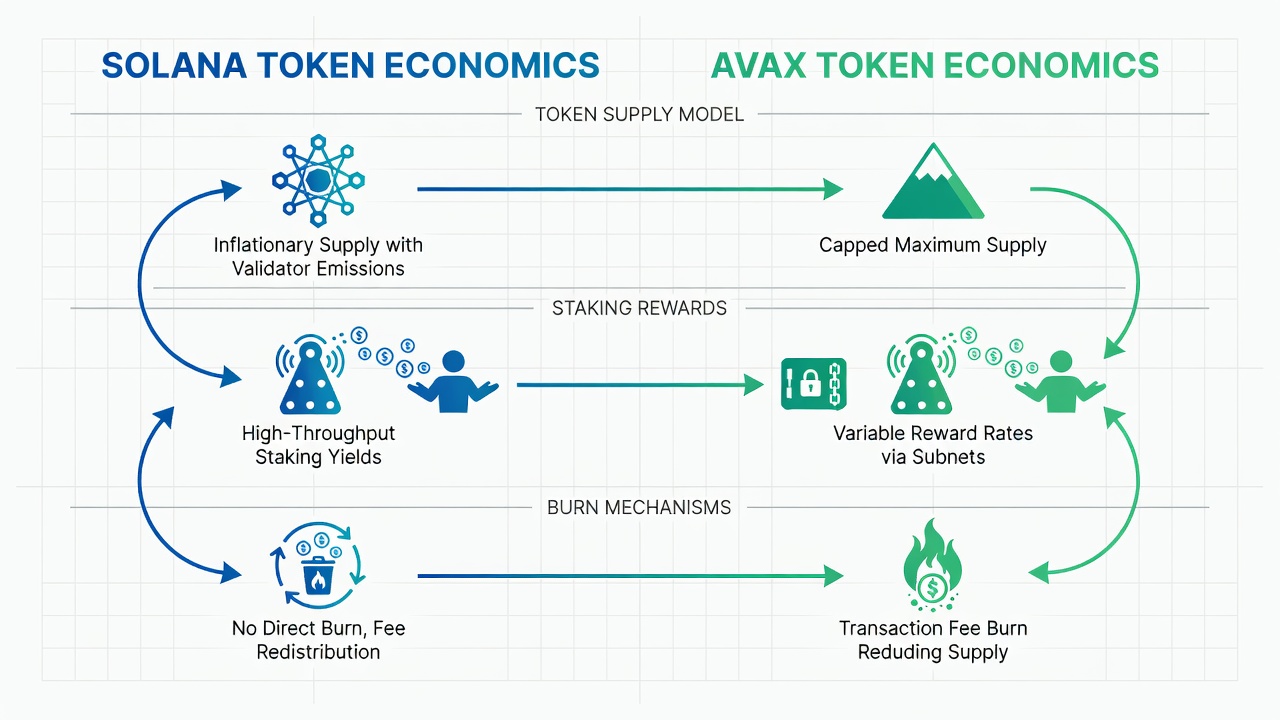
Comparing SOL and AVAX Supply Models
Solana's uncapped supply contrasts with Avalanche's hard cap, leading to different inflation trajectories. SOL relies on a declining inflation rate paired with fee burns for balance, while AVAX combines capped issuance with aggressive burning during usage spikes. Investors evaluating both must consider how these models interact with network growth projections through 2026 and beyond.
- SOL inflation decreases yearly, supporting validator incentives without rapid dilution when staking participation remains high.
- AVAX burns create scarcity potential tied to real usage metrics, rewarding networks that attract consistent developer and user activity.
- Staking participation rates influence security for both networks differently due to reward structures and lock-up requirements.
- Governance influence varies: AVAX holders vote directly on protocol changes, while SOL governance occurs through community and foundation-led upgrades.
Impact on Long-Term Holding Strategies
Tokenomics directly affect holding decisions. For SOL, regular staking can offset inflationary pressures, making it suitable for passive strategies that compound rewards automatically. AVAX holders may benefit from burn events during bull markets, enhancing scarcity without active intervention. Both approaches require monitoring governance participation to stay aligned with protocol upgrades that could alter economics.
Network security remains intertwined with token distribution. Higher staking rates on either chain improve resistance to centralization risks, providing a foundation for sustainable value accrual. A common mistake to avoid is treating staking solely as a yield opportunity without considering validator reliability or opportunity costs during market downturns.
Network Security and Dilution Mitigation
Strong tokenomics support network security by aligning incentives between holders and validators. On Solana, the disinflationary curve encourages long-term staking commitments that protect against 51% style attacks. Avalanche's burn mechanism adds an additional layer by reducing circulating supply during high-demand periods, indirectly strengthening the economic cost of any malicious activity.
Practical steps for investors include diversifying across both chains, regularly reviewing staking dashboards, and participating in governance forums. These actions help maintain exposure while adapting to evolving supply dynamics. For example, reallocating a portion of rewards into additional stakes during low-activity periods can build resilience against future dilution.
FAQ
What are the dilution risks for SOL holders?
Solana's inflation introduces gradual dilution, but declining rates and staking rewards help manage this for active participants. Long-term holders benefit from compounding to maintain relative ownership percentages. Those who ignore staking entirely face higher effective dilution compared to engaged delegators.
How does AVAX governance participation work?
AVAX token holders can stake and vote on proposals affecting fees, subnets, and upgrades. Active involvement allows influence over tokenomics parameters that shape future supply and utility. Participation thresholds exist to prevent spam, and successful proposals can directly modify burn rates or reward distributions.
Do burn mechanisms guarantee value appreciation?
Burns reduce supply but value depends on demand, adoption, and overall market conditions. They serve as one factor alongside utility and network effects in comprehensive analysis. Historical patterns from 2026 indicate that burns amplify positive effects when paired with genuine usage growth rather than speculative spikes.
Further details on Solana's economic model are available via Solana's official resources. Investors should review on-chain data regularly for the latest 2026 metrics and consider consulting multiple data providers before making allocation decisions.

No comments yet. Be the first!