 CryptoChain Blog

Introduction to Enterprise Blockchain Integration in 2026
Enterprises are increasingly turning to high-performance Layer 1 blockchains like Solana and Avalanche (AVAX) to drive efficiency, reduce costs, and enable new business models. In 2026, integration strategies focus on seamless connectivity between these networks and existing enterprise systems. This article provides a comprehensive guide covering practical steps, sector-specific examples, and key considerations for successful adoption. Organizations across finance and supply chain sectors are evaluating how these platforms can replace or augment legacy infrastructure while maintaining regulatory alignment and operational resilience.
The shift toward blockchain integration is driven by the need for faster settlement times, greater transparency, and reduced intermediaries. Solana’s architecture emphasizes speed through its proof-of-history mechanism, while AVAX leverages a subnet model that allows customized virtual machines tailored to specific enterprise requirements. Both networks have matured their tooling and governance processes, making them viable for production workloads beyond pilot stages.
Comparing Transaction Throughput and Cost Advantages
Solana and AVAX offer significant advantages over traditional centralized systems. Solana achieves high throughput with parallel processing, while AVAX uses subnets for customizable performance. Compared to legacy databases and payment rails, these blockchains reduce latency and operational overhead in high-volume environments. Qualitative analyses show lower per-transaction costs in production deployments versus traditional systems, particularly in finance and logistics where speed directly impacts revenue.
Throughput Benchmarks
Solana consistently handles thousands of transactions per second in real-world tests, making it suitable for real-time settlement. AVAX subnets can be tuned for even higher localized throughput. Enterprises benefit from these capabilities in scenarios requiring rapid data reconciliation. When benchmarked against conventional enterprise resource planning systems, both networks demonstrate superior performance during peak periods such as end-of-quarter reporting or holiday supply surges. Decision makers should run controlled tests using their own transaction patterns to quantify the exact gains in speed and reliability.
Practical Steps for API Setups and Hybrid Cloud Solutions
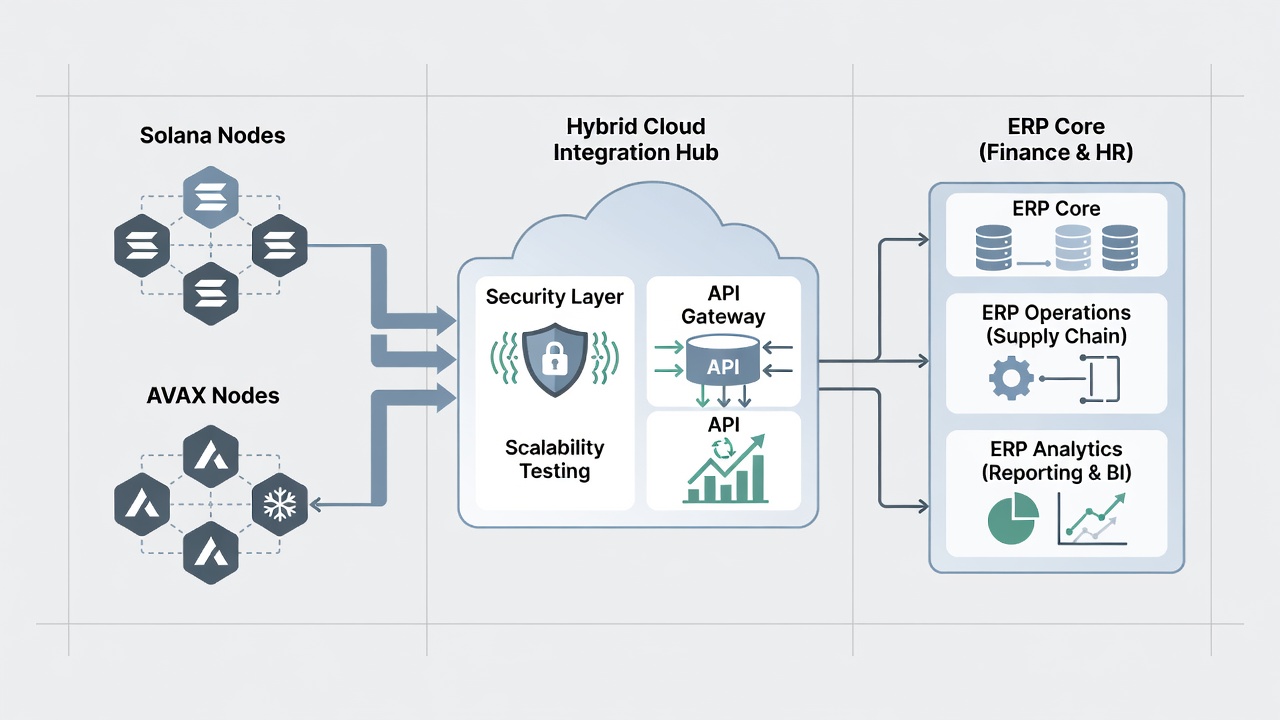
Successful integration begins with robust API configurations. Developers use official SDKs from Solana and Avalanche to connect applications to the networks. Hybrid cloud architectures combine on-premise infrastructure with blockchain nodes hosted on major cloud providers.
- Establish secure RPC endpoints with authentication layers and rate limiting to prevent abuse.
- Implement middleware for data validation before on-chain submission, ensuring only verified records reach the ledger.
- Use containerized deployments for scalable node management that can be orchestrated across multiple availability zones.
- Configure monitoring dashboards that track latency, error rates, and gas usage in real time.
Hybrid solutions allow enterprises to maintain control over sensitive data while leveraging blockchain immutability for audit trails. A typical architecture routes non-sensitive metadata to public chains while keeping proprietary details in private subnets or off-chain databases with cryptographic references.
Real-World Examples in Finance and Supply Chain
In finance, institutions use Solana for instant cross-border settlements and AVAX for tokenized asset management. Banks have piloted platforms that settle securities trades within seconds rather than days, improving capital efficiency. Asset managers tokenize funds on AVAX subnets to enable fractional ownership and automated compliance checks at the protocol level.
Supply chain operators integrate these networks to track provenance in real time, reducing disputes and improving transparency. One logistics firm combined AVAX subnets with existing ERP systems to automate compliance checks at each checkpoint. Another retailer deployed Solana-based tracking for perishable goods, allowing instant verification of temperature logs from farm to store. These implementations demonstrate how blockchain can serve as a shared source of truth across multiple parties without requiring all participants to adopt identical internal systems.
Security Audits, Scalability Testing, and Compliance Frameworks
Before deployment, enterprises must conduct thorough security audits using third-party firms specializing in smart contract reviews. Audits typically cover access controls, upgrade mechanisms, and oracle integrations. Scalability testing involves load simulation across peak transaction volumes to identify bottlenecks before they affect live operations. Compliance frameworks align with global regulations through KYC/AML integrations and on-chain governance tools that support reporting requirements.
Regular penetration testing and formal verification of critical contracts further reduce risk. Enterprises often establish internal blockchain security teams that collaborate with external auditors to maintain ongoing vigilance as network protocols evolve.
Key Partnership Models with L1 Networks
Direct partnerships with foundation teams or through ecosystem accelerators provide technical support and co-marketing opportunities. Revenue-sharing models and joint development grants help offset initial integration costs. Some organizations join validator programs to gain deeper insight into network governance and influence future upgrades that affect enterprise use cases.
Common Mistakes to Avoid
Enterprises often underestimate the importance of testing network upgrades. Another frequent error is neglecting to design for data privacy from the outset, leading to costly retrofits later. Teams may also overlook the need for multi-signature controls on administrative keys or fail to establish clear escalation procedures when incidents occur on-chain. Finally, choosing a network solely based on current throughput without evaluating long-term governance and ecosystem support can limit future flexibility.
FAQ: Addressing Enterprise Concerns
How do Solana and AVAX handle regulatory compliance?
Both networks support permissioned subnets and compliance tooling that integrates with existing enterprise identity systems, allowing selective disclosure of transaction data to regulators.
What are the main scalability considerations?
Testing should include stress scenarios that mimic real business peaks, ensuring consistent performance under load while monitoring resource consumption on validator nodes.
Are there proven partnership pathways?
Yes, many enterprises start with pilot programs facilitated by official developer relations teams, progressing to production through structured support agreements.
How should organizations approach data residency requirements?
Hybrid models that combine private subnets with selective on-chain anchoring help satisfy regional data laws while still benefiting from decentralized consensus.
What training is recommended for internal teams?
Structured programs covering wallet management, smart contract basics, and incident response prepare staff to operate and troubleshoot blockchain components effectively.
Implementation Checklist for Initial Adoption
- Define clear business objectives and KPIs that tie directly to measurable outcomes such as settlement speed or inventory accuracy.
- Select appropriate L1 features by evaluating whether Solana’s raw speed or AVAX’s customization better matches the use case.
- Conduct security and compliance reviews with independent auditors before any mainnet exposure.
- Build and test API integrations in a staging environment that mirrors production traffic patterns.
- Deploy hybrid cloud infrastructure with monitoring, alerting, and automated failover mechanisms.
- Train internal teams on blockchain operations, security best practices, and governance participation.
- Launch a limited pilot with measurable outcomes and a defined rollback plan if issues arise.
- Iterate based on performance data and stakeholder feedback, documenting lessons learned for future phases.
Conclusion
By following structured integration strategies, enterprises can unlock the full potential of Solana and AVAX in 2026. Focus on practical implementation, rigorous testing, and strategic partnerships to achieve sustainable results across finance, supply chain, and beyond. Organizations that invest in thorough preparation today position themselves to capture competitive advantages as blockchain adoption accelerates across industries.

No comments yet. Be the first!