 CryptoChain Blog

Introduction to Sustainable Layer 1 Blockchains
As blockchain adoption accelerates in 2026, investors and developers increasingly prioritize environmental responsibility alongside performance. Solana and Avalanche (AVAX) stand out among layer 1 altcoins for their proactive green innovations. This article examines their energy-efficient mechanisms, carbon offset initiatives, real-world eco-friendly applications, and actionable guidance for sustainable development and staking. The search for responsible altcoin investing often leads users to compare carbon footprints and sustainability programs. Both networks leverage proof-of-stake variants that dramatically reduce energy use compared to legacy proof-of-work systems, making them attractive for environmentally conscious participants seeking scalable alternatives without heavy ecological costs.
Understanding these innovations requires looking beyond basic claims to examine technical architectures, third-party verifications, and practical implementation strategies that developers and stakers can apply immediately. This deep dive provides the context needed to evaluate these platforms for long-term, low-impact adoption.
Solana’s Energy-Efficient Consensus Mechanism
Solana employs a unique combination of proof-of-history and proof-of-stake to achieve high throughput with minimal energy consumption. This architecture timestamps transactions efficiently, allowing validators to process blocks rapidly without intensive computational work. As a result, Solana maintains one of the lowest energy profiles among high-performance layer 1s. Validators benefit from streamlined cryptographic processes that avoid the redundant calculations common in older systems, resulting in transaction energy costs that remain negligible even during peak network activity. Developers benefit from these efficiencies when deploying decentralized applications that require frequent on-chain interactions. The network’s design inherently discourages wasteful operations, aligning technical performance with environmental goals while supporting thousands of transactions per second.
AVAX’s Sustainability Framework and Subnets
Avalanche uses a proof-of-stake consensus across its primary network and customizable subnets. This modular approach enables projects to launch dedicated chains with tailored sustainability parameters. AVAX validators participate in a lightweight staking process that consumes far less electricity than traditional mining. Subnets further enhance this by allowing isolation of workloads, which can be optimized for specific environmental standards or regional renewable energy availability. The platform’s focus on scalability does not compromise its green credentials, as subnet operators can select hardware and energy sources that align with lower-emission targets. This flexibility makes Avalanche particularly suitable for enterprise and institutional use cases where compliance with sustainability reporting is required.
Carbon Footprint Comparison and Offset Programs
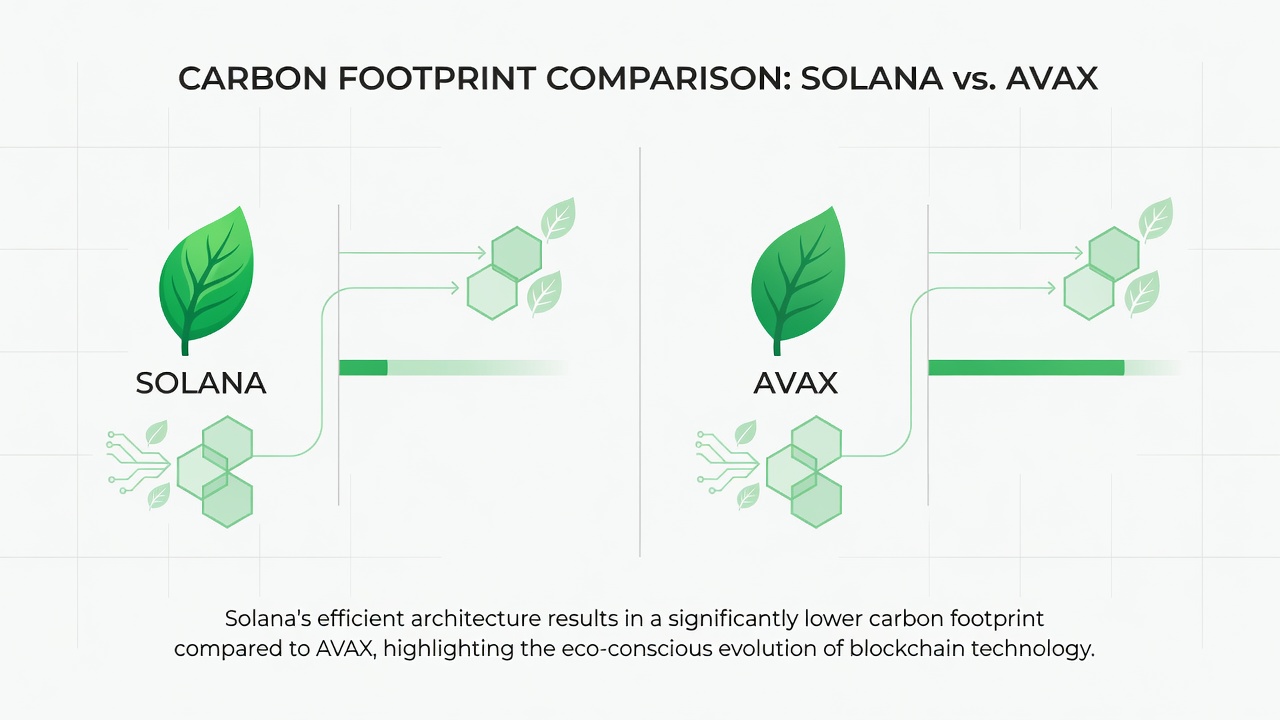
Direct comparisons reveal that both Solana and AVAX operate with carbon emissions orders of magnitude below proof-of-work chains. Independent analyses consistently rank them among the most efficient large-scale networks. Solana has implemented ongoing carbon offset purchases, while Avalanche supports community-driven reforestation and renewable energy initiatives. According to data referenced by the International Energy Agency, proof-of-stake networks like these can achieve energy reductions exceeding 99 percent relative to older models. Users seeking low-impact options can verify these programs through transparent on-chain reporting and third-party audits. These efforts demonstrate how layer 1 altcoins can scale without proportional environmental costs, offering clear advantages for responsible investors.
Real-World Case Studies of Eco-Friendly dApps
Several decentralized applications showcase practical sustainability. On Solana, carbon-credit marketplaces enable transparent tokenization of verified offsets, allowing users to retire credits directly on-chain with immutable records. Avalanche hosts green DeFi protocols that prioritize energy-efficient liquidity pools and incentivize low-carbon staking pools through reward mechanisms tied to verified renewable usage. Additional examples include supply-chain tracking dApps on both networks that monitor and reduce emissions in real time by integrating IoT data with blockchain ledgers. These case studies illustrate measurable reductions in transaction-related emissions when projects migrate to these platforms, providing templates that other teams can replicate for similar environmental gains.
Partnerships with Green Tech Projects
Both ecosystems actively collaborate with environmental organizations. Solana has partnered with renewable energy tracking initiatives, while Avalanche supports climate-focused DAOs that fund reforestation through tokenized incentives. Such alliances extend blockchain utility beyond finance into verifiable ecological outcomes. Explore official resources for deeper insight: Solana’s official documentation for technical sustainability details, Avalanche’s network overview for subnet and offset information, and International Energy Agency reports on blockchain energy trends.
Practical Steps for Developers to Build Sustainable Applications
Developers can adopt the following steps to minimize environmental impact while maintaining high functionality:
- Choose energy-efficient languages and frameworks optimized for Solana or Avalanche runtimes, such as Rust for Solana programs that compile to compact bytecode.
- Implement batching and off-chain computation to reduce on-chain transaction volume, thereby lowering cumulative validator energy demands across the network.
- Integrate carbon offset APIs directly into smart contracts for automatic mitigation, ensuring every user interaction contributes to verified reforestation projects.
- Deploy on low-energy subnets when using Avalanche to isolate resource usage and tailor energy profiles to specific geographic renewable sources.
- Regularly audit code for unnecessary state growth that increases validator load, using profiling tools to identify and eliminate redundant storage operations.
- Monitor network-wide sustainability dashboards provided by each ecosystem to benchmark application performance against emerging green standards.
Following these practices ensures applications remain performant while supporting broader sustainability objectives and attracting environmentally aware users.
Tips for Users Seeking Low-Impact Staking Options
Stakers can prioritize validators with documented renewable energy usage and transparent reporting. Both networks offer delegation interfaces that display validator performance metrics, including sustainability indicators where available. Diversifying across multiple green validators further reduces individual carbon attribution. Users should also consider lock-up periods and reward structures that favor long-term, low-turnover participation, which minimizes additional network overhead. Reviewing recent network reports before committing assets helps ensure alignment with personal environmental standards and maximizes the positive impact of staking activities.
Measuring Blockchain Sustainability and Common Pitfalls
Measuring personal or project-level impact involves tracking transaction volumes, estimating kWh per operation using public network data, and subtracting verified offsets. Tools from ecosystem explorers simplify these calculations. Common mistakes to avoid include selecting validators solely based on yield without checking energy sources, overlooking subnet-specific rules on Avalanche, and failing to update applications as efficiency standards evolve. Investors should also watch for greenwashing claims by demanding third-party audits rather than relying on marketing materials alone.
FAQs on Measuring Blockchain Sustainability
How is blockchain energy consumption typically measured?
Analysts calculate kilowatt-hours per transaction or per validator, often comparing results against traditional payment networks. Tools from reputable research organizations provide standardized methodologies that account for hardware variations and network utilization rates.
What metrics indicate a truly sustainable layer 1?
Key indicators include low kWh per transaction, verified carbon offset volumes exceeding emissions, high renewable energy percentages among validators, and transparent public dashboards updated at least monthly.
Can staking contribute to carbon reduction?
Yes, selecting validators powered by renewables and participating in offset programs directly supports lower network emissions while generating returns for participants.
How do Solana and AVAX compare to other layer 1s in 2026?
Both maintain significantly lower footprints than many competitors, with ongoing improvements through community proposals and technical upgrades focused on further efficiency gains.
Conclusion
Solana and AVAX demonstrate that high-performance layer 1 altcoins can lead in environmental responsibility. Their consensus innovations, offset programs, and developer tools offer concrete pathways for sustainable blockchain adoption. By following the outlined steps, avoiding common pitfalls, and using the provided FAQs as reference points, participants can make informed decisions that balance technological advancement with ecological stewardship in 2026 and beyond, fostering a more responsible crypto ecosystem overall.

No comments yet. Be the first!