 CryptoChain Blog
Understanding MEV Risks in 2026 Altcoin Markets
Maximal Extractable Value (MEV) remains a critical concern for traders and developers on high-throughput Layer 1 blockchains like Solana and Avalanche. In 2026, as altcoin DeFi volumes surge, front-running and sandwich attacks continue to erode transaction value. This guide examines built-in protections, private mempool setups, and real-world protocol examples to help secure your flows. MEV occurs when validators or bots reorder, insert, or censor transactions for profit. On Solana's parallel execution model and Avalanche's subnets, these risks manifest differently than on Ethereum, demanding chain-specific tactics that account for unique consensus mechanisms and transaction throughput capabilities. Developers must recognize that MEV extraction techniques evolve rapidly. In altcoin ecosystems, particularly those handling high-frequency trading of tokens like those on decentralized exchanges, even small delays can lead to significant losses. Understanding these dynamics allows for proactive defense rather than reactive fixes after an attack has occurred. The impact extends beyond individual trades, affecting overall market liquidity and user trust in altcoin platforms when repeated exploits become public.
Traders dealing with volatile altcoins often face amplified risks during market swings, where a single sandwich attack can result in substantial slippage. Recognizing early warning signs, such as unusual pending transaction patterns, helps in deploying timely countermeasures across both chains.
Comparing Native MEV Protections on Solana and Avalanche
Solana incorporates Jito's bundle system with built-in priority fees, while Avalanche uses its Snowman consensus and emerging private transaction relays. Both chains have evolved by 2026 to include optional shielding layers that developers can activate based on transaction sensitivity. Solana emphasizes speed through its Gulf Stream protocol, which reduces mempool exposure time, whereas Avalanche leverages its primary network and custom subnets for isolated transaction environments that limit searcher visibility. This structural difference means Solana prioritizes rapid inclusion with compute unit auctions, making it efficient for high-frequency altcoin swaps but vulnerable without additional privacy layers. Avalanche's approach allows for more granular control through subnet configurations, enabling protocols to isolate sensitive flows from the broader network.
| Feature | Solana | Avalanche |
|---|---|---|
| Native Mempool | Public with Jito bundles | Subnet-level relays |
| Priority Mechanism | Compute unit pricing | Dynamic fee markets |
| Private Tx Support | Third-party integrations | Built-in shielded options |
| Attack Resistance | High throughput limits | Validator diversity |
| Typical Latency | Under 400ms blocks | Sub-second finality |
The comparison highlights that Solana excels in raw speed but requires additional layers for privacy, while Avalanche offers more flexible subnet configurations for tailored protection. Traders should evaluate these based on their specific altcoin pairs and volume requirements. For instance, Solana's model benefits meme coin traders needing instant execution, whereas Avalanche suits DeFi protocols managing complex cross-subnet altcoin bridges.
Implementing Private Mempools Step-by-Step on Solana
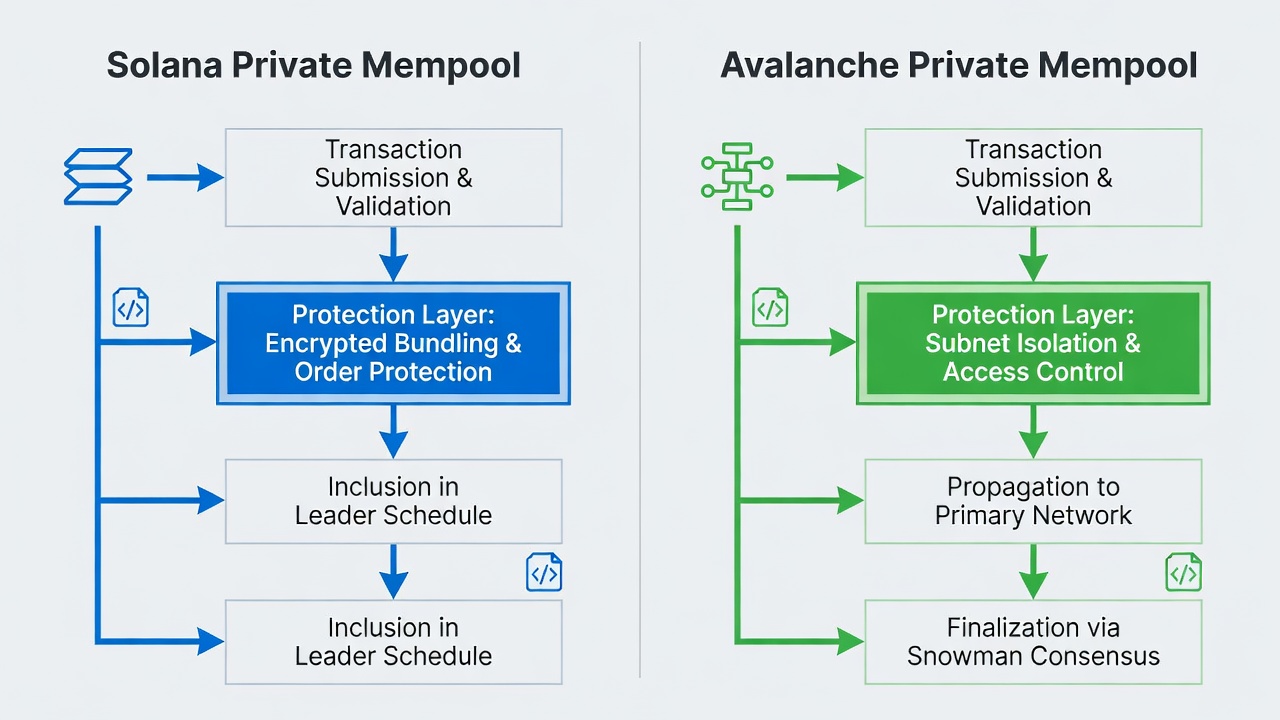
Private mempools hide pending transactions from searchers. Follow these steps for Solana: First, integrate a service like Jito or custom RPC endpoints that support encrypted routing. Second, configure your client to route transactions through encrypted channels by setting appropriate flags in your Solana CLI or SDK configuration. Third, monitor for bundle inclusion using on-chain analytics tools to verify that your transactions bypass public visibility. Fourth, test in a staging environment to ensure compatibility with your existing smart contract interactions. Fifth, implement fallback mechanisms in case the private route experiences congestion. Sixth, log all transaction hashes and compare them against public explorers to confirm shielding effectiveness. Seventh, periodically rotate RPC providers to avoid dependency risks.
const connection = new Connection('https://api.mainnet-beta.solana.com');
const tx = new Transaction().add(...);
await connection.sendTransaction(tx, {skipPreflight: true, preflightCommitment: 'confirmed'});
Implementing Private Mempools Step-by-Step on Avalanche
For Avalanche, leverage subnet-specific relays and tools compatible with the C-Chain. Begin by selecting a supported private relay provider that integrates with Avalanche's consensus. Next, update your transaction submission code to use shielded endpoints instead of standard RPC calls. Then, enable dynamic fee adjustments to prioritize inclusion without exposing details. Finally, validate the setup by simulating high-volume trades and reviewing logs for any leakage indicators. Additional considerations include ensuring compatibility with Avalanche's multi-chain architecture and testing across primary and custom subnets to prevent cross-chain MEV vectors from emerging.
Real-World Examples from DeFi Protocols
High-volume protocols on Solana such as Jupiter aggregator and on Avalanche like Trader Joe have adopted hybrid shielding. These examples show reduced slippage in volatile altcoin pairs during peak activity. Jupiter uses bundled transactions to minimize exposure windows, resulting in more predictable execution for users swapping altcoins. Trader Joe implements subnet-isolated order matching that prevents sandwich attacks by limiting mempool access. Additional cases include protocols that combine commit-reveal schemes with private channels to handle large altcoin liquidations without triggering bots. Another notable instance is a Solana-based lending platform that integrated Jito bundles for liquidation transactions, cutting MEV-related losses by routing through private paths during 2026 market events. On Avalanche, a cross-chain bridge protocol utilized shielded relays to protect altcoin transfers between subnets, demonstrating improved resilience against front-running in high-value moves.
Practical Tools Comparison and Best Practices
Selecting the right tools requires evaluating integration ease, cost implications, and security guarantees. Popular options include Jito for Solana bundles and custom Avalanche relays for subnet privacy. Always simulate transactions before submission to identify potential vulnerabilities. Use time-locked or commit-reveal patterns for large orders to add an extra layer of protection. Monitor validator behavior via public dashboards to detect anomalies early. Maintain updated client libraries to incorporate the latest network upgrades. Layering multiple techniques, such as combining native priority fees with third-party relays, often yields the strongest results for sustained altcoin trading operations.
- Regularly audit your transaction routing logic for leaks by reviewing mempool data.
- Combine multiple protection methods for layered defense against evolving threats.
- Educate team members on chain-specific MEV vectors through internal workshops.
- Track on-chain metrics for sudden increases in failed transactions indicating attacks.
- Document all configurations for easy replication across development and production environments.
Decision Framework for Choosing Protection Methods
When deciding between approaches, consider transaction volume, altcoin volatility, and technical resources. High-volume traders on Solana may prioritize speed-focused bundles, while Avalanche users focused on privacy lean toward subnet isolation. Testing in controlled settings reveals which combination best fits individual workflows.
Common Pitfalls and FAQ
What are the most frequent MEV mistakes on these chains?
Users often overlook priority fee calibration, leading to delayed inclusions that expose trades longer than necessary. Another common issue is failing to test private mempool integrations under load, which can result in unexpected reverts during market volatility.
How do private mempools affect speed?
They add minimal latency but significantly cut attack surfaces when properly configured, often improving overall execution reliability for altcoin traders.
Are there risks in relying solely on third-party relays?
Yes, dependency on external services introduces single points of failure, so hybrid approaches with native features are recommended to maintain uptime.
Can these techniques scale for institutional altcoin trading?
Yes, with proper monitoring and redundancy, they support large-scale operations while preserving transaction confidentiality.
Further reading is available at Solana and Avalanche official resources for the latest 2026 updates. Developers can also reference Mozilla Developer Network for general transaction handling best practices in web3 environments.
Conclusion
Adopting these MEV protection techniques positions altcoin users for safer operations on Solana and Avalanche in 2026. By combining native features with private mempools and vigilant monitoring, teams can minimize losses while maintaining efficient transaction flows. Looking ahead, continued network upgrades will likely introduce even more robust options, encouraging ongoing adaptation among developers and traders alike.

No comments yet. Be the first!