 CryptoChain Blog

Introduction to Oracle Integration on Solana and AVAX
Oracle networks play a critical role in delivering off-chain data to smart contracts on layer-1 blockchains like Solana and Avalanche (AVAX). In 2026, developers building altcoin-powered DeFi protocols require accurate, tamper-resistant price feeds and real-time event data to power lending, derivatives, and automated market makers. This article examines Chainlink and Pyth Network integrations, focusing on practical implementation for Solana and AVAX developers. Search intent around this topic centers on actionable guidance: how to connect oracles, compare operational costs, address 2026-specific security upgrades, and avoid common integration mistakes. Real-world DeFi examples and a dedicated FAQ section on scalability and latency round out the discussion. As altcoin ecosystems mature, the demand for reliable oracles continues to grow because smart contracts cannot access external information without trusted intermediaries.
Why Oracles Matter for Solana and AVAX L1 Altcoins
Solana and Avalanche both support high-throughput environments ideal for altcoin ecosystems, yet they remain isolated from external data sources. Without reliable oracles, price manipulation and stale data can lead to liquidations or failed executions. Chainlink provides decentralized price feeds with broad asset coverage, while Pyth focuses on high-frequency financial data from institutional sources. Developers often choose between these providers based on latency requirements and network compatibility. Both networks have seen upgrades in 2026 that improve cross-chain messaging and data verification. For instance, Solana’s parallel processing capabilities make it suitable for applications needing frequent updates, whereas AVAX subnets allow customized environments for specialized DeFi tools. Integrating oracles correctly ensures that altcoin projects can compete with established ecosystems by maintaining data integrity across volatile markets.
Chainlink Integration Strategies
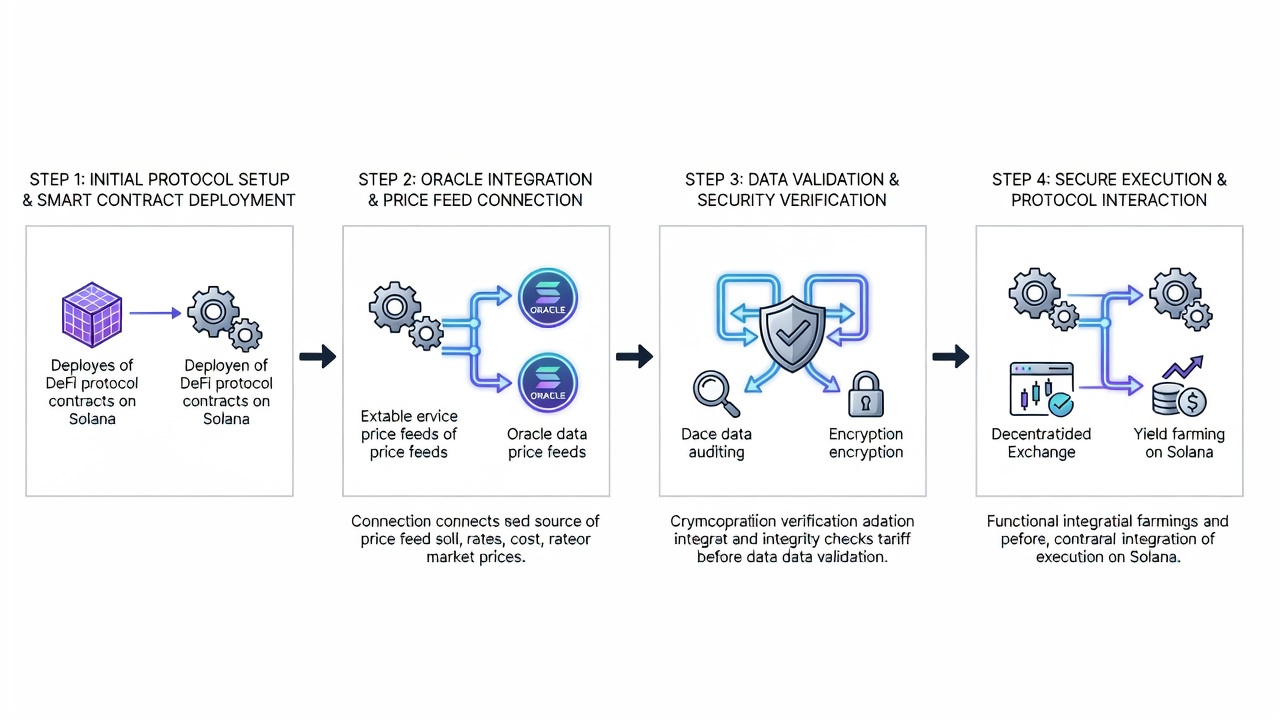
Chainlink’s decentralized oracle network aggregates data from multiple sources before feeding it on-chain. On Solana, integration typically involves the Chainlink Data Feeds program and the Solana program library. On AVAX, developers use Chainlink’s Avalanche-compatible contracts. The process emphasizes modularity so that teams can start with testnet deployments before scaling. Additional considerations include configuring heartbeat intervals and deviation thresholds to balance freshness against network load. Chainlink documentation outlines best practices for maintaining feed accuracy during network congestion periods.
Step-by-Step Setup on Solana
- Install the Solana CLI and create a new project with Anchor, ensuring all dependencies are updated for 2026 compatibility.
- Add the Chainlink program ID to your Anchor.toml configuration and verify the correct cluster endpoints.
- Write a consumer contract that calls the latestRoundData function to retrieve price data, including error handling for network delays.
- Implement additional validation logic to cross-check multiple feeds when available.
- Deploy and verify the contract on Solana mainnet or devnet, then monitor performance through on-chain analytics tools.
Similar steps apply on AVAX using Hardhat or Foundry with Chainlink’s Avalanche contracts, with extra attention paid to subnet-specific routing.
Pyth Network Integration Strategies
Pyth delivers sub-second price updates directly from exchanges and market makers. Its pull-based model reduces on-chain costs compared to traditional push oracles. This architecture suits high-frequency trading protocols where every millisecond matters. Developers benefit from Pyth’s publisher diversity, which aggregates quotes from multiple venues to minimize manipulation risks. Integration also supports custom confidence intervals that allow contracts to reject low-quality data automatically.
Step-by-Step Setup on AVAX
- Install the Pyth SDK for EVM-compatible chains and configure the appropriate network endpoints.
- Obtain a price feed ID from the Pyth network dashboard for your desired asset pair, confirming coverage for emerging altcoins.
- Implement a price update function that calls the Pyth contract’s getPriceNoOlderThan method with robust staleness checks.
- Add fallback mechanisms that switch to secondary feeds if primary data becomes unavailable.
- Handle staleness checks and fallback logic in your smart contract while testing edge cases such as flash crashes.
On Solana, Pyth offers a dedicated program that developers can invoke via CPI calls for minimal overhead, allowing seamless integration with existing Solana programs.
Cost Comparison Between Solana and AVAX Oracle Setups
Operational expenses differ significantly between the two networks. Solana generally offers lower transaction fees due to its parallel execution model, making frequent price updates more economical for high-frequency trading protocols. Avalanche provides predictable fee structures through its subnets, which can benefit projects requiring dedicated throughput. Benchmarking on testnets remains essential because fee markets can shift with overall network activity. Teams should also factor in the cost of oracle node operations and any premium features offered by providers for enhanced data granularity. Qualitative analysis shows that Solana setups often favor cost-sensitive applications, while AVAX configurations excel in environments demanding consistent performance across dedicated subnets.
Security Considerations for 2026 Upgrades
Both Solana and AVAX introduced enhanced validator security and data attestation mechanisms in 2026. When integrating oracles, always implement multi-source verification and circuit breakers that pause operations during detected anomalies. Chainlink’s on-chain reputation system and Pyth’s publisher diversity help mitigate single-point failures. Regular audits and bug-bounty participation remain essential best practices. Additional measures include using time-weighted average prices to smooth out short-term volatility and deploying proxy contracts that allow rapid feed switching without full redeployment. Developers should also monitor validator performance metrics specific to each network to anticipate potential data delivery issues during peak loads.
Real-World DeFi Protocol Examples
Several established protocols demonstrate successful oracle usage. Marginfi on Solana leverages Pyth feeds for real-time collateral valuations, while Trader Joe on Avalanche combines Chainlink and Pyth data for robust liquidation engines. Other examples include perpetual futures platforms on Solana that rely on hybrid feeds to maintain accurate funding rates and lending protocols on AVAX that use oracle-driven risk parameters to protect user funds. These implementations highlight the value of hybrid oracle strategies that balance coverage and latency while adapting to 2026 network upgrades.
Common Pitfalls to Avoid
- Relying on a single oracle provider without fallback mechanisms, which can expose protocols to downtime or manipulation.
- Ignoring network-specific gas optimizations, leading to higher costs during periods of elevated activity.
- Failing to account for data staleness windows during high-volatility periods, resulting in incorrect liquidations or missed opportunities.
- Skipping comprehensive testing across both mainnet and testnet environments, which often reveals hidden integration bugs.
- Neglecting ongoing monitoring after deployment, allowing gradual drift in data quality to go unnoticed.
Best Practices and Decision Framework
When selecting an oracle, evaluate your protocol’s latency tolerance, asset coverage needs, and expected transaction volume. Start with a proof-of-concept on testnet that simulates real market conditions. Document every configuration choice and maintain version control for all smart contract code. Engage with community forums and official support channels to stay informed about upcoming changes. This structured approach helps teams avoid costly rework and ensures long-term resilience.
Conclusion
Effective oracle integration on Solana and AVAX requires careful selection between Chainlink and Pyth based on use-case needs. By following structured setup guides, monitoring costs, and prioritizing security, altcoin developers can build resilient DeFi applications in 2026. Continuous monitoring of network upgrades will ensure long-term reliability and position projects for sustained growth.
FAQ
How do scalability upgrades in 2026 affect oracle latency?
Both networks improved parallel processing and data propagation, reducing average oracle response times by measurable margins for high-throughput applications while maintaining data accuracy.
Which oracle offers better latency for Solana-based perpetual futures?
Pyth’s pull-based architecture typically delivers lower latency on Solana, though Chainlink remains competitive for assets with broad data-source coverage and established reputation systems.
What security features should developers prioritize?
Multi-oracle aggregation, staleness checks, and emergency circuit breakers are critical regardless of the chosen provider, alongside regular audits and active participation in bug-bounty programs.
How can teams decide between Chainlink and Pyth for a new AVAX altcoin project?
Assess the specific asset pairs required, expected update frequency, and budget constraints before running comparative tests on devnet environments to identify the optimal fit.

No comments yet. Be the first!