 CryptoChain Blog
Introduction to SOL and AVAX Tokenomics in 2026
As altcoin investors evaluate Layer 1 blockchains for long-term holdings, understanding tokenomics is essential for assessing economic security and value accrual potential. Solana (SOL) and Avalanche (AVAX) both prioritize robust staking systems and usage-based mechanisms, yet their designs create distinct risk-reward profiles. This comprehensive 2026 analysis examines staking participation, fee burns, inflation dynamics, and real-world governance impacts to help holders build resilient portfolios. Tokenomics directly influence how networks resist attacks, distribute rewards, and capture value from decentralized finance activity across global users.
Staking Participation Rates and Validator Incentives
Staking participation rates serve as a primary indicator of economic security because higher rates increase the cost of any potential network attack. Solana's delegated proof-of-stake model allows token holders to delegate to validators, creating broad distribution of voting power while maintaining high throughput. In 2026, participation has remained strong due to consistent reward structures and low barriers for delegation. Avalanche employs a similar proof-of-stake approach but emphasizes subnet-specific staking, where validators secure multiple custom blockchains simultaneously. This creates differentiated incentives compared to Solana's unified validator set. Validator incentives on Solana include both inflationary rewards and a share of transaction fees, encouraging operators to maintain high uptime and hardware performance. Avalanche rewards focus on uptime plus additional bonuses for supporting active subnets, which can lead to more specialized validator pools. Practical comparison shows Solana favoring scale and speed while Avalanche rewards flexibility for enterprise and DeFi use cases. Holders benefit from reviewing validator dashboards to select participants with strong historical performance and reasonable commission rates.
Fee Burn Mechanisms and Value Accrual from Network Usage
Fee burn mechanisms tie token value directly to real usage by permanently removing tokens from circulation during transactions. Solana implements a base fee burn plus priority fee distribution that rewards validators while reducing overall supply. Avalanche uses a dynamic fee model where a portion of fees is burned based on network congestion levels, creating a counter-cyclical scarcity effect. These designs help each L1 capture value from DeFi activity such as swaps, lending protocols, and liquidity provision. When DeFi volume rises, burns accelerate, supporting long-term price stability for holders. In 2026, governance decisions on Avalanche adjusted burn percentages to better align with subnet growth, demonstrating responsive token utility improvements. Solana's community similarly explored upgrades to priority fee allocation that enhanced validator incentives without diluting holder value. Monitoring on-chain analytics reveals how burns correlate with usage spikes during market events.
Inflation Schedules and Supply Dynamics
Inflation schedules determine the rate at which new tokens enter circulation and directly affect long-term holder returns. Solana follows a disinflationary schedule with gradual reductions in issuance, aiming for eventual stability once network fees dominate rewards. Avalanche maintains a more variable emission rate tied to staking participation targets, allowing adjustments through governance. Supply dynamics differ because Solana's fixed maximum supply creates clearer scarcity narratives, whereas Avalanche's model permits flexibility for ecosystem expansion. 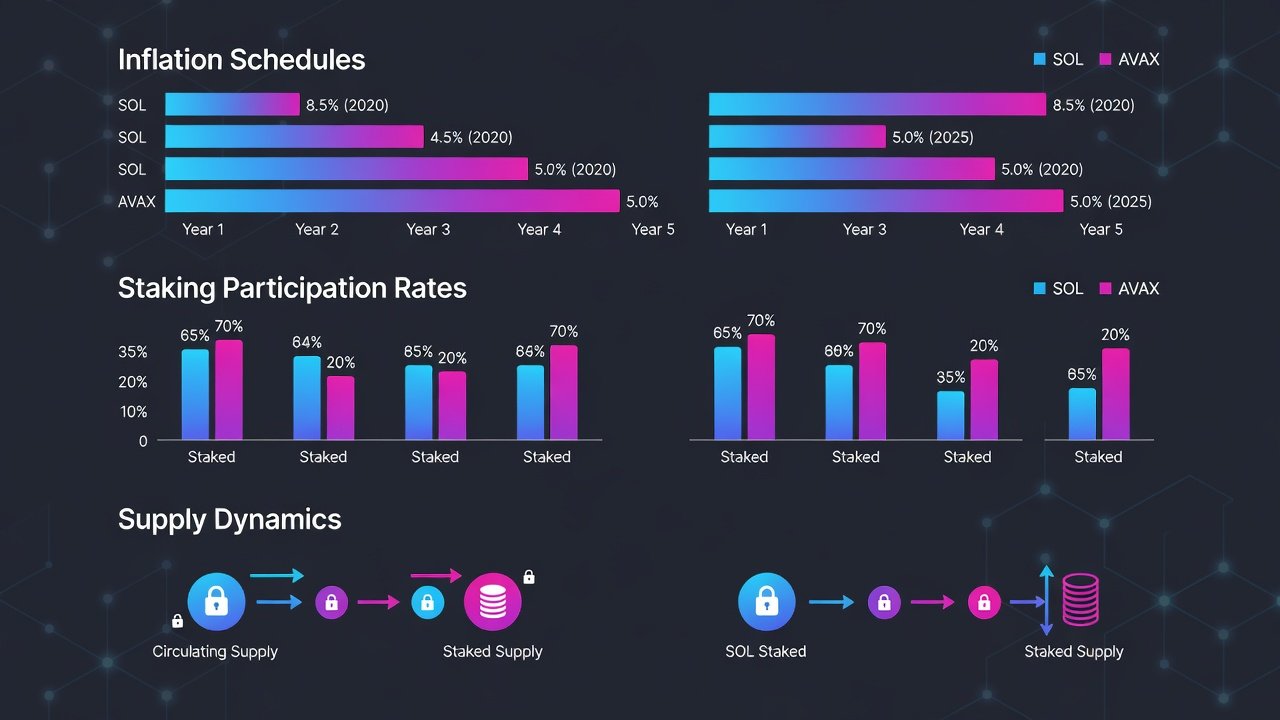
Comparing Value Capture from DeFi Activity
Value accrual from DeFi depends on how effectively each chain routes fees and usage back to token holders. Solana captures significant value through high-frequency trading and NFT marketplaces that generate consistent transaction volume. Avalanche excels in cross-chain DeFi applications and institutional subnets that attract specialized capital. Data-driven comparisons highlight Solana's advantage in raw transaction count versus Avalanche's strength in customized economic zones. Real protocol upgrades in 2026, including Solana's enhanced fee market refinements and Avalanche's subnet governance tools, have improved value routing efficiency. Holders can track these metrics through public explorers to time allocation decisions.
Practical Strategies for Sustainable Yields
Developing a sustainable yield strategy begins with diversification across both networks to mitigate chain-specific risks. Step one involves assessing current staking participation rates and selecting validators with proven reliability. Step two requires setting up delegation through official wallets while monitoring commission changes. Step three includes periodic rebalancing based on inflation schedule updates and DeFi volume trends. Common mistakes to avoid include concentrating all holdings on a single chain during high-volatility periods or ignoring governance proposals that alter reward mechanics. Another frequent error is chasing short-term yields without reviewing long-term supply dynamics. Examples from 2026 include successful holders who adjusted positions after Solana's governance vote on reward distribution and Avalanche's subnet incentive program launch. These moves preserved capital while maintaining competitive yields.
Real Protocol Upgrades and Governance Decisions Impacting Token Utility
Throughout 2026, several governance decisions have shaped token utility. Solana implemented upgrades to its fee-burning logic that increased the proportion of fees permanently removed, strengthening scarcity. Avalanche introduced new subnet reward multipliers that encouraged validator participation in emerging DeFi verticals. These changes demonstrate how community-driven decisions can enhance economic security and value accrual over time. Investors should follow official forums to stay informed about upcoming proposals that may affect staking returns or burn rates.
Mistakes to Avoid and Risk Factors
Overlooking slashing conditions or validator centralization risks can erode yields unexpectedly. Portfolio allocation should account for correlation between SOL and AVAX price movements during broader market downturns. Diversification across staking pools and maintaining liquid reserves for opportunities remain sound practices.
FAQ
What are the primary risk factors when staking SOL versus AVAX?
Key risks include validator slashing, network congestion events, and governance changes that alter reward structures. Reviewing recent participation data helps quantify exposure.
How do fee burns influence long-term value accrual?
Burns reduce circulating supply in proportion to usage, creating deflationary pressure when DeFi activity grows, though results vary with overall transaction volume.
What practical steps improve yield sustainability?
Regularly compare inflation schedules, diversify validators, and monitor governance proposals for both chains to adapt allocations proactively.
Should investors favor one chain over the other for 2026?
Allocation depends on individual risk tolerance, with Solana suiting high-throughput preferences and Avalanche fitting subnet-focused strategies.
How often should portfolios be rebalanced?
Quarterly reviews aligned with major upgrades or governance votes provide a balanced approach without excessive trading costs.
Conclusion
SOL and AVAX tokenomics deliver distinct frameworks for economic security and value accrual through staking, burns, and inflation controls. By applying the strategies outlined above and staying current with 2026 governance developments, altcoin investors can pursue sustainable yields while managing downside risks. Solana official resources and Avalanche network details offer continuous updates for informed decision-making.
No comments yet. Be the first!