 CryptoChain Blog

Introduction to High-Frequency Trading on Layer 1 Blockchains in 2026
High-frequency trading (HFT) in cryptocurrency markets demands ultra-low latency, reliable execution, and robust defenses against maximal extractable value (MEV). Solana and Avalanche (AVAX) have emerged as leading Layer 1 alternatives in the 2026 altcoins landscape due to their high throughput and sub-second finality. This guide examines practical optimization methods for deploying HFT strategies on these networks, going beyond basic overviews to provide traders with concrete implementation details.
Traders seeking edge must understand network-specific architectures. Solana's proof-of-history consensus enables parallel transaction processing, while Avalanche's subnet model offers customizable environments. Both chains support sophisticated bot frameworks that process real-time data feeds efficiently. In 2026, the competitive landscape favors chains that minimize slippage during volatile periods and allow seamless integration with centralized exchanges for arbitrage opportunities.
Network Latency Advantages: Solana vs AVAX
Solana consistently achieves average block times under 400 milliseconds, making it suitable for strategies requiring rapid order placement. AVAX delivers similar performance through its Snowman consensus, with finality often under one second on the C-Chain. Comparative benchmarks from mid-2026 show Solana maintaining higher sustained throughput during peak volatility periods, often handling thousands of transactions per second without congestion.
When evaluating reliability metrics, consider validator distribution and geographic node spread. Solana's global validator set reduces single-point failures, whereas AVAX subnets allow traders to isolate high-frequency workloads on dedicated chains for further latency reduction. Practical testing reveals that Solana excels in raw speed for simple transfers, while AVAX provides more deterministic outcomes in complex DeFi interactions. Traders should run their own latency probes using tools like custom scripts that ping multiple validators across regions to identify optimal routing paths.
Setting Up Custom RPC Endpoints for Optimal Performance
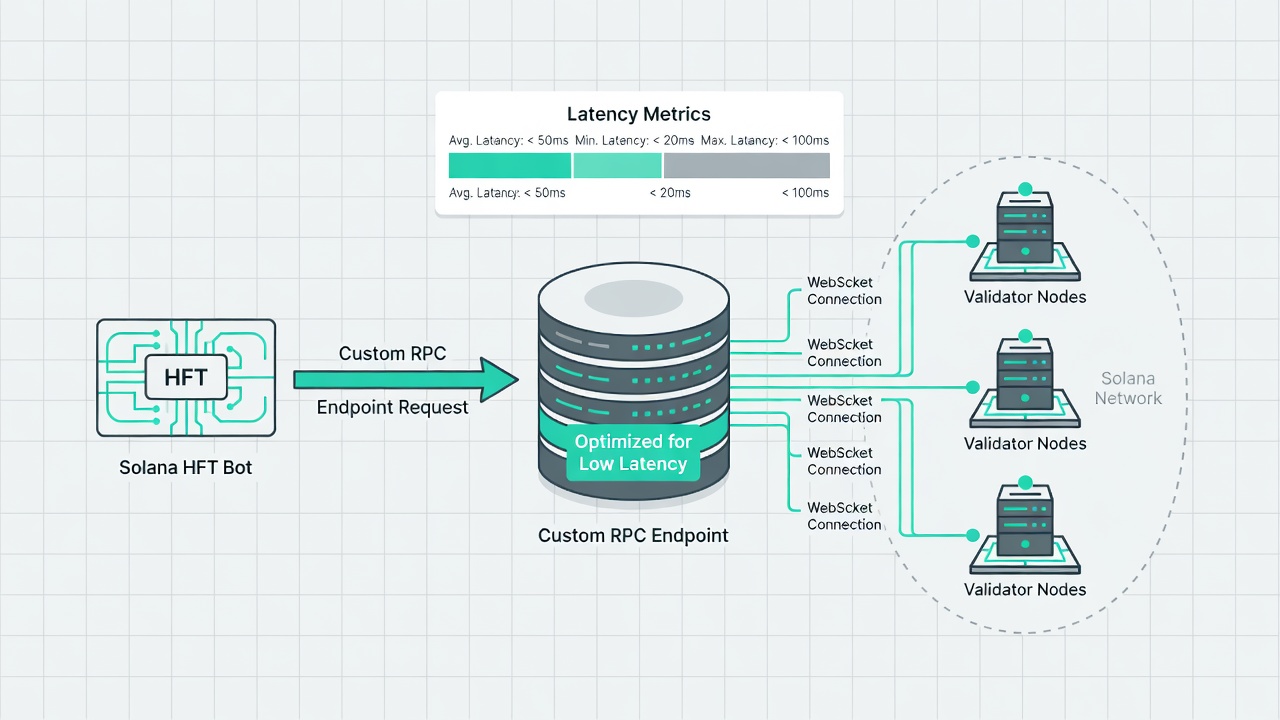
Default public RPCs introduce unacceptable delays for HFT. Custom setups using providers with dedicated nodes in low-latency regions are essential. For Solana, configure multiple fallback endpoints and implement connection pooling in your bot code. This involves selecting providers that offer dedicated infrastructure with guaranteed uptime and geographic proximity to major trading hubs such as New York and Singapore.
Practical steps include:
- Selecting providers with geographic proximity to major exchanges and testing round-trip times daily.
- Enabling WebSocket subscriptions for real-time account updates and order book snapshots.
- Implementing retry logic with exponential backoff to handle transient network issues while logging all failures for later analysis.
- Monitoring metrics such as average response time and error rates through integrated dashboards.
Similar configurations apply to AVAX, where traders often run their own nodes on subnets optimized for trading pairs. Example configuration for a Solana connection might include environment variables for primary and backup RPCs, combined with health-check loops that switch endpoints automatically when latency exceeds thresholds.
MEV-Resistant Strategies Tailored to Each Ecosystem
MEV remains a critical concern. On Solana, use priority fee auctions and private transaction channels to mitigate sandwich attacks. AVAX traders can leverage time-locked commitments within subnets to obscure order flow from opportunistic searchers. Advanced techniques include splitting large orders across multiple accounts and using just-in-time liquidity mechanisms that reduce visibility of pending transactions.
Automated bot frameworks should incorporate these protections natively. Libraries such as those built on the Solana Web3.js and AvalancheJS enable seamless integration of MEV-resistant routing logic. For instance, a strategy might detect potential MEV opportunities by monitoring mempool equivalents and adjusting execution timing accordingly, thereby preserving profit margins in competitive environments.
Real-Time Data Feeds and Automated Bot Frameworks
Accurate price oracles and order-book snapshots drive profitable HFT. Integrate multiple indexed data sources to avoid single-point manipulation. Reliable feeds come from established providers that aggregate data across decentralized exchanges on both chains. Code snippets for a basic Solana bot might look like this:
const connection = new Connection('https://your-custom-rpc.solana.com');
const subscriptionId = connection.onAccountChange(accountKey, (accountInfo) => {
  // Process update and execute trade with MEV checks
  if (validateNoSandwich(accountInfo)) {
    executeTrade(accountInfo);
  }
});
AVAX equivalents use similar event listeners within the Avalanche network, often combined with WebSocket streams for C-Chain events. Deploying these frameworks requires rigorous backtesting against historical chain data and simulation of worst-case slippage scenarios. Additional layers can include machine learning models that predict short-term price movements based on on-chain volume patterns.
Fee Optimization Examples and Execution Speed Comparisons
Transaction fees on both networks remain competitive. Optimization involves batching operations and selecting optimal compute unit limits on Solana or gas price tuning on AVAX. Execution speed tests conducted as of 2026-07-24 indicate Solana edges out in raw throughput while AVAX provides more predictable finality in subnet environments. Traders benefit from comparing these metrics across different market conditions, such as during high-volume NFT mints or major token launches.
Traders should monitor metrics such as slot utilization and cross-chain bridge delays when arbitraging between the two ecosystems. Fee optimization examples include dynamically adjusting priority fees based on recent network congestion data and using compute budget instructions to minimize unnecessary expenditure without sacrificing inclusion probability.
Practical Deployment Steps for Traders
- Choose a primary chain based on your strategy's latency tolerance and conduct a two-week pilot on testnets.
- Establish secure RPC infrastructure with monitoring alerts, including automated failover scripts.
- Develop and audit bot code for MEV resistance, incorporating multiple data source validations.
- Implement risk controls including position sizing, maximum drawdown limits, and circuit breakers that halt trading on anomalous events.
- Continuously benchmark performance against live market conditions and refine parameters weekly.
- Document all strategy parameters and maintain version-controlled code repositories for reproducibility.
FAQs on Risk Mitigation and Regulatory Considerations
How can traders mitigate smart contract risks in 2026 HFT setups?
Use audited codebases, limit exposure per trade, and maintain emergency withdrawal mechanisms. Regular security reviews are recommended, along with formal verification tools where available for critical functions.
What regulatory factors apply to automated trading on these chains?
Compliance with evolving global frameworks remains essential. Refer to official guidance from bodies such as the U.S. Securities and Exchange Commission for updates on digital asset trading rules and reporting requirements.
Are there cross-chain considerations between Solana and AVAX?
Bridge latency can erode HFT advantages. Prefer native liquidity where possible and monitor bridge security status via official project resources like Solana and Avalanche.
What common mistakes should new HFT operators avoid?
Over-reliance on a single RPC provider, neglecting to simulate extreme market scenarios, and failing to update bot logic after network upgrades are frequent pitfalls that lead to unexpected losses.
Conclusion
Solana and AVAX continue to offer compelling environments for high-frequency trading in 2026. By focusing on latency optimization, custom infrastructure, and MEV defenses, traders can build resilient strategies that capitalize on each chain's strengths. Continuous adaptation to network upgrades ensures long-term competitiveness in this dynamic space, allowing sophisticated participants to maintain an edge through meticulous engineering and ongoing performance analysis.


No comments yet. Be the first!