 CryptoChain Blog

Introduction: The Rise of Layer 1 Blockchains in Global Payments
In 2026, Solana and Avalanche (AVAX) stand out as leading Layer 1 altcoins reshaping cross-border payments. These blockchains deliver the speed, affordability, and security needed for seamless international transfers, outperforming traditional systems in efficiency. Businesses and individuals increasingly turn to these networks for micropayments and remittances, as their design prioritizes real-world utility in fintech applications. The global payments landscape has long been dominated by slow, expensive intermediaries, but Solana and Avalanche introduce alternatives that support instant settlement across borders. This shift aligns with rising demand for decentralized finance tools that integrate directly with existing payment rails while reducing friction for users in emerging markets and developed economies alike.
Scalability Advantages for High-Volume Transactions
Solana achieves high throughput through its unique Proof of History consensus combined with Proof of Stake. Avalanche uses a novel subnet architecture that enables parallel processing across custom chains. Both handle thousands of transactions per second, making them ideal for global payment volumes. These features support growing demand from e-commerce and remittance services without congestion during peak times. Scalability also allows developers to build complex payment logic, such as automated recurring transfers or conditional releases based on delivery confirmations. In practice, this means networks remain responsive even when handling millions of daily micro-transactions from mobile users worldwide.
Transaction Speed Comparisons
Speed remains critical for payments. Solana typically finalizes transactions in under a second. Avalanche achieves similar results with sub-second confirmations on its primary network. In contrast, older networks often require minutes for settlement. Real-world testing shows these advantages translate directly to user satisfaction, particularly for time-sensitive scenarios like payroll disbursements or emergency remittances. Merchants benefit from reduced cart abandonment when checkout processes complete almost instantly.
- Solana: Average confirmation under 400 milliseconds
- Avalanche: Sub-second finality on C-Chain
- Traditional banking rails: 1-5 business days for cross-border
- Other Layer 1 alternatives: often 5-30 seconds with higher variability
These metrics position both chains favorably for time-sensitive transfers and demonstrate clear differentiation from legacy infrastructure.
Fee Structures Optimized for Micropayments
Low costs enable everyday use cases like streaming payments or small remittances. Solana maintains fractions of a cent per transaction on average. Avalanche offers similarly competitive fees through its efficient validator model. This structure supports micropayments that would be uneconomical on higher-fee networks. Users can send value repeatedly without accumulating significant overhead, opening opportunities for content creators to receive micro-tips or for IoT devices to exchange small amounts autonomously. Qualitative comparisons highlight how these fee profiles encourage broader experimentation with payment innovations.
Partnerships with Payment Providers
Both ecosystems feature integrations with established fintech players. Solana collaborates with payment processors for stablecoin transfers. Avalanche supports enterprise solutions through its subnets tailored for compliance-heavy payment flows. These partnerships help bridge blockchain technology with traditional banking systems, allowing hybrid solutions where fiat on-ramps connect smoothly to on-chain settlement. Official Solana resources highlight ongoing developments in payment infrastructure. Similar details appear on Avalanche's official site. Additional context on global financial standards can be found through authoritative references such as IMF publications on digital payments.
Live Payment dApps and Real-World Examples
Applications such as Jupiter on Solana enable instant swaps paired with payment routing. On Avalanche, platforms like Benqi integrate with payment gateways for cross-border settlements. These dApps demonstrate live usage for merchants accepting crypto payments globally. Further examples include decentralized payroll tools that distribute wages across multiple countries in seconds and e-commerce plugins that convert cart totals to stablecoins automatically. Users benefit from instant settlement and reduced intermediary costs in emerging markets where traditional banking access remains limited.
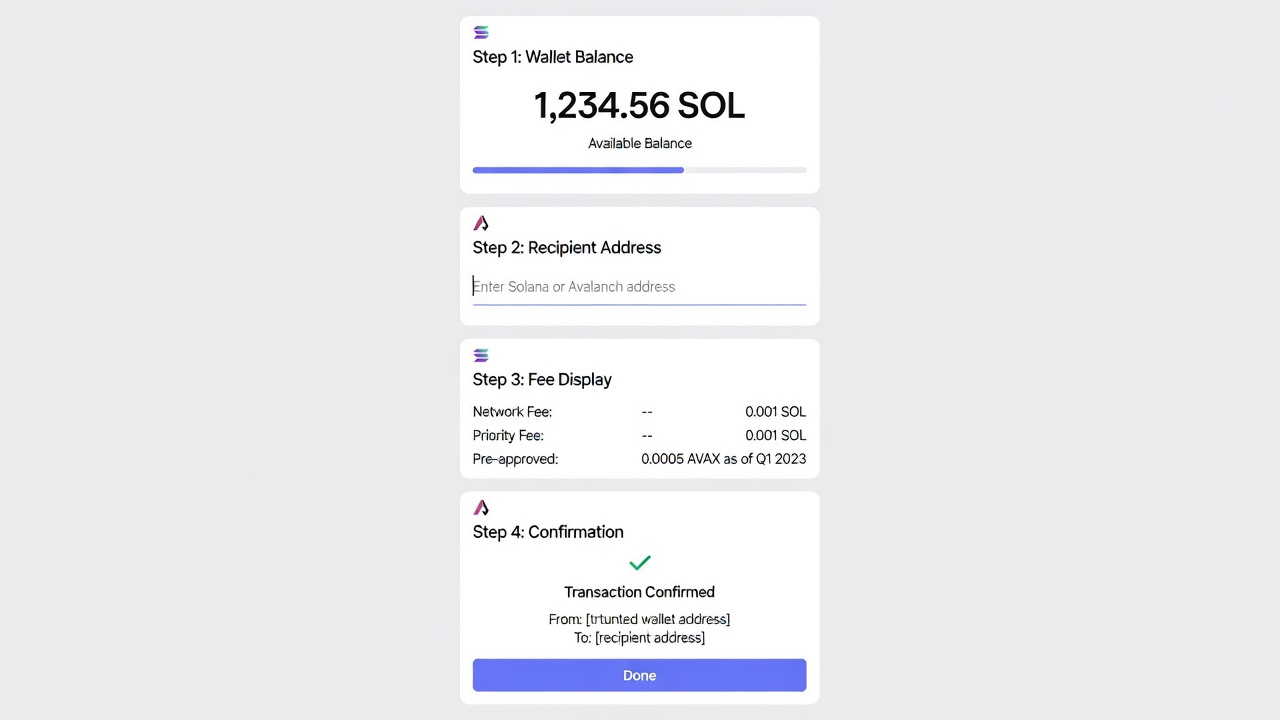
Step-by-Step User Flow for Sending Funds
Here is a practical guide for transferring value using these networks. Begin by selecting a non-custodial wallet that supports both ecosystems for maximum flexibility. Next, acquire native tokens or stablecoins through reputable exchanges and transfer them into the wallet. Enter the recipient's address carefully, double-checking for typos, then specify the amount and review any network fees displayed. Confirm the transaction via biometric authentication or hardware wallet signing. Finally, monitor the explorer link provided to verify completion, which typically occurs within seconds. This process typically completes faster than legacy wire transfers and includes built-in transparency for every step.
Common mistakes to avoid include sending to incorrect addresses without verification and neglecting to test small amounts first on new recipients. Always enable transaction previews where available and maintain updated wallet software to incorporate the latest security patches.
Security Protocols and Best Practices
Both chains employ robust consensus mechanisms resistant to common attacks. Solana uses turbine block propagation for efficiency. Avalanche relies on repeated random sampling for consensus. Users should enable multi-signature options and verify contract addresses to enhance safety. Additional best practices involve using hardware wallets for larger holdings, maintaining separate addresses for different purposes, and participating in community bug bounty programs when possible. Regular audits by independent firms further strengthen ecosystem trust and provide ongoing reassurance for payment-focused users.
2026 Trends and Forward Outlook
Expect deeper integration with CBDC pilots and expanded subnet deployments on Avalanche. Solana continues scaling through hardware optimizations and mobile-first dApps. Adoption barriers like volatility are addressed through stablecoin dominance in payment flows. Emerging trends also point toward greater interoperability between these networks and traditional payment networks, enabling seamless hybrid experiences. Developers are exploring programmable payment conditions that trigger automatically upon external data inputs, such as delivery confirmations or performance milestones.
Frequently Asked Questions
How do these chains handle volatility in payments?
Stablecoins pegged to fiat dominate usage, minimizing price swings during transfers and providing predictable value for both senders and receivers.
What adoption barriers remain in 2026?
Regulatory clarity and user education continue evolving, though wallet UX improvements accelerate mainstream access. Infrastructure gaps in certain regions are narrowing as more on-ramps appear.
Are Solana and AVAX suitable for enterprise payments?
Yes, through custom subnets and high-throughput designs tailored for compliance and volume, allowing enterprises to meet audit and reporting requirements while enjoying blockchain benefits.
What practical steps help newcomers start safely?
Start with small test transactions, research wallet security features thoroughly, and follow official documentation for each network before scaling usage.
Conclusion
Solana and Avalanche deliver compelling advantages for 2026 global payments. Their focus on speed, cost, and integration opens new possibilities for fintech innovation worldwide, positioning these Layer 1 altcoins as foundational infrastructure for the evolving payments ecosystem.

No comments yet. Be the first!