 CryptoChain Blog

Introduction to Validator Evaluation in 2026
Altcoin investors staking on Solana and Avalanche (AVAX) need more than basic APY figures to succeed in a maturing market. Validator performance directly influences long-term yields, network security, and portfolio resilience. In 2026, sophisticated metrics such as uptime, commission rates, delegation trends, slashing history, and network contribution scores provide the data-driven edge required for informed decisions. These metrics help investors move beyond surface-level staking guides and evaluate validators as critical infrastructure components rather than simple reward generators. This comprehensive guide examines each metric in depth, offering practical benchmarks, real-world examples, and monitoring techniques tailored to Solana and AVAX ecosystems. By understanding how these factors interact, delegators can optimize returns while mitigating risks like centralization and unexpected penalties.
Uptime and Reliability Benchmarks
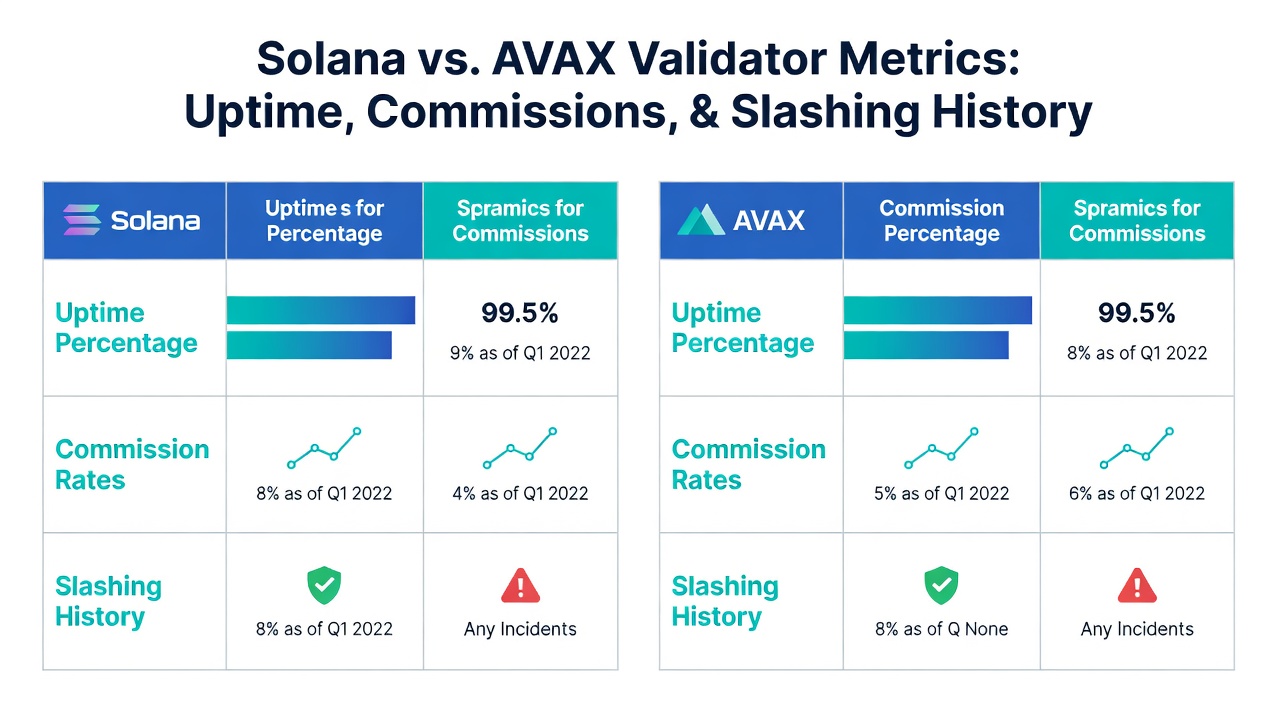
Uptime remains the foundational metric for any validator assessment. Solana validators target 99.5% or higher availability to maintain consistent block production, while AVAX validators aim for similar thresholds to avoid penalties from the network’s proof-of-stake mechanisms. Downtime reduces rewards and can trigger delegation outflows as stakers migrate to more reliable nodes. For instance, a validator experiencing repeated outages in early 2026 saw delegation drop by over 15% within weeks as investors reacted to performance data published on public explorers. Reliability also affects vote success rates, which in turn influence overall network throughput on high-speed chains like Solana.
Practical Monitoring Steps
- Access public dashboards for real-time status and historical performance charts.
- Set automated alerts for uptime falling below 99% over any 24-hour window.
- Review 90-day logs to identify patterns such as maintenance windows or geographic issues.
- Cross-reference with community forums for context on any reported incidents.
Commission Rates and Their Impact on Yields
Commission rates determine the validator’s share of staking rewards and represent a direct trade-off between operator sustainability and delegator returns. Competitive rates on Solana typically range between 5-8%, while AVAX validators often sit at 4-7%. Lower commissions boost delegator yields but must be balanced against operational quality and infrastructure investment. A validator lowering its rate from 7% to 5% in mid-2026 attracted substantial new stake, illustrating how rate adjustments influence delegation flows and can signal either aggressive growth strategies or improved efficiency. Investors should track rate changes over time rather than focusing solely on the current percentage.
Delegation Trends and Network Health
Tracking delegation trends reveals validator popularity and potential centralization risks. Over-concentrated stake on a few validators increases systemic vulnerability, especially during network stress events. Investors should favor validators with steady, diversified delegation rather than rapid spikes that may indicate temporary incentives or marketing campaigns. Monitoring these trends helps identify nodes that maintain consistent community trust across market cycles.
Solana official documentation highlights how stake distribution affects network performance and long-term decentralization goals.
Slashing History and Risk Assessment
Slashing events penalize misbehavior or extended downtime and can permanently reduce staked capital. Reviewing a validator’s slashing history is essential for risk management. Zero incidents over the past year signals strong operational standards and robust infrastructure. Any past slashes should be contextualized by severity, frequency, and the validator’s subsequent recovery actions, such as upgraded hardware or improved monitoring protocols.
Network Contribution Scores
Advanced evaluators incorporate network contribution scores that measure governance participation, vote accuracy, and infrastructure support beyond basic staking. High-scoring validators contribute to overall chain health by participating in upgrades, providing reliable RPC endpoints, and engaging in community governance. These scores are increasingly published on official explorers and serve as a differentiator when commission rates and uptime appear similar across candidates.
Comparison Tables of Top Validators
Here is a simplified 2026 benchmark comparison (data illustrative of typical top performers across both networks):
| Chain | Validator | Uptime | Commission | Slashing Incidents | Delegation Trend |
|---|---|---|---|---|---|
| Solana | Top Node A | 99.8% | 6% | 0 | Steady growth |
| Solana | Top Node B | 99.6% | 5.5% | 1 | Moderate increase |
| AVAX | Prime Validator X | 99.9% | 4.5% | 0 | Stable |
| AVAX | Prime Validator Y | 99.7% | 6% | 0 | Gradual rise |
Real Examples of Metrics Affecting Yields
Consider a Solana delegator choosing between two validators: one with 99.9% uptime and 7% commission versus another at 99.4% uptime and 5% commission. Over a full year the higher-uptime option often delivers superior net returns despite the elevated commission, especially during high-reward periods when missed blocks compound losses. On AVAX, a validator with a clean slashing record and strong contribution score maintained higher effective yields for delegators even when its commission sat slightly above the network average, because consistent participation maximized reward distribution. These examples demonstrate that isolated metrics rarely tell the full story; investors must weigh combinations of factors against their risk tolerance and investment horizon.
Centralization Risks to Monitor
Heavy stake concentration remains a key concern for both Solana and AVAX. Investors mitigate this by spreading delegations across multiple validators and regularly reviewing concentration metrics published by each network. Excessive concentration can lead to governance capture or heightened vulnerability during outages, underscoring the importance of diversification in long-term L1 altcoin portfolios.
Avalanche network resources provide ongoing transparency reports on stake distribution and validator performance.
Practical Tools and Dashboards for Ongoing Evaluation
Effective monitoring relies on a combination of official explorers, community dashboards, and on-chain analytics platforms. Users can configure custom alerts for commission changes, uptime drops, or delegation shifts. Regular reviews every quarter, supplemented by immediate checks after major network upgrades, help maintain optimal validator selections. Combining quantitative data with qualitative signals such as operator transparency and community engagement produces the most reliable evaluation framework.
FAQ: Selecting Validators for Long-Term Portfolios
How often should I review validator metrics?
Quarterly reviews are recommended, with immediate checks after major network upgrades or reported incidents to stay ahead of performance changes.
Does lower commission always mean better yields?
No. Quality uptime, low slashing risk, and strong network contribution frequently outweigh minor commission differences over multi-year holding periods.
What tools help monitor multiple validators?
Official explorers, community dashboards, and on-chain analytics platforms offer comprehensive views that aggregate the key metrics discussed throughout this article.
Should centralization influence my choices?
Yes. Diversifying across validators reduces exposure to single-point failures and supports healthier network decentralization.
How do contribution scores affect long-term staking?
Validators with high contribution scores tend to maintain better overall performance and governance influence, indirectly supporting sustainable reward rates for delegators.
Conclusion
Selecting validators for Solana and AVAX in 2026 requires a holistic approach that integrates uptime, commission, slashing history, delegation trends, and network contribution. By applying the practical steps and examples outlined above, altcoin investors can build resilient staking strategies that maximize yields while managing risks. Continuous monitoring and thoughtful diversification remain the cornerstones of successful long-term L1 portfolio management.

No comments yet. Be the first!