 CryptoChain Blog

Introduction to Bitcoin Address Clustering in 2026
As Bitcoin's network matures into 2026, analysts require sophisticated techniques to map wallet behaviors and trace entity flows beyond simple transaction volumes. Address clustering reveals hidden connections between addresses controlled by the same entity, enabling deeper intelligence for compliance, investment research, and security assessments. The growing adoption of Bitcoin across institutional and retail channels has increased the volume of on-chain activity, making manual analysis impractical. Clustering algorithms allow professionals to group addresses likely controlled by exchanges, miners, mixers, or individual users with greater accuracy.
This comprehensive guide covers practical applications of clustering algorithms, real-world examples involving exchanges, integration with public datasets, and comparisons of leading analysis platforms. Readers will gain actionable insights for risk assessment and trend identification in an evolving regulatory landscape.
Core Heuristic Algorithms for Clustering
Several established heuristics form the foundation of modern clustering. The common-input-ownership heuristic assumes that inputs to a transaction are controlled by one entity. Multi-input clustering extends this by grouping addresses across multiple transactions. Change-address detection further refines clusters by identifying outputs returning funds to the sender.
Advanced 2026 approaches combine these with machine learning to handle obfuscation techniques like CoinJoin and Lightning Network channels. Analysts apply graph-based models where addresses are nodes and transactions are edges, revealing clusters through community detection algorithms such as Louvain or Leiden methods. Additional heuristics include address reuse patterns, transaction timing correlations, and amount-based fingerprinting. These methods become essential when dealing with large datasets containing millions of addresses.
Understanding the limitations of each heuristic is critical. For example, CoinJoin transactions deliberately break common-input assumptions, requiring analysts to apply exclusion rules or probabilistic scoring.
Step-by-Step Example: Clustering a Transaction Group
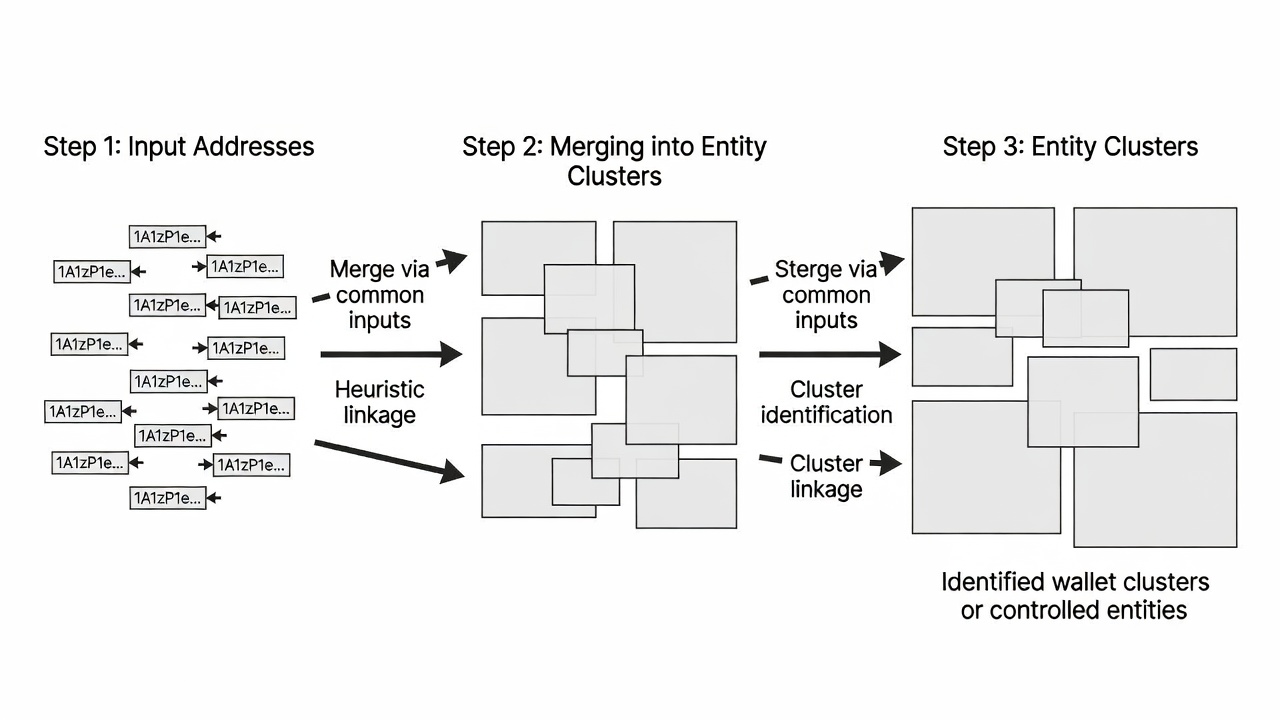
Consider a sample Bitcoin transaction cluster involving an exchange deposit. Start by collecting raw transaction data from a public explorer. Identify all inputs to a deposit transaction and apply the common-input-ownership rule to link them. Next, trace change outputs and merge with known exchange deposit patterns from public reports.
Follow these detailed steps for accurate results:
- Extract transaction IDs and input addresses using a blockchain explorer API.
- Apply the multi-input heuristic to form initial clusters by merging addresses that appear together in the same transaction.
- Identify potential change addresses by analyzing output amounts and wallet behavior patterns.
- Cross-reference clusters with known entity labels from public sources and regulatory disclosures.
- Validate clusters using timing correlations, amount distributions, and reuse frequency.
- Assign risk scores based on connections to high-risk entities such as sanctioned addresses or mixers.
- Document the final entity cluster for reporting and further monitoring.
This structured process helps identify flows from individual users to custodial services and supports compliance workflows.
Real-World Case Studies of Exchange Wallets
Exchange wallets often exhibit distinct clustering signatures due to hot and cold storage management. In documented cases, clusters reveal large-scale movements between custodial entities and on-chain mixers. Public data from regulatory filings assists in labeling these clusters accurately.
For instance, patterns observed in major exchange outflows demonstrate how clustering uncovers relationships between seemingly unrelated addresses. One notable example involved tracing funds from a compromised hot wallet through multiple hops to identify the ultimate beneficiary. Analysts combined clustering with timing analysis to link deposits from multiple users to a single exchange-controlled cluster. Such case studies highlight the importance of maintaining updated entity databases.
Learn more about Bitcoin's foundational protocol and its implications for address reuse prevention.
Integrating Public Data Sources for Enhanced Analysis
Effective clustering combines on-chain data with off-chain intelligence. Sources include regulatory disclosures, exchange transparency reports, and blockchain analytics APIs. In 2026, analysts leverage open datasets from government agencies to validate clusters and reduce attribution errors.
Public sources such as enforcement actions and court documents provide ground-truth labels that improve machine learning models. Combining these reduces false positives and improves entity attribution accuracy for trend identification. Analysts should regularly update their datasets to reflect new regulatory developments and exchange wallet movements.
Comparison of Chainalysis Alternatives
While Chainalysis remains prominent, alternatives offer specialized features for clustering. Open-source tools provide customizable heuristics, while commercial platforms emphasize real-time monitoring and visualization. Key factors for selection include data coverage, heuristic sophistication, and integration capabilities.
Popular alternatives include TRM Labs, Elliptic, and open-source frameworks built on libraries like BlockSci or custom Python scripts using graph databases. Each tool differs in user interface, API access, and support for advanced features such as entity labeling and risk scoring. Analysts should evaluate platforms based on their specific needs for risk assessment versus exploratory research, considering factors like scalability and data freshness.
Review official U.S. Treasury resources on cryptocurrency compliance and tracing.
Practical Applications for Risk Assessment
Clustering techniques directly support risk assessment by identifying exposure to sanctioned addresses, ransomware operators, or high-risk jurisdictions. Financial institutions use clustered entity data to enhance transaction monitoring systems and meet regulatory requirements. For example, clustering can flag deposits from addresses previously linked to theft or fraud, allowing for proactive account reviews.
Trend identification benefits from longitudinal cluster analysis, revealing shifts in entity behavior such as increased use of privacy tools or changes in withdrawal patterns. This information aids in forecasting market movements and detecting emerging threats.
Privacy Considerations and Best Practices
While powerful, clustering raises important privacy considerations for Bitcoin users. Analysts must balance investigative needs with ethical and legal responsibilities. Users seeking greater privacy should avoid address reuse, employ CoinJoin or similar mixing services cautiously, and leverage new protocols like Taproot for improved obfuscation.
Common pitfalls include over-reliance on a single heuristic without validation and failure to account for evolving privacy technologies. Best practices recommend combining multiple data sources and regularly auditing cluster accuracy.
Conclusion
Bitcoin address clustering techniques continue evolving in 2026, offering powerful insights when applied rigorously. By mastering heuristics, studying case examples, and integrating diverse data, analysts gain a competitive edge in on-chain intelligence and risk management.
FAQ
What are common pitfalls in Bitcoin clustering?
Over-reliance on single heuristics and ignoring privacy tools like CoinJoin can lead to inaccurate clusters. Always cross-validate with multiple data points and update heuristics as the network evolves.
How does clustering impact user privacy?
Clustering reduces pseudonymity by linking addresses to real-world entities. Users should employ best practices such as address reuse avoidance and selective use of privacy-enhancing technologies to mitigate risks.
Are there free tools for basic clustering?
Yes, several open-source options exist alongside commercial solutions, though advanced features often require paid access or custom development.
How frequently should clusters be updated?
Clusters should be refreshed at least weekly or whenever new transactions involving labeled entities appear, as wallet behaviors change rapidly.


No comments yet. Be the first!