 CryptoChain Blog
Introduction to Quantum Computing Risks in Bitcoin
Bitcoin's security relies on elliptic curve cryptography, specifically secp256k1, which underpins private key generation and transaction signing. As quantum computing advances, the potential for algorithms like Shor's to break these systems raises concerns for 2026 traders monitoring long-term holdings. This analysis examines current vulnerabilities, mitigation paths, and data-driven strategies to integrate quantum resilience into investment routines. Quantum threats are not immediate but require proactive awareness because Bitcoin's immutability means any successful attack on exposed keys could permanently compromise funds. In 2026, traders will benefit from understanding how incremental hardware improvements could accelerate risks over the following decade, allowing portfolios to adapt without panic-driven decisions.
Current Cryptographic Vulnerabilities
Bitcoin addresses are vulnerable once public keys are exposed, typically during transaction spending. Grover's algorithm could accelerate brute-force attacks on hashes, while Shor's poses a direct threat to ECDSA signatures. Research indicates that sufficiently powerful quantum computers could derive private keys from public ones in polynomial time, though no such machine exists today. Traders should note that dormant addresses with exposed keys face higher exposure risks as hardware evolves. For instance, any UTXO that has been spent once reveals its public key on the blockchain, creating a permanent record that future quantum systems might exploit. Comparisons with classical computing show exponential difficulty increases needed for quantum machines to scale attacks effectively. Current estimates suggest thousands of logical qubits are required, far beyond near-term hardware capabilities. Additional vulnerabilities include potential impacts on Bitcoin's proof-of-work hashing, though these are considered less severe than signature breaks because Grover's algorithm offers only quadratic speedup rather than exponential.
Real-world testing of smaller quantum instances has already demonstrated proof-of-concept attacks on simplified elliptic curves, underscoring the need for vigilance even if full-scale threats remain distant.
Emerging Mitigation Strategies: Post-Quantum Signatures
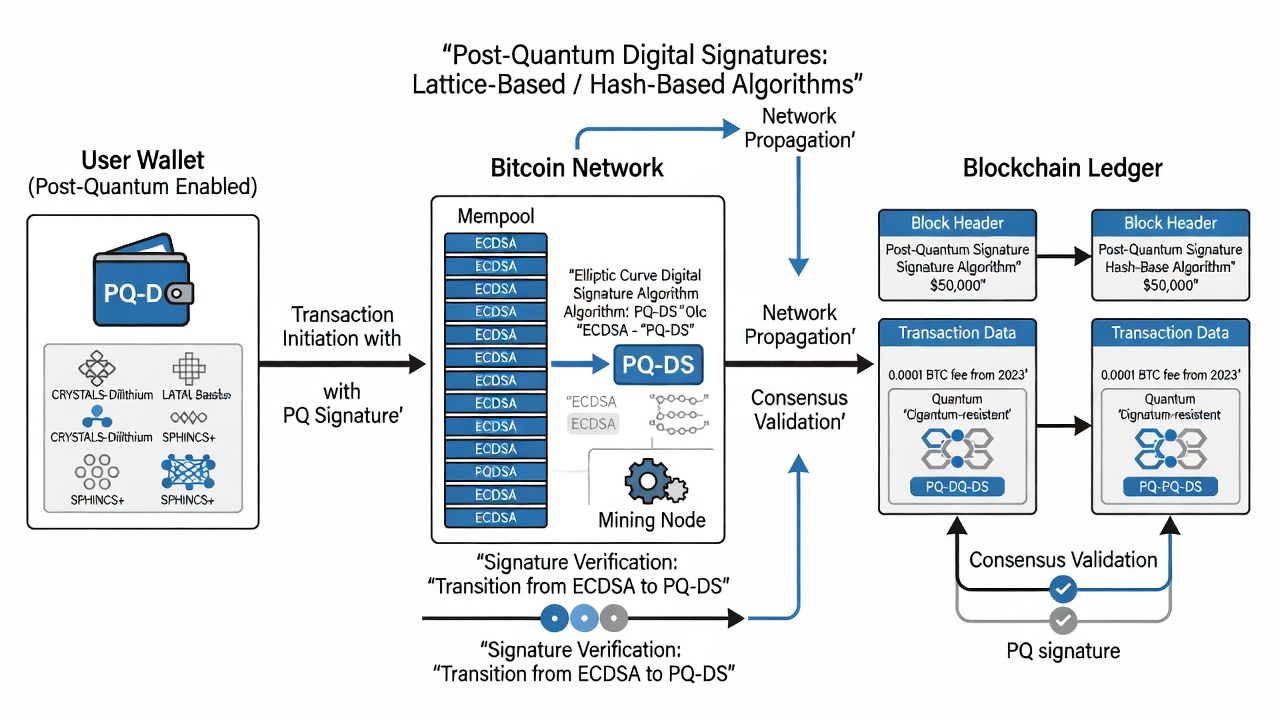
Post-quantum cryptography focuses on lattice-based, hash-based, and multivariate schemes resistant to quantum attacks. Bitcoin could adopt upgrades like those standardized by NIST, including CRYSTALS-Dilithium or SPHINCS+ for signature schemes. Soft forks or layered solutions such as quantum-resistant address formats represent feasible integration paths without disrupting the core network. These new signature methods typically involve larger key and signature sizes, which could increase transaction fees and block space usage, requiring careful optimization during any protocol upgrade. Practical adoption would involve community consensus through Bitcoin Improvement Proposals. Early experiments in sidechains and testnets demonstrate feasibility, though full mainnet deployment remains years away. NIST post-quantum standards provide benchmarks for evaluating these alternatives. Hybrid approaches that combine classical and post-quantum signatures during a transition period offer an additional layer of safety while maintaining backward compatibility for existing wallets.
Timeline Projections for Quantum Adoption
Industry roadmaps project cryptographically relevant quantum computers arriving between 2030 and 2040, with incremental progress tracked via qubit counts and error rates. For 2026 specifically, hardware is expected to reach hundreds of noisy qubits, insufficient for breaking Bitcoin but useful for testing smaller cryptographic instances. Experts anticipate continued improvements in error correction and qubit stability, potentially enabling demonstration of small-scale Shor's algorithm applications on toy cryptographic problems within the next few years. Traders can monitor metrics from sources like qubit coherence times and gate fidelity reports. Conservative models suggest Bitcoin's existing hash rate and multi-signature practices offer interim protection even as quantum capabilities grow. Annual reports from major quantum hardware developers provide useful signals for when error rates drop below critical thresholds needed for cryptanalysis.
Bitcoin Preparedness Versus Other Assets
Bitcoin's transparent ledger allows proactive address migration, unlike some permissioned blockchains with fixed cryptography. Ethereum's planned upgrades include post-quantum considerations in its roadmap, while assets like Monero emphasize privacy features that may intersect differently with quantum threats. Overall, Bitcoin benefits from its simplicity and large developer base, positioning it ahead of many altcoins in adaptability. Compared with traditional financial assets such as stocks or bonds, Bitcoin offers greater transparency for implementing upgrades but lacks the centralized governance that could accelerate change in corporate systems. Privacy-focused coins face unique challenges because quantum attacks could also compromise mixing protocols if not redesigned. Litecoin and other Bitcoin forks share similar vulnerabilities due to code lineage, making coordinated upgrades across these networks valuable for ecosystem-wide resilience.
- Bitcoin: Strong community governance and proven upgrade history
- Ethereum: Active research into hybrid cryptographic layers
- Privacy coins: Variable exposure depending on ring signature implementations
- Traditional assets: Centralized control enables faster but less transparent fixes
Practical Steps for Investors to Monitor Developments
Traders should establish routine checks of quantum computing news from academic and corporate labs. Key actions include tracking NIST and academic publications on post-quantum standards quarterly, using multi-signature wallets and avoiding address reuse to minimize exposed public keys, following Bitcoin Core development discussions for any quantum-related BIPs, and simulating portfolio adjustments by modeling scenarios where signature schemes evolve. Additional recommendations involve subscribing to developer mailing lists, reviewing quarterly hardware progress reports from leading labs, and testing quantum-resistant wallet prototypes on testnets to gain familiarity before mainnet availability. These steps integrate quantum factors into standard technical and on-chain analysis without requiring immediate portfolio overhauls. Investors may also maintain a portion of holdings in newer address formats once they become available, allowing gradual migration.
- Track NIST and academic publications on post-quantum standards quarterly.
- Use multi-signature wallets and avoid address reuse to minimize exposed public keys.
- Follow Bitcoin Core development discussions for any quantum-related BIPs.
- Simulate portfolio adjustments by modeling scenarios where signature schemes evolve.
- Review annual quantum hardware roadmaps from major research institutions.
Real-World Examples of Research Initiatives
Projects such as the Quantum Resistant Ledger explore native post-quantum implementations, while academic collaborations between universities and firms like IBM test hybrid signature schemes on blockchain prototypes. The Bitcoin community has hosted workshops on quantum readiness, and European research consortia continue funding studies on lattice-based cryptography for distributed ledgers. Additional initiatives include testnet experiments by independent developers demonstrating Dilithium-based transaction signing and joint efforts by universities in the United States and Asia to benchmark post-quantum signature performance against Bitcoin's existing throughput requirements. These real-world efforts provide concrete data points that traders can reference when assessing the pace of progress toward quantum-safe Bitcoin.
FAQ: Common Concerns About Quantum Risks
Will quantum computers break Bitcoin in 2026?
No credible timeline supports a break by 2026, as hardware scale remains insufficient according to current engineering projections.
How can holders protect existing coins?
Move funds to new addresses using best practices and monitor for protocol upgrades that introduce quantum-safe options.
Are there any immediate costs involved?
Standard wallet operations incur only network fees; no specialized quantum tools are commercially required at present.
What happens if SHA-256 is also threatened?
Current analysis shows Grover's algorithm provides only modest speedup, leaving proof-of-work largely intact even under quantum conditions.
Should traders sell Bitcoin due to quantum fears?
No, because mitigation strategies and community governance make a catastrophic break unlikely before upgrades are deployed.
Conclusion
Bitcoin's quantum resilience will depend on timely adoption of post-quantum cryptography and vigilant community oversight. By understanding vulnerabilities, tracking timelines, and applying practical monitoring steps, 2026 traders can position their strategies for both risks and opportunities in an evolving technological landscape. Continuous education and incremental adjustments will prove more effective than reactive measures once quantum hardware reaches critical milestones.


No comments yet. Be the first!