 CryptoChain Blog

2026 Blockchain News: How DAOs Are Transforming Corporate Governance
In 2026, decentralized autonomous organizations continue to reshape how companies approach governance, decision-making, and stakeholder engagement. Blockchain news and cryptocurrency news outlets regularly cover the rapid evolution of DAOs as they move from experimental projects to viable alternatives for traditional corporate boards. These structures leverage smart contracts to enable transparent, token-holder-driven processes that eliminate many layers of bureaucracy found in legacy organizations. As adoption grows, businesses in finance, supply chain, and technology sectors are experimenting with DAO frameworks to improve efficiency, accountability, and global participation. This article examines the latest developments, provides concrete examples, and offers actionable guidance for organizations considering a transition.
Understanding DAO Governance Models in 2026
DAOs function through programmable rules encoded in smart contracts deployed on public blockchains. Token holders submit proposals and cast votes, with outcomes executed automatically once thresholds are met. In 2026, governance models have matured beyond simple token-weighted voting. Popular approaches now include quadratic voting, which reduces the influence of large holders by making additional votes progressively more expensive, and conviction voting, where votes gain strength over time to favor sustained community support. These innovations address early criticisms of plutocracy while maintaining decentralization. Many DAOs also incorporate delegation systems, allowing smaller holders to assign voting power to trusted representatives without surrendering ownership. The result is a more nuanced balance that traditional boards struggle to replicate through periodic meetings and proxy voting.
Transparency remains a core advantage. Every proposal, vote, and treasury transaction is permanently recorded on-chain, creating an immutable audit trail that investors and regulators can review at any time. This level of openness contrasts sharply with the closed-door deliberations common in conventional corporate governance.
Real-World Case Studies of DAO Adoption
Multiple organizations have successfully implemented DAO structures in 2026. A leading decentralized finance protocol transitioned its board responsibilities to a DAO, allowing token holders to vote on protocol upgrades and treasury allocations exceeding several million dollars. The change accelerated feature releases and increased community retention by giving users direct influence over product direction. In the supply-chain sector, a mid-sized logistics company adopted a DAO for vendor selection and contract approvals. Participants used on-chain voting to evaluate bids, resulting in a 40 percent reduction in approval time compared with previous board processes. Another example comes from a renewable energy startup that formed a DAO to manage community investment pools, distributing returns automatically based on proposal outcomes. These cases illustrate how DAOs can handle complex operational decisions while maintaining regulatory compliance through hybrid legal structures. Observers in blockchain news note that such transitions often begin with limited-scope pilots before expanding to full governance responsibilities.
Ethereum Foundation resources continue to serve as a primary reference for developers building the underlying smart contract infrastructure that powers these real-world implementations.
Voting Mechanisms and Treasury Management Updates
Advanced voting systems in 2026 incorporate safeguards against manipulation. Time-locked voting periods prevent last-minute vote swings, while reputation-weighted systems reward consistent, constructive participation. Many DAOs now integrate off-chain signaling tools that feed into on-chain execution, allowing broader discussion before formal votes occur. Treasury management has similarly evolved. Automated dashboards track fund performance in real time, and multi-signature requirements combined with role-based access controls reduce single-point failure risks. Yield-generation strategies are increasingly common, with treasuries allocated across diversified DeFi protocols under community-approved parameters. Recent cryptocurrency news highlights how these tools help DAOs maintain purchasing power amid market volatility without requiring constant manual intervention.
Regulatory Hurdles Highlighted in Blockchain Updates
Regulatory uncertainty remains one of the most significant barriers to widespread DAO adoption. Different jurisdictions apply varying classifications, with some treating governance tokens as securities and others focusing on the legal status of DAO members. In the United States, ongoing guidance from the Securities and Exchange Commission influences how organizations structure their entities. SEC guidance continues to emphasize the importance of clear disclosure and investor protections. Companies launching DAOs often establish legal wrappers such as limited liability companies or foundations in favorable jurisdictions to shield participants from personal liability while preserving on-chain decentralization. Data-privacy regulations and cross-border voting requirements add further complexity that legal and technical teams must address during the design phase.
Comparing Traditional Boards and DAO Structures
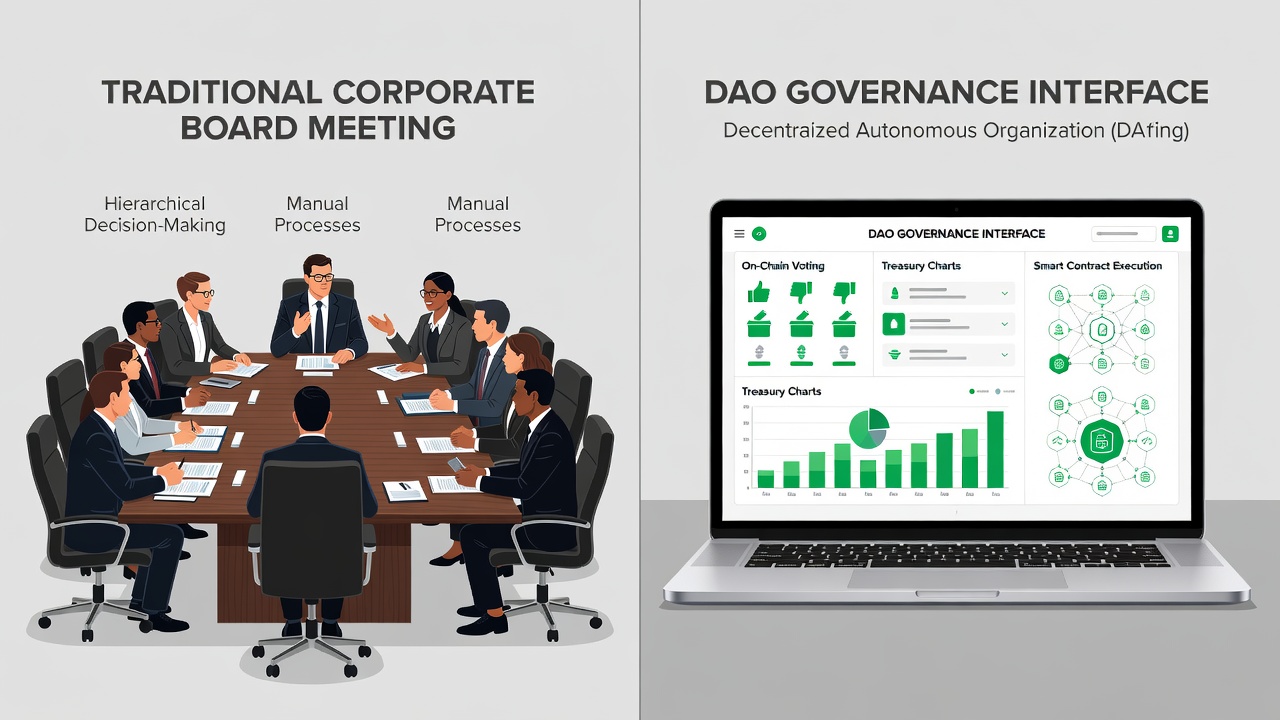
The differences between traditional corporate boards and DAO governance extend beyond technology. Traditional boards typically consist of a small group of appointed directors who meet at fixed intervals, limiting responsiveness to fast-moving market conditions. In contrast, DAOs enable continuous, asynchronous participation from a global token-holder base. Decision speed improves dramatically because proposals can be submitted and voted on without scheduling constraints. Transparency also differs significantly: board minutes remain private unless disclosed, whereas DAO activity is publicly verifiable. Inclusion expands as well, since anyone acquiring governance tokens can participate rather than relying on nomination processes. Accountability strengthens through immutable records that replace periodic external audits. However, DAOs face challenges around low voter turnout and the need for clear dispute-resolution mechanisms that traditional legal systems already provide.
Practical Steps for Launching a Compliant DAO
Organizations planning a DAO should follow a structured approach to maximize success and minimize risks. Begin by drafting a comprehensive governance whitepaper that defines token distribution, voting thresholds, and proposal categories. Next, select a blockchain with mature tooling and security audits. Engage specialized legal counsel early to determine whether a hybrid entity structure is necessary. Develop and test smart contracts in a staging environment, paying particular attention to treasury controls and emergency pause functions. Launch with a small pilot proposal to gauge community engagement and refine processes before scaling. Finally, establish ongoing education resources for token holders to encourage informed participation. These steps help avoid common pitfalls such as security vulnerabilities or governance deadlocks.
Challenges and Mistakes to Avoid
Even well-designed DAOs encounter obstacles. Low participation rates can lead to decisions dominated by a few active members. Mitigation strategies include incentive programs and simplified voting interfaces. Security remains paramount; several high-profile incidents in prior years underscore the need for multiple independent audits. Another frequent mistake involves unclear tokenomics that concentrate power among early investors. Organizations should model different distribution scenarios and incorporate vesting schedules to promote long-term alignment. Regulatory missteps can result in enforcement actions, making proactive legal review essential rather than reactive.
Future Outlook in Crypto News
Blockchain news in 2026 projects continued mainstream integration of DAOs across venture capital, nonprofit management, and even traditional corporate subsidiaries. As regulatory frameworks mature, adoption barriers will decrease, positioning DAOs as a standard option for organizations seeking greater stakeholder involvement and operational transparency. The combination of improved tooling, clearer legal pathways, and demonstrated case studies suggests that DAO governance will play an increasingly central role in corporate structures worldwide.
FAQ
What are the main benefits of DAO governance over traditional boards?
DAOs provide greater transparency through on-chain records, faster decision cycles via continuous voting, and broader inclusion by allowing any token holder to participate directly in governance.
Are DAOs legally recognized in most jurisdictions?
Legal recognition varies by country. Many organizations adopt hybrid structures that combine on-chain governance with recognized legal entities to address liability and regulatory requirements.
How do DAOs handle treasury management securely?
They rely on multi-signature wallets, automated proposal execution, real-time dashboards, and community-approved investment policies to maintain control and transparency over funds.
What regulatory risks should investors monitor?
Investors should track securities classifications, KYC obligations, cross-border compliance rules, and evolving guidance from authorities such as the SEC.
Can traditional companies transition to a DAO model?
Yes, many organizations begin with pilot programs that gradually transfer specific governance functions to a DAO while retaining necessary legal protections during the transition period.

No comments yet. Be the first!