 CryptoChain Blog

Introduction to 2026 Cross-Chain Interoperability
The cryptocurrency landscape in 2026 continues to evolve rapidly, with cross-chain interoperability emerging as a critical solution to fragmented blockchain ecosystems. Developers and investors are increasingly focused on protocols that enable seamless asset transfers, data sharing, and smart contract interactions across networks like Ethereum, Solana, and newer Layer-1 chains. This article delves into the latest advancements, providing actionable insights for navigating these developments.
Fragmented liquidity and siloed applications have long hindered growth in decentralized finance (DeFi). Cross-chain solutions address these issues by creating bridges that maintain security while boosting efficiency. As adoption grows, understanding these trends is essential for builders and investors seeking to capitalize on unified ecosystems. In 2026, the push toward interoperability is driven by the need to support complex multi-chain strategies, where users demand fluid movement of value without relying on centralized exchanges. This unification not only improves user experience but also unlocks new economic models that were previously impossible due to isolated networks.
Key Cross-Chain Protocols and Comparisons
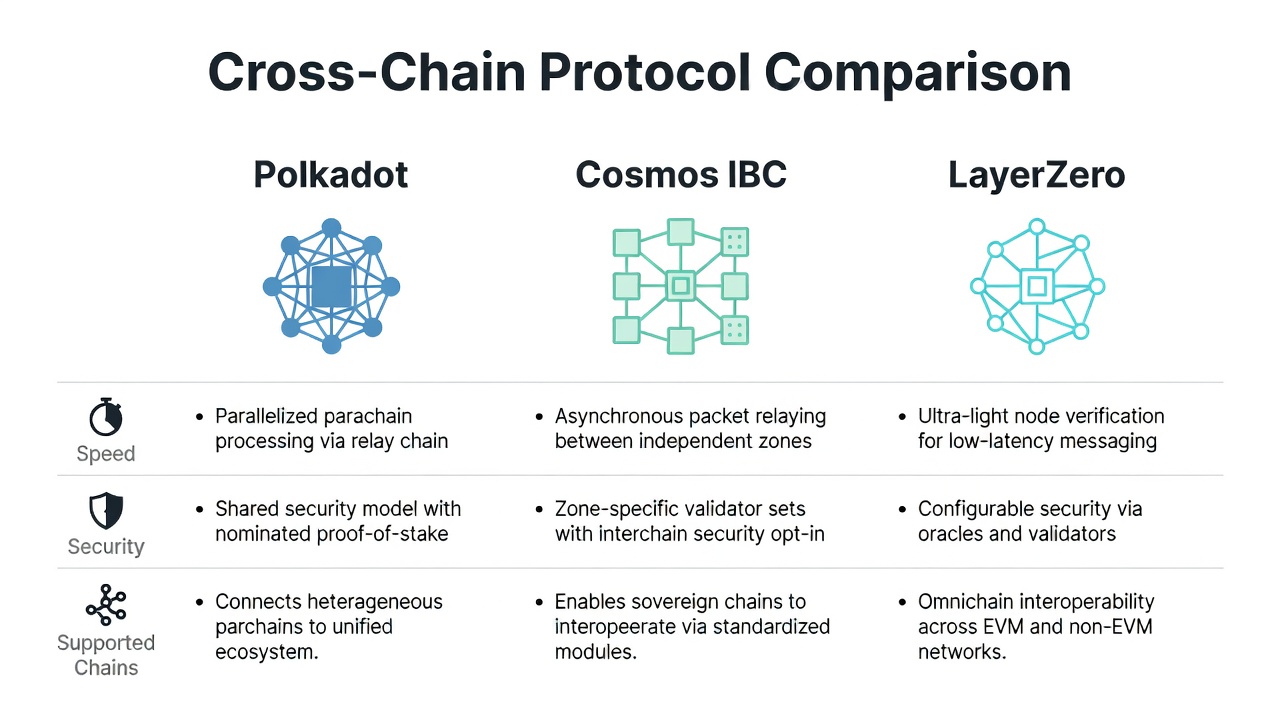
Several protocols dominate the 2026 interoperability space. Polkadot's relay chain facilitates parachain connections, allowing parallel processing across specialized networks. Cosmos employs the Inter-Blockchain Communication (IBC) protocol for sovereign chain interactions. LayerZero offers lightweight messaging for arbitrary data transfer between EVM-compatible chains and beyond. Additional players include Wormhole for secure messaging and Axelar for generalized cross-chain communication.
Comparisons reveal distinct strengths. Polkadot emphasizes shared security through its relay chain, making it ideal for projects requiring robust consensus guarantees across multiple chains. Cosmos prioritizes flexibility for independent chains, enabling developers to maintain full sovereignty while still communicating. LayerZero stands out for its gas-efficient messaging and broad chain support, often favored in high-volume DeFi applications. Benchmarks from recent tests show Polkadot achieving higher throughput in multi-chain DeFi scenarios compared to earlier versions, though exact metrics vary by implementation. Wormhole excels in speed for NFT transfers, while Axelar provides strong developer tooling for custom integrations. Choosing the right protocol depends on factors like chain compatibility, latency tolerance, and security assumptions.
Polkadot official site provides detailed documentation on these features. For broader context, explore resources at Cosmos network and LayerZero.
Real-World Integration Examples in DeFi
DeFi platforms are actively integrating these protocols. For instance, decentralized exchanges now leverage cross-chain bridges to aggregate liquidity from Ethereum and Solana pools, enabling users to swap assets without centralized intermediaries. Yield aggregators use interoperability layers to move funds dynamically across chains for optimal returns. Lending protocols connect Solana's high-speed environment with Ethereum's robust smart contract ecosystem, allowing collateralization on one chain while borrowing on another.
Consider a practical case: a user holding SOL on Solana can bridge assets to an Ethereum-based lending market using LayerZero, earning yields while retaining exposure to Solana-native opportunities. Another example involves NFT marketplaces that use Wormhole to enable cross-chain trading, letting collectors move digital assets between ecosystems seamlessly. These integrations demonstrate how interoperability reduces silos and fosters innovation, with platforms reporting increased trading volumes due to expanded liquidity access. Builders can replicate these by starting with testnet deployments to validate flows before mainnet launches.
Performance Benchmarks and Metrics
Performance evaluations in 2026 highlight improvements in latency and security. Cross-chain transactions via advanced protocols often complete in under 30 seconds with minimal fees, depending on network congestion. Security audits focus on preventing exploits common in earlier bridge designs through mechanisms like threshold signatures and oracle networks.
Developers should review official resources from Ethereum and Solana for integration guidelines. Benchmarks typically measure throughput, finality time, and resilience to attacks, guiding protocol selection based on specific use cases. For example, IBC-based transfers may prioritize finality over raw speed, suiting enterprise applications, whereas LayerZero optimizes for retail DeFi speed. Ongoing monitoring tools help track real-time performance across chains.
Practical Steps for Developers Adopting Solutions
Adopting cross-chain protocols requires careful planning. Follow these steps:
- Assess project requirements: Determine if messaging, asset bridging, or full contract execution is needed, and map out the specific chains involved to avoid compatibility issues.
- Choose a protocol: Evaluate based on supported chains, security model, and developer tooling, considering factors like audit history and community support.
- Implement SDKs: Use official libraries for Polkadot, Cosmos IBC, or LayerZero to handle connections, starting with simple message passing before advancing to complex asset movements.
- Test thoroughly: Simulate cross-chain interactions on testnets to identify edge cases such as network outages or high gas scenarios.
- Monitor and update: Stay informed on protocol upgrades to maintain compatibility and incorporate new features like enhanced privacy layers.
These steps help mitigate risks and ensure robust implementations. Additional best practices include using multi-sig wallets for bridge operations and documenting all integration decisions for team collaboration.
Addressing Security Risks: Common FAQs
Security remains a top concern. How do protocols prevent bridge hacks? Most now employ multi-signature schemes and zero-knowledge proofs for verification. What about smart contract vulnerabilities? Regular audits and formal verification processes reduce exposure.
Investors often ask about regulatory implications across chains. Interoperability can complicate compliance, so projects should incorporate modular designs that allow jurisdiction-specific adjustments. Another common question involves oracle reliability: many protocols now use decentralized oracles to minimize single points of failure. Always prioritize audited solutions and community-vetted protocols. Finally, users wonder about recovery mechanisms in case of failures—most advanced bridges include time-locked withdrawals and emergency pause functions to protect funds during incidents.
Forward-Looking Trends for 2026 and Beyond
Looking ahead, interoperability will likely incorporate AI-driven routing for optimal paths and enhanced privacy features using zero-knowledge technologies. Emerging chains will integrate natively, further unifying the ecosystem. Investors should monitor developments through reputable sources to position portfolios effectively. Trends also point toward standardized messaging formats that reduce integration overhead, potentially leading to a more interconnected Web3 where applications operate fluidly across dozens of chains without user friction.
In conclusion, 2026 marks a pivotal year for cross-chain advancements. By understanding protocols, examples, and best practices, stakeholders can navigate cryptocurrency news with confidence and drive meaningful innovation in the evolving blockchain space.


No comments yet. Be the first!