 CryptoChain Blog

Introduction to Decentralized Storage in 2026
The blockchain landscape in 2026 continues to evolve rapidly, with decentralized storage networks emerging as critical infrastructure for Web3 applications. As centralized cloud providers face increasing scrutiny over data privacy, censorship resistance, and single points of failure, protocols like Filecoin, Arweave, and Sia offer compelling alternatives that align with the core principles of decentralization. This article provides an in-depth comparison to help crypto enthusiasts, developers, and enterprises make informed decisions about storage solutions that can support everything from NFT metadata to large-scale enterprise archives.
Recent protocol upgrades have focused on improving scalability, reducing latency, enhancing token utility, and strengthening security models. Whether you're integrating storage into dApps, building decentralized applications that require reliable data persistence, or evaluating investment opportunities in the broader crypto ecosystem, understanding these networks' strengths and trade-offs is essential. The year 2026 has seen accelerated adoption driven by regulatory clarity in several jurisdictions and growing demand for verifiable, tamper-proof data storage solutions.
Filecoin: Latest Upgrades and Ecosystem Growth
Filecoin remains a leader in decentralized storage, emphasizing a marketplace model where providers compete on price and reliability. In 2026, the network introduced enhancements to its proof systems, enabling faster retrieval times and better support for large-scale datasets through improved proof-of-replication and proof-of-spacetime mechanisms. These upgrades have also introduced better interoperability with other blockchain ecosystems, allowing seamless data migration across networks.
Enterprise adoption examples include integrations with media companies archiving vast video libraries and research institutions storing scientific datasets for long-term accessibility. The Filecoin official site highlights ongoing developer grants that fuel ecosystem tools, including new SDKs for easier integration into existing applications. Filecoin's strength lies in its massive network capacity and active miner community, which provides competitive incentives for maintaining high uptime.
Arweave: Permanent Data Storage Focus
Arweave distinguishes itself with a one-time payment model for permanent data storage, appealing to users prioritizing immutability over frequent access. 2026 updates include improved bundling features and expanded gateway infrastructure, making data access more resilient across global nodes while enhancing query performance for developers building on its blockweave architecture.
Real-world use cases feature NFT projects archiving metadata permanently to prevent link rot and news organizations preserving historical records against potential censorship. Its unique endowment model ensures data availability without ongoing fees, setting it apart from pay-as-you-go alternatives and making it ideal for archival purposes where data must remain accessible indefinitely.
Sia: Privacy-Centric Storage Solutions
Sia emphasizes user-controlled encryption and competitive pricing through its host marketplace. Recent 2026 developments involve optimizations to the Skynet portal network, improving file sharing speeds and integration with decentralized applications while adding advanced features for customizable redundancy levels.
Adoption stories include small businesses using Sia for secure backups of sensitive financial records and developers building privacy-focused file-sharing apps that leverage end-to-end encryption. The protocol's emphasis on renter-host agreements provides granular control over storage parameters, appealing to users who require high levels of customization and data sovereignty.
Performance Benchmarks: Scalability and Costs
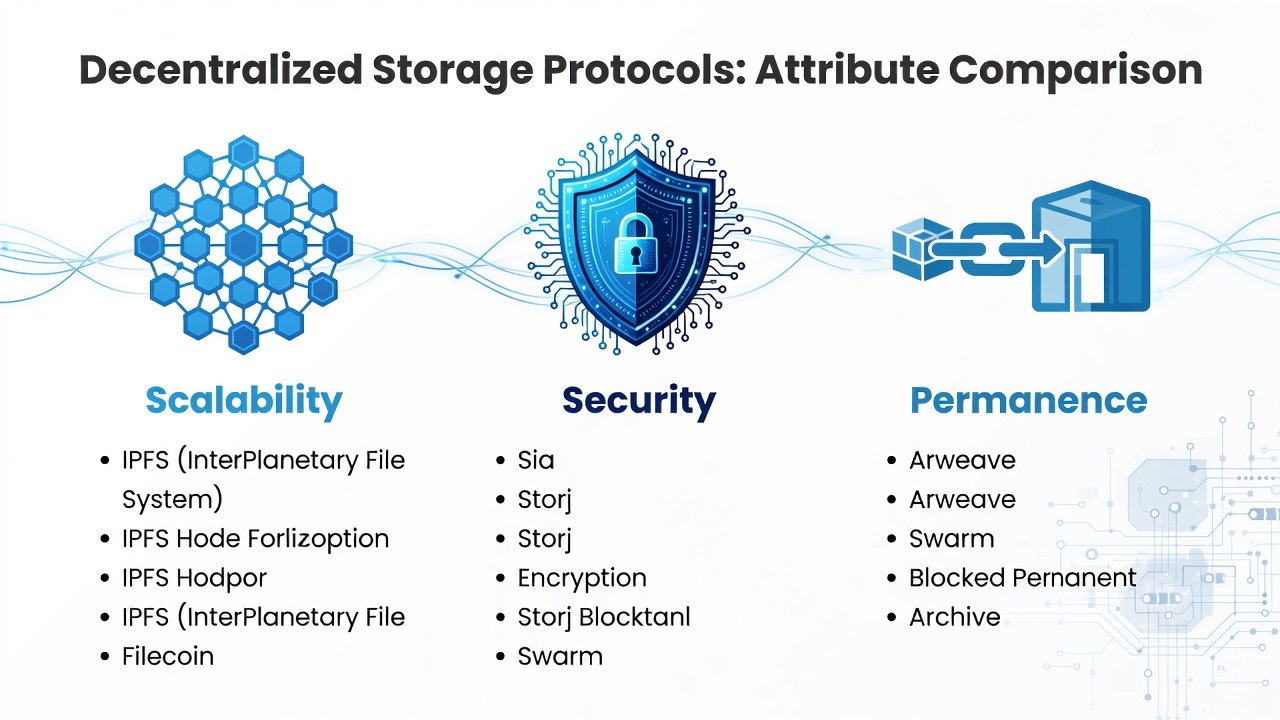
Evaluating these networks requires examining key metrics such as throughput, retrieval speed, redundancy options, and long-term viability. Filecoin excels in raw capacity with extensive available storage across thousands of nodes, while Arweave prioritizes permanence and data integrity over high-frequency access speeds. Sia offers strong performance in encrypted environments where privacy is paramount.
Scalability improvements across all three have addressed earlier bottlenecks, with better sharding techniques and refined node incentives leading to higher overall network efficiency. For cost comparisons, qualitative factors like market-driven pricing on Filecoin versus Arweave's upfront model should guide choices based on expected data lifespan and access patterns. Independent audits in 2026 have confirmed improved consistency in retrieval success rates across the board.
Enterprise Adoption Examples in 2026
Organizations are increasingly turning to these protocols for mission-critical applications. A major streaming service now leverages Filecoin for redundant backups of content libraries, ensuring availability even during regional outages. Academic consortia use Arweave for open-access research archives that require permanent verifiability, while Sia powers several fintech startups handling sensitive transaction logs with enhanced privacy controls.
These cases demonstrate practical benefits including reduced vendor lock-in, enhanced censorship resistance, and alignment with decentralized governance principles. Additional examples involve supply chain platforms storing provenance data on Sia and decentralized social networks using Arweave to preserve user-generated content permanently.
Step-by-Step Guide for Evaluating Storage Providers
- Define your data requirements, including volume, access frequency, retention period, and compliance needs. This foundational step helps narrow options quickly by matching protocol strengths to specific use cases such as temporary caching versus permanent archives.
- Assess network security features such as encryption standards, redundancy options, and resistance to common attacks like data loss or Sybil attempts. Review whitepapers and recent audit reports to verify claims about fault tolerance.
- Review recent protocol upgrades and community governance activity. Active development roadmaps and transparent voting mechanisms indicate long-term sustainability and responsiveness to user feedback.
- Test integration via developer documentation, sample deployments, and sandbox environments. Hands-on testing reveals real-world performance differences that benchmarks alone cannot capture.
- Analyze token economics for long-term sustainability, utility mechanisms, and potential volatility impacts on operational costs. Strong tokenomics correlate with healthier network participation rates.
- Compare real-world performance through benchmarks from independent auditors and community reports. Look for metrics on uptime, retrieval latency, and successful deal completion rates over extended periods.
Security Enhancements and Best Practices
All three networks have bolstered defenses against common threats like data loss and Sybil attacks through advanced cryptographic proofs and incentive alignments. Filecoin's latest verification tools, Arweave's replication proofs, and Sia's end-to-end encryption represent key advancements that improve overall trustworthiness.
Users should implement multi-provider strategies for critical data, combining strengths from multiple networks. Regular monitoring of node health and employing client-side encryption add further layers of protection in production environments.
Token Economics and Investment Considerations
Token utility varies significantly: Filecoin's FIL rewards storage providers for contributing capacity, Arweave's AR funds perpetual storage endowments, and Sia's SC facilitates direct host payments. In 2026, market trends favor networks with strong utility and active development communities. Monitoring on-chain metrics such as active deals and storage utilization provides valuable signals for adoption trends and investment potential.
Common Mistakes to Avoid
One frequent error is overlooking long-term data access patterns when selecting a provider, leading to unexpectedly high costs or performance issues. Another is neglecting to test retrieval speeds under realistic conditions before committing large datasets. Finally, ignoring governance participation can result in missed opportunities to influence protocol direction.
FAQ: Common Concerns About Data Permanence and Token Economics
How permanent is data on these networks?
Arweave guarantees permanence through its endowment model. Filecoin and Sia rely on ongoing incentives but offer high durability with proper configuration and redundancy settings.
What risks do token price fluctuations pose?
Volatility can affect storage costs indirectly through provider economics. Diversifying across protocols and using stablecoin options where available mitigates exposure.
Are these suitable for enterprise compliance?
Yes, with hybrid approaches that combine decentralized storage and traditional audits for regulatory needs, though specific requirements vary by industry.
How do retrieval speeds compare in practice?
Filecoin and Sia generally offer faster on-demand retrieval, while Arweave excels when data permanence outweighs speed requirements.
Conclusion
Decentralized storage networks like Filecoin, Arweave, and Sia each bring unique advantages to the 2026 crypto ecosystem. By focusing on upgrades, benchmarks, enterprise examples, and practical evaluation steps, readers can navigate trends effectively. The Arweave project site and Sia official resources provide further details for deeper exploration and integration guidance.


No comments yet. Be the first!