 CryptoChain Blog

Introduction to DePIN Storage Networks in 2026
Decentralized Physical Infrastructure Networks (DePIN) have transformed how data storage operates, shifting from centralized cloud providers to community-driven node operators. In 2026, storage-focused DePIN projects like Filecoin and Arweave continue to attract investors seeking passive income through node deployments. This article examines real-world case studies, token performance, node economics, and measured returns to help readers evaluate opportunities. DePIN models leverage blockchain incentives to encourage individuals and businesses to contribute physical hardware, creating resilient global networks that compete directly with traditional data centers. Operators benefit from token rewards while providing essential infrastructure for Web3 applications, archival services, and enterprise data needs. The growth in decentralized storage demand stems from increasing concerns over data sovereignty, censorship resistance, and cost efficiency compared to hyperscale cloud providers.
Understanding Filecoin Deployments
Filecoin remains a leader in decentralized storage with its proof-of-replication and proof-of-spacetime mechanisms. Operators provide storage capacity and earn rewards based on deals secured on the network. Recent case studies from 2026 highlight operators in North America and Europe achieving consistent yields through optimized hardware setups and active deal participation. Successful deployments often involve enterprise-grade servers with multi-terabyte capacities, redundant power supplies, and high-bandwidth connections. Operators in regions with lower electricity costs tend to report better margins, while those in urban areas focus on retrieval speed to capture additional fees. Network utilization has improved as more decentralized applications integrate Filecoin for data persistence, creating steady deal flow for active nodes.
Arweave Storage Network Performance
Arweave focuses on permanent data storage using a one-time payment model for perpetual access. Its blockweave architecture rewards miners for both storage and recall. 2026 deployments show strong adoption among archival use cases, with operators reporting stable economics tied to data permanence incentives. Projects archiving historical records, NFT metadata, and research datasets frequently choose Arweave, leading to predictable endowment-style rewards. Operators benefit from lower ongoing operational complexity since data is stored once and rewarded over time without constant deal renegotiation. European operators have noted particular success with compliance-friendly archival workloads that align with long-term regulatory data retention requirements.
Token Performance and Node Economics
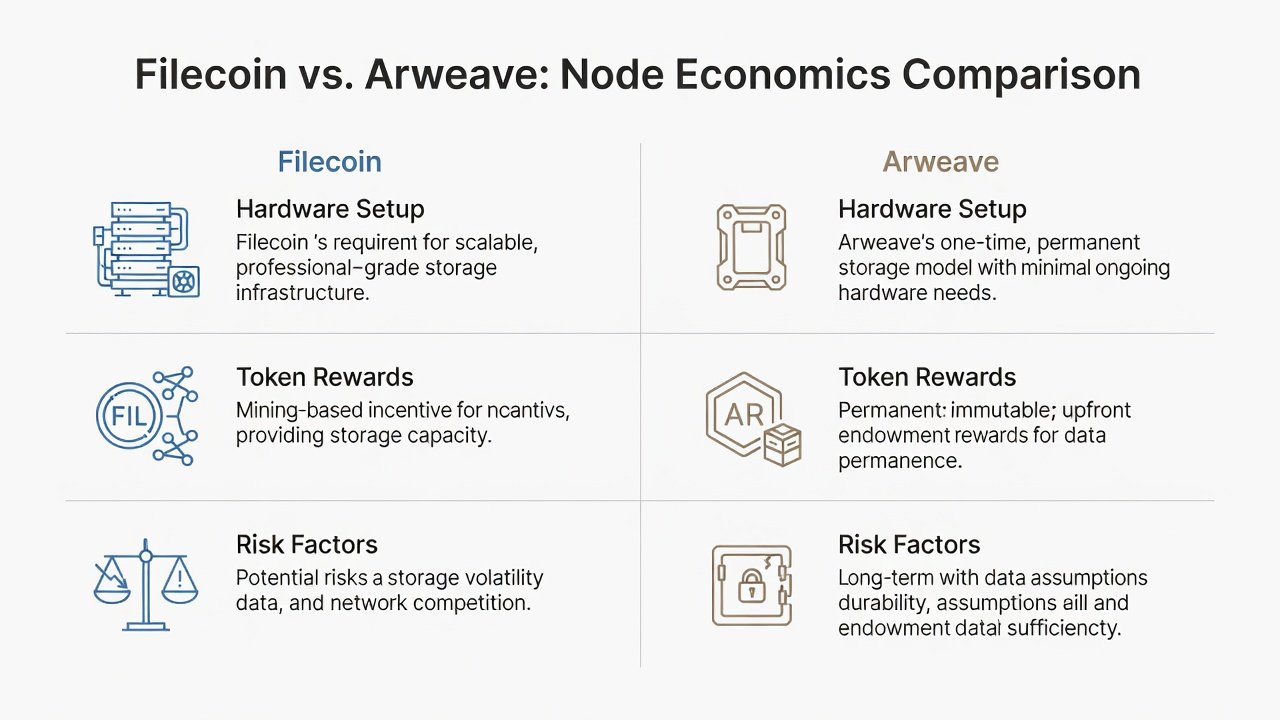
Both networks tie rewards to native tokens, with economics influenced by network demand, storage utilization rates, and hardware efficiency. Filecoin operators benefit from storage deals and retrieval fees, while Arweave emphasizes long-term endowment models. Case studies reveal differences in capital requirements and operational overhead between the two. Filecoin nodes require ongoing management to secure competitive deals and maintain high uptime, whereas Arweave nodes can operate with more set-and-forget characteristics after initial configuration. Token price fluctuations directly impact ROI calculations, making hedging strategies and diversified holdings common among experienced operators. Network growth metrics, such as total storage capacity added quarterly, provide leading indicators for future reward potential.
Measured ROI Benchmarks and Yields
Real operator reports from 2026 demonstrate varying returns based on scale, location, and maintenance practices. Benchmarks emphasize the importance of monitoring utilization metrics and energy costs. Practical evaluation includes comparing baseline performance against network averages. Larger operations with 100-plus terabytes often achieve economies of scale through bulk hardware purchases and automated monitoring tools, while smaller hobbyist nodes focus on learning and incremental scaling. Energy efficiency plays a major role in net profitability, with operators in renewable-energy-rich areas gaining an edge. Regular performance audits help identify underperforming hardware or connectivity issues that erode yields over time.
Setup Steps for Storage Nodes
Beginners can follow structured steps: select compatible hardware, install required software clients, configure network connectivity, and join storage marketplaces. Both Filecoin and Arweave provide documentation for initial deployment, with emphasis on security best practices such as wallet management and regular updates. First, research current hardware recommendations from community forums and official repositories to ensure compatibility with the latest protocol versions. Second, prepare a dedicated environment with sufficient cooling and uninterrupted power supply. Third, install the node software, generate wallet addresses, and complete any required collateral or registration processes. Fourth, test connectivity and begin accepting storage deals or uploading test data. Finally, implement monitoring dashboards to track uptime, rewards, and potential issues. Many operators start with a single node before expanding based on observed performance.
Regulatory Notes for US and EU Investors
US investors should review guidance from the Securities and Exchange Commission regarding digital asset classifications. EU participants must consider MiCA framework implications for crypto service providers. Tax reporting and compliance remain critical across jurisdictions. Operators are advised to maintain detailed records of hardware purchases, electricity expenses, and token rewards for accurate tax filings. Some jurisdictions require business licenses when operating at scale, while others treat node operation as personal investment activity. Cross-border operators should also monitor evolving rules around data localization and cross-border data transfers that could affect node placement decisions.
Comparing Incentive Models
Filecoin uses a market-driven deal system with competitive bidding, while Arweave employs a fixed endowment approach. A scannable comparison reveals trade-offs in predictability versus potential upside. Operators often diversify across networks to balance risk.
- Filecoin: Deal-based rewards with variable utilization; higher operational involvement required
- Arweave: One-time payments for permanent storage; simpler long-term economics
- Shared factors: Hardware efficiency, network growth, and token price dynamics
- Diversification benefit: Reduced exposure to single-protocol changes
Risk Factors and Practical Evaluation Checklist
Key risks include token volatility, hardware failure, regulatory shifts, and network competition. Use this checklist before committing resources: assess local electricity costs, verify hardware compatibility, review historical utilization data, understand lock-up periods, and consult legal advisors for cross-border operations. Additional considerations include insurance options for hardware, backup connectivity plans, and exit strategies should network conditions deteriorate. Operators should also evaluate smart contract risks and potential protocol upgrades that could alter reward structures.
Actionable Tips for Beginners Entering Storage Nodes
Start small with proven hardware configurations, join community forums for troubleshooting, monitor performance dashboards daily, and reinvest early rewards strategically. Diversification across Filecoin and Arweave can mitigate single-network exposure. Always prioritize security through hardware wallets and multi-signature setups. Track key performance indicators weekly and adjust configurations based on observed reward patterns. Many beginners join existing mining pools or operator communities to share knowledge and reduce individual learning curves. Regular software updates are essential to maintain compatibility and capture any new incentive programs introduced by the networks.
Short FAQ Section
What hardware is needed for Filecoin nodes?
Enterprise-grade servers with high storage capacity and reliable internet are typical starting points for competitive performance. Beginners often begin with mid-range NAS devices before scaling to dedicated racks.
How does Arweave differ from traditional cloud storage?
Arweave offers permanent data availability through a blockchain-based endowment rather than recurring subscriptions, appealing to users needing immutable long-term archives.
Are storage node returns guaranteed?
No, returns depend on network conditions, operator efficiency, and market demand, making due diligence essential before deployment.
What are common mistakes new operators make?
Underestimating electricity costs, neglecting regular maintenance, and failing to secure wallets properly are frequent issues that reduce overall profitability.
Conclusion
DePIN storage networks present compelling opportunities in 2026 for those prepared to navigate technical and regulatory landscapes. By studying Filecoin and Arweave case studies, investors can make informed decisions aligned with their risk tolerance and goals. Resources like the Filecoin official site and Arweave project site offer further technical details for implementation. Continued network development and growing adoption suggest these models will remain relevant for years ahead.


No comments yet. Be the first!