 CryptoChain Blog

Introduction to DePIN Node ROI in 2026
Decentralized Physical Infrastructure Networks, commonly known as DePIN, have matured into a significant segment of the Web3 ecosystem by 2026. These networks allow individuals and small operators to deploy physical hardware that contributes to real-world infrastructure such as wireless connectivity, decentralized storage, GPU rendering, and even energy distribution. Participants earn token rewards in return for their contributions, creating potential passive income streams. However, calculating realistic return on investment requires careful analysis of hardware expenses, ongoing operational costs, network utilization rates, and token price dynamics.
This guide serves as a practical resource for beginner to intermediate operators who want to compare ROI across wireless, storage, and energy-focused DePIN projects. It draws on current protocol data to outline benchmarks, regulatory considerations in major markets, and a straightforward framework for estimating earnings. By the end, readers will have actionable insights to evaluate whether deploying a node aligns with their financial and technical goals.
Understanding the Broader DePIN Landscape in 2026
DePIN projects operate on the principle that decentralized ownership of physical infrastructure can outperform traditional centralized models in cost efficiency and resilience. Wireless networks provide connectivity in underserved areas, storage nodes offer redundant data hosting, rendering platforms distribute computational workloads, and energy nodes facilitate peer-to-peer power trading. Each category presents unique reward mechanisms tied to supply and demand on the network.
Market adoption has accelerated as enterprises and developers seek alternatives to centralized cloud providers. Token incentives encourage geographic distribution of nodes, which improves overall network performance. Operators must therefore consider location strategy alongside hardware selection when planning deployments.
Key Factors Affecting 2026 DePIN Returns
Several interconnected elements determine net profitability. Hardware acquisition represents the primary capital outlay, ranging from compact wireless devices to multi-GPU workstations or rack-mounted storage arrays. Power consumption, internet bandwidth, and routine maintenance add recurring expenses that can erode gross rewards if not managed carefully.
Token reward benchmarks depend on protocol-specific algorithms that measure contribution quality. High-uptime nodes in high-demand zones typically accumulate more tokens. Volatility in token valuations introduces additional uncertainty, requiring operators to model conservative scenarios. Regulatory compliance also plays a role, especially for wireless spectrum use or large-scale energy installations.
Side-by-Side Comparison: Helium, Render, and Akash
Helium specializes in wireless coverage through its LoRaWAN and emerging 5G initiatives. Nodes earn tokens primarily based on data transfer volume and the number of devices they serve. Coverage in rural or suburban areas can yield steadier but lower rewards, while urban hotspots face greater competition yet higher potential throughput.
Render focuses on distributed GPU rendering for creative industries and AI training. Operators with capable graphics hardware receive jobs through a marketplace model. Utilization rates directly influence earnings, making consistent availability and fast processing speeds critical success factors.
Akash provides decentralized compute and storage capacity. Providers list available resources and earn tokens when tenants lease them via a reverse auction system. Storage-heavy configurations often attract long-term tenants, leading to more predictable revenue compared with bursty rendering workloads.
Across all three, qualitative differences emerge in setup complexity, hardware longevity, and risk exposure. Wireless nodes generally require the lowest technical expertise, while storage and compute setups demand ongoing monitoring of disk health and network latency.
Incorporating Energy Nodes into the ROI Analysis
Energy DePIN projects extend the model by allowing operators to contribute solar arrays, battery storage, or smart metering infrastructure. Rewards are typically tied to verified energy production or grid stabilization services. These projects often involve higher regulatory scrutiny around electrical codes and interconnection agreements, but they can complement wireless or storage nodes by diversifying income sources.
Building a Simple Step-by-Step Earnings Calculator
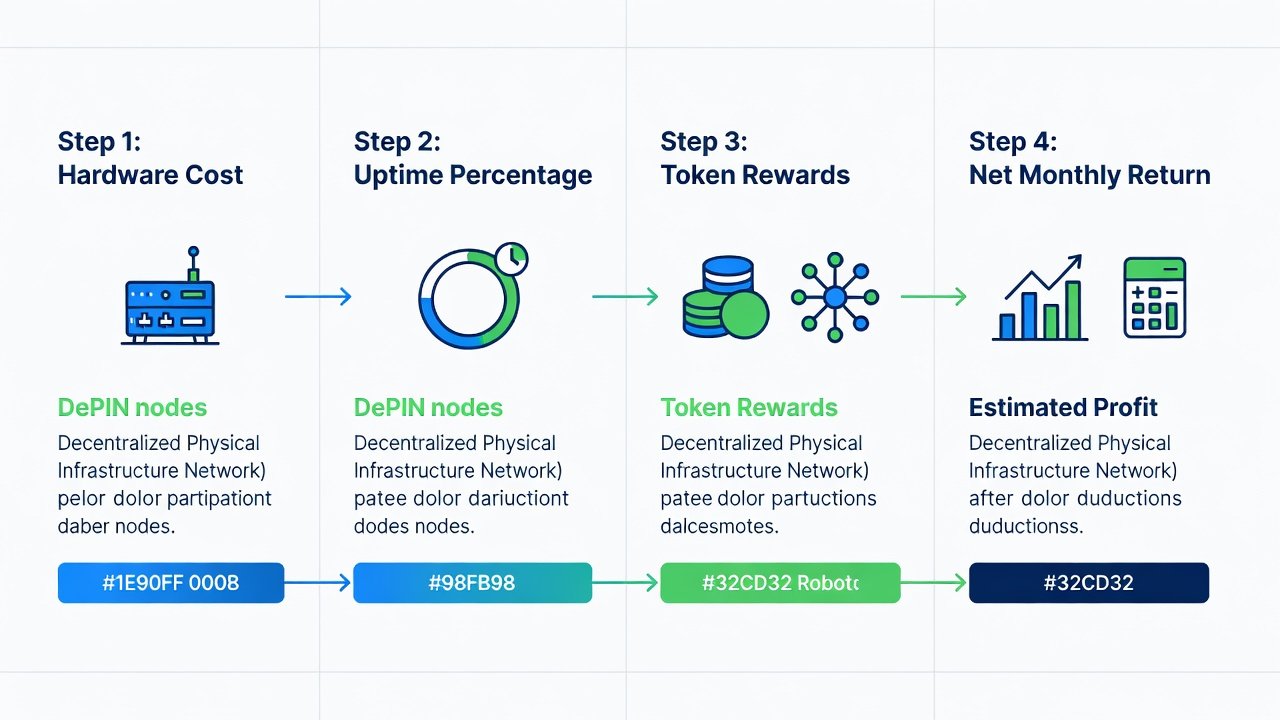
Creating a personalized projection involves gathering data from official protocol dashboards and applying basic arithmetic. Begin by documenting total hardware and installation expenses. Next, estimate average daily uptime and expected utilization based on historical network statistics. Review current reward schedules to calculate gross token accumulation, then subtract electricity and connectivity costs to arrive at net figures.
Apply a volatility buffer by modeling returns under both optimistic and conservative token price assumptions. Repeat the process for each protocol under consideration. Practical examples show that wireless nodes may deliver consistent monthly net returns in favorable locations, whereas storage and rendering nodes can experience wider variance tied to job availability and seasonal demand patterns.
Regulatory Notes for US and EU Operators
United States operators must navigate Federal Communications Commission guidelines for wireless deployments and varying state rules on data-center operations. Energy projects additionally require compliance with local utility interconnection standards. In the European Union, GDPR requirements govern data processed on storage nodes, while energy efficiency regulations affect high-power hardware choices. Early consultation with legal professionals helps avoid compliance pitfalls that could delay or derail deployments.
Security Tips and Exit Strategies
Robust security practices protect both hardware and accumulated rewards. Use dedicated hardware wallets, enable two-factor authentication on all dashboards, and maintain offline backups of critical keys. Physical security measures such as locked enclosures reduce theft risk for outdoor wireless installations.
Exit strategies should be planned from the outset. Gradual token sales help manage market impact, while hardware resale through secondary marketplaces can recover a portion of the initial investment. Keeping detailed records supports accurate tax reporting in applicable jurisdictions.
Common Pitfalls and Mistakes to Avoid
- Underestimating electricity costs in high-utilization environments can turn projected profits into losses.
- Ignoring firmware updates leaves nodes vulnerable to exploits that compromise rewards.
- Over-concentrating capital in a single protocol increases exposure to project-specific risks.
- Failing to verify local zoning or spectrum rules before installation leads to costly remediation.
FAQ on Volatility, Compliance, and Operations
How does token volatility affect net returns?
Even nodes with strong utilization can see reduced USD-equivalent earnings during market downturns. Diversification across protocols and maintaining a long-term holding perspective help smooth these fluctuations.
What compliance issues arise most often?
Common challenges include unlicensed wireless transmissions and inadequate data protection measures. Reviewing official government resources and engaging local experts minimizes these risks.
Are there minimum hardware requirements?
Each protocol publishes detailed specifications. Exceeding baseline requirements often improves reward eligibility and reduces the likelihood of downtime.
Conclusion and Actionable Next Steps
Evaluating DePIN node ROI in 2026 demands a balanced view of technical feasibility, financial projections, and regulatory realities. Operators who methodically compare wireless, storage, and energy options while prioritizing security and compliance position themselves for sustainable participation. Begin by exploring coverage and marketplace data on Helium, reviewing provider guidelines at Render, and analyzing tenant dynamics through Akash. Deploy a single test node, monitor performance over several months, and scale only after validating real-world results. Staying engaged with protocol communities ensures timely awareness of upgrades that can further enhance returns.


No comments yet. Be the first!