 CryptoChain Blog

Introduction to Crypto Custody in 2026
The landscape of digital asset storage has transformed dramatically by 2026, driven by institutional demand for robust security and seamless compliance. As blockchain adoption accelerates across global markets, custody solutions must address sophisticated threats while supporting integration with decentralized finance ecosystems. This analysis delves into emerging technologies, regulatory shifts, and practical strategies for risk mitigation that institutions are actively implementing today. Organizations ranging from hedge funds to traditional banks now view advanced custody not merely as a storage mechanism but as a strategic enabler for growth in volatile markets.
Institutions increasingly prioritize solutions that combine multi-party computation (MPC) with quantum-resistant encryption to future-proof assets against evolving cyber risks. These technologies have moved from experimental phases into mainstream deployment, offering measurable improvements in operational resilience and auditability. The following sections provide an in-depth examination supported by real-world examples and decision frameworks.
Key Security Protocols: MPC and Quantum-Resistant Encryption
Multi-party computation enables private key sharing across multiple parties without exposing the full key, significantly reducing single-point-of-failure risks that plagued earlier wallet architectures. In practice, MPC splits cryptographic operations so that no single entity ever holds the complete key material, making coordinated attacks far more difficult. Leading implementations now incorporate threshold signatures that require a minimum number of authorized nodes to approve transactions, adding an extra layer of governance control.
Quantum-resistant encryption employs post-quantum algorithms like lattice-based cryptography to safeguard against future quantum computing attacks. Quantum threats, though not yet realized at scale, pose existential risks to current elliptic curve cryptography standards. Institutions are therefore migrating to hybrid systems that layer classical and post-quantum protections. This dual approach ensures backward compatibility while preparing portfolios for the post-quantum era expected within the next decade.
These protocols enhance resilience, allowing institutions to maintain control even in distributed environments. Real-world implementations at major asset managers have demonstrated improved audit trails and reduced breach probabilities through continuous monitoring and automated key rotation mechanisms.
Regulatory Compliance Trends Shaping Custody
Global regulators continue refining frameworks for digital asset custody. In the United States, agencies emphasize segregation of client assets and regular attestations by independent auditors. SEC guidelines stress transparency in operations and clear disclosure of custody arrangements in fund prospectuses. European regulators have introduced similar requirements under MiCA, mandating that custodians maintain adequate capital reserves and implement robust cybersecurity policies.
International bodies like the Bank for International Settlements provide benchmarks for operational resilience. BIS reports highlight the need for standardized risk management in cross-border custody arrangements. In Asia, jurisdictions such as Singapore and Japan have accelerated licensing regimes that reward providers demonstrating advanced technical safeguards. Compliance now integrates automated reporting tools that align with evolving anti-money laundering standards from FinCEN. These tools reduce manual overhead while ensuring real-time visibility into transaction flows.
Provider Comparisons and Insurance Models
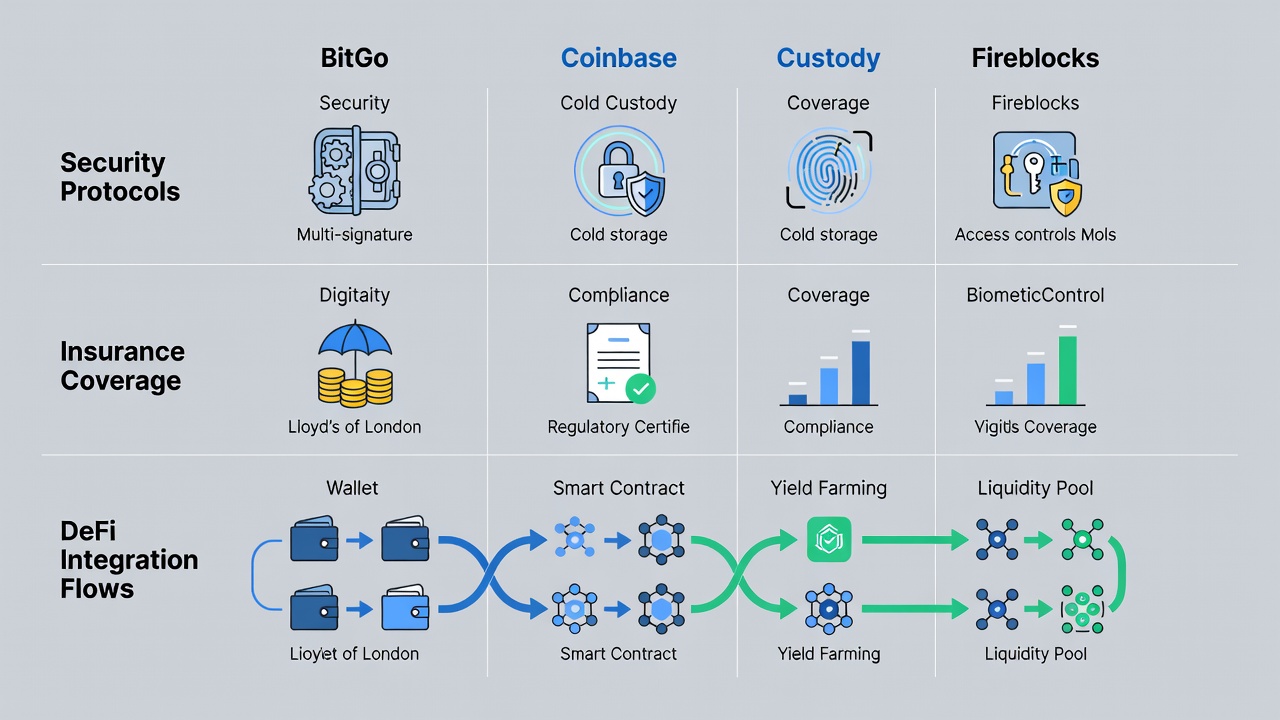
Leading custody providers differ in architecture, geographic coverage, and insurance offerings. Some emphasize cold storage hybrids that keep the majority of assets offline, while others focus on MPC-based hot wallets for liquidity needs in high-frequency trading environments. When comparing providers, institutions evaluate factors such as key generation methods, geographic redundancy of data centers, and support for multi-chain operations.
Insurance models typically cover cyber theft, with coverage structured around asset valuation and recovery protocols. Policies often include riders for social engineering attacks and insider threats. Institutions evaluate deductibles and claim processes carefully, seeking providers that offer transparent underwriting criteria and rapid response teams. A thorough comparison should include reviewing historical incident reports and third-party penetration test results.
- Assess provider track record with third-party audits from recognized firms
- Compare insurance limits relative to portfolio size and volatility exposure
- Review integration capabilities with existing treasury and accounting systems
- Evaluate response times for incident management and key recovery scenarios
- Examine client onboarding timelines and ongoing support structures
Integration with DeFi Protocols
Secure custody now bridges traditional finance and DeFi through controlled API access and smart contract whitelisting. This allows yield generation without compromising asset sovereignty or regulatory standing. Advanced platforms provide granular permissioning so that only approved protocols can interact with custodied assets, reducing exposure to smart contract vulnerabilities.
Case studies from major firms demonstrate successful pilots where custody platforms enable tokenized asset lending while maintaining regulatory compliance. One North American bank piloted a DeFi integration that generated additional returns on idle stablecoin holdings without moving assets off-platform. Such integrations require rigorous smart contract audits and ongoing monitoring dashboards that flag anomalous activity in real time.
Practical Steps for Selecting Custody Solutions
Follow these steps to choose an optimal provider that aligns with both security and business objectives:
- Define your risk tolerance and asset volume requirements by conducting an internal audit of current holdings and projected growth
- Request detailed security architecture documentation including MPC threshold configurations and quantum-resistant roadmap timelines
- Conduct proof-of-concept testing with sample transactions across multiple blockchain networks to validate performance under stress
- Review insurance policies and regulatory certifications to ensure coverage matches your jurisdiction and asset classes
- Assess long-term scalability for DeFi and institutional workflows by examining API documentation and historical uptime metrics
- Negotiate service level agreements that include clear penalties for downtime and defined escalation paths for security incidents
Real-World Case Studies
Leading financial institutions have adopted MPC-driven custody to manage multi-billion-dollar portfolios, achieving measurable reductions in operational incidents. A European investment bank integrated quantum-resistant layers ahead of regulatory mandates, positioning itself as a leader in secure digital asset services and attracting new institutional clients seeking compliant solutions. Another example involves a U.S.-based hedge fund that combined MPC custody with automated DeFi yield strategies, resulting in improved capital efficiency and reduced counterparty risk compared to traditional prime brokerage arrangements.
Common Mistakes to Avoid
Many organizations underestimate the importance of geographic diversification in key storage, leading to concentrated risk during regional outages. Others neglect regular key rotation schedules or fail to test incident response plans, leaving them vulnerable during actual events. Over-reliance on a single provider without contingency arrangements has also caused liquidity issues during platform migrations.
FAQ
What are typical costs associated with institutional crypto custody?
Fees vary based on assets under custody and service levels, often structured as percentage-based or tiered models without fixed recent public benchmarks.
How accessible are advanced custody solutions for smaller institutions?
Many providers offer scalable entry points with modular features that grow alongside adoption, including shared infrastructure options and phased implementation roadmaps.
What future innovations are expected in crypto custody?
Expect deeper AI-driven threat detection, enhanced cross-chain interoperability tools, and broader support for tokenized real-world assets by late 2026.
Conclusion
Navigating 2026 crypto custody requires balancing cutting-edge security with regulatory foresight and operational practicality. By prioritizing MPC, quantum resistance, and strategic integrations, institutions can mitigate risks effectively while capitalizing on emerging market opportunities. The evolution of these solutions continues to redefine how digital assets are protected and utilized at scale.


No comments yet. Be the first!