 CryptoChain Blog

Introduction to DAO Governance in 2026
Decentralized autonomous organizations have moved beyond experimental projects to become central players in the cryptocurrency ecosystem. In 2026, investors and participants are actively searching for insights on practical involvement and risk management within these structures. This evolution reflects broader crypto market trends driven by technological advancements and regulatory developments. As DAOs mature, their governance frameworks directly influence how communities allocate resources, make decisions, and adapt to volatile market conditions. Effective governance ensures DAOs can adapt, allocate resources wisely, and maintain community trust. Understanding these dynamics helps stakeholders navigate opportunities and pitfalls in the current landscape, where participation often requires both technical knowledge and strategic foresight.
Market participants increasingly view DAOs not merely as investment vehicles but as collaborative entities that shape protocol development and ecosystem growth. This shift demands a deeper examination of governance models to assess long-term viability and potential returns.
The Evolution of DAO Governance Models
Early DAOs relied on simple token-weighted voting, which often led to plutocracy and low participation rates. By 2026, hybrid models incorporating quadratic voting, delegation, and reputation systems have gained traction. These changes address previous shortcomings while aligning incentives across diverse participants. Historical examples show how initial designs favored large holders, leading to centralization concerns that prompted widespread experimentation with alternative mechanisms. Today, many protocols incorporate time-weighted voting to reward sustained engagement rather than one-time token accumulation.
Market data from leading protocols shows increased engagement, with governance proposals now routinely addressing sustainability, scalability, and compliance. This maturation influences wider crypto trends, including integration with traditional finance and institutional adoption. Organizations are also experimenting with AI-assisted proposal analysis to streamline decision-making processes and reduce voter fatigue.
On-Chain vs Off-Chain Governance: A Detailed Comparison
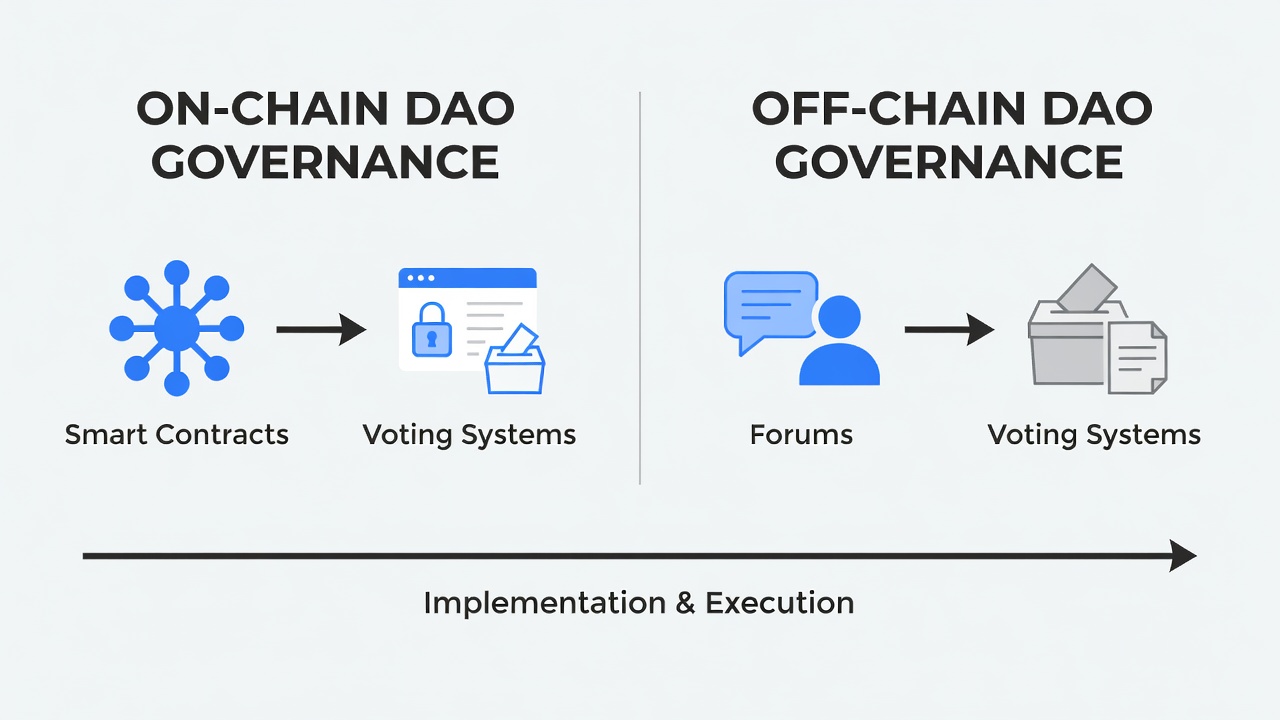
On-chain governance executes decisions directly through smart contracts, offering transparency and immutability. However, it can suffer from high gas fees and rigidity during upgrades. Off-chain governance, conducted via forums and signaling votes, allows for nuanced discussion but risks lower accountability. The choice between these approaches often depends on the DAO's size, technical infrastructure, and community preferences.
- Transparency: On-chain provides verifiable records; off-chain relies on community archives.
- Speed: Off-chain discussions accelerate consensus before formal execution.
- Accessibility: On-chain favors technically proficient users, while off-chain broadens inclusion.
- Security: On-chain reduces human error in execution but exposes code vulnerabilities.
- Flexibility: Off-chain enables iterative feedback that can refine proposals before on-chain ratification.
Many leading DAOs now combine both approaches for optimal results, balancing security with flexibility. For instance, some protocols use off-chain signaling to gauge sentiment before committing to costly on-chain votes, thereby improving efficiency without sacrificing decentralization principles.
Voting Mechanisms and Treasury Management
Modern voting systems include conviction voting, where token holders signal long-term preferences, and liquid democracy for delegated authority. These reduce whale dominance and encourage informed participation. Conviction voting allows participants to lock tokens for extended periods to amplify their influence on proposals, fostering commitment over speculation. Liquid democracy enables users to delegate votes to experts while retaining the ability to override at any time.
Treasury management has also advanced, with multi-signature wallets, automated yield strategies, and diversified asset allocations becoming standard. DAOs increasingly use on-chain analytics to forecast spending and mitigate volatility risks. Effective treasury oversight involves regular audits, diversified holdings across stable assets and productive investments, and clear spending caps to prevent overextension during market downturns.
Real-World Case Studies from Leading DAOs
Uniswap DAO demonstrates effective treasury oversight through community-voted grants that fund ecosystem growth. MakerDAO has refined its stability mechanisms via iterative governance proposals, adapting to market shifts. These examples highlight how robust frameworks drive sustained value creation. Uniswap's grant programs have supported developer tools and educational initiatives, directly contributing to protocol adoption. MakerDAO's governance has evolved to include complex risk parameters that adjust collateral requirements dynamically based on community consensus.
Additional insights from protocols like Arbitrum reveal the importance of transparent proposal pipelines and regular audits in maintaining participant confidence. Arbitrum's governance has incorporated delegate systems that allow smaller holders to pool influence effectively. Across these cases, successful DAOs prioritize clear communication channels and measurable outcomes for every major decision.
Step-by-Step Guide: Joining and Contributing to a DAO
Participation begins with research and builds toward active involvement. Follow these practical steps:
- Identify aligned DAOs by reviewing their mission, tokenomics, and governance history on official forums. Start by examining past proposals, voter turnout statistics, and treasury reports to ensure the organization's direction matches your interests and risk tolerance.
- Acquire governance tokens through reputable exchanges and store them securely in a compatible wallet. Consider using hardware wallets for larger holdings and enable multi-factor authentication to protect against unauthorized access.
- Review active proposals and participate in discussions on platforms like Discord or dedicated governance portals. Engage thoughtfully by asking clarifying questions and providing data-backed arguments rather than emotional opinions.
- Vote on proposals using your tokens, starting with smaller decisions to build familiarity. Track your voting history and reflect on outcomes to refine your strategy over time.
- Contribute value by submitting ideas, providing expertise, or joining working groups focused on development and operations. Many DAOs offer bounties or recognition for high-quality contributions, turning passive holders into active ecosystem builders.
Always assess risks such as smart contract vulnerabilities and token price fluctuations before committing significant resources. Diversifying across multiple DAOs can further reduce exposure to any single governance failure.
Regulatory Considerations for 2026
Emerging regulations are shaping DAO operations globally. Frameworks emphasize disclosure requirements and liability structures, prompting many organizations to adopt legal wrappers. Participants should monitor developments from authorities to ensure compliant engagement. Authoritative resources include U.S. Securities and Exchange Commission guidance on digital assets. Additional considerations arise from international bodies addressing cross-border token flows and taxation implications for DAO members.
Market Insights and Future Outlook
DAO governance improvements are fueling crypto market resilience, with enhanced models attracting new capital and talent. As adoption grows, expect further innovations in decentralized decision-making that could redefine organizational structures across industries. Analysts note rising institutional interest in DAO participation as governance tools become more user-friendly and secure. This trend may lead to hybrid models blending on-chain voting with traditional corporate oversight in regulated environments.
Risks and Common Pitfalls in DAO Participation
Beyond regulatory uncertainty, participants face technical risks including smart contract exploits and governance attacks. Low voter turnout can allow small groups to dominate decisions, while token concentration creates centralization vulnerabilities. Mitigation strategies include using multi-signature safeguards, participating in security audits, and maintaining active community involvement to detect issues early.
Frequently Asked Questions
What are common pitfalls when joining a DAO?
Overlooking token lockup periods and failing to diversify participation across multiple DAOs can expose investors to unnecessary concentration risks. Another frequent mistake is neglecting to review proposal history, which reveals patterns in decision quality and execution success.
How do I evaluate a DAO's treasury health?
Examine on-chain dashboards for allocation breakdowns, historical spending patterns, and revenue sources to gauge long-term viability. Pay special attention to yield-generating activities and reserve ratios that buffer against market downturns.
Are there risks from regulatory changes in 2026?
Yes, evolving rules around securities and decentralized entities require ongoing vigilance; consult legal experts familiar with crypto jurisdictions. Staying informed through official channels helps anticipate compliance needs before they impact operations.
Conclusion
DAO governance continues to evolve rapidly, offering sophisticated tools for community-driven crypto projects. By mastering voting mechanisms, treasury practices, and participation strategies, investors can engage confidently while mitigating risks in this dynamic 2026 landscape. Continued innovation in these areas promises to expand the influence of decentralized organizations well beyond the crypto sector.


No comments yet. Be the first!