 CryptoChain Blog

Introduction to 2027 Crypto Regulations
The cryptocurrency landscape in 2027 continues to evolve rapidly under the influence of an increasingly sophisticated global regulatory environment. Governments, financial authorities, and international bodies are refining their approaches to digital assets, creating both challenges and opportunities for market participants. Projects and investors must adapt proactively to new compliance requirements if they wish to thrive amid shifting conditions. This comprehensive guide delivers in-depth cryptocurrency analysis, real-world case studies from multiple jurisdictions, and practical steps to navigate these changes while capitalizing on emerging 2027 crypto trends. Understanding the interplay between regulation and innovation is essential for anyone involved in blockchain-based finance, decentralized protocols, or digital asset investment.
Key Regulatory Developments in Major Jurisdictions
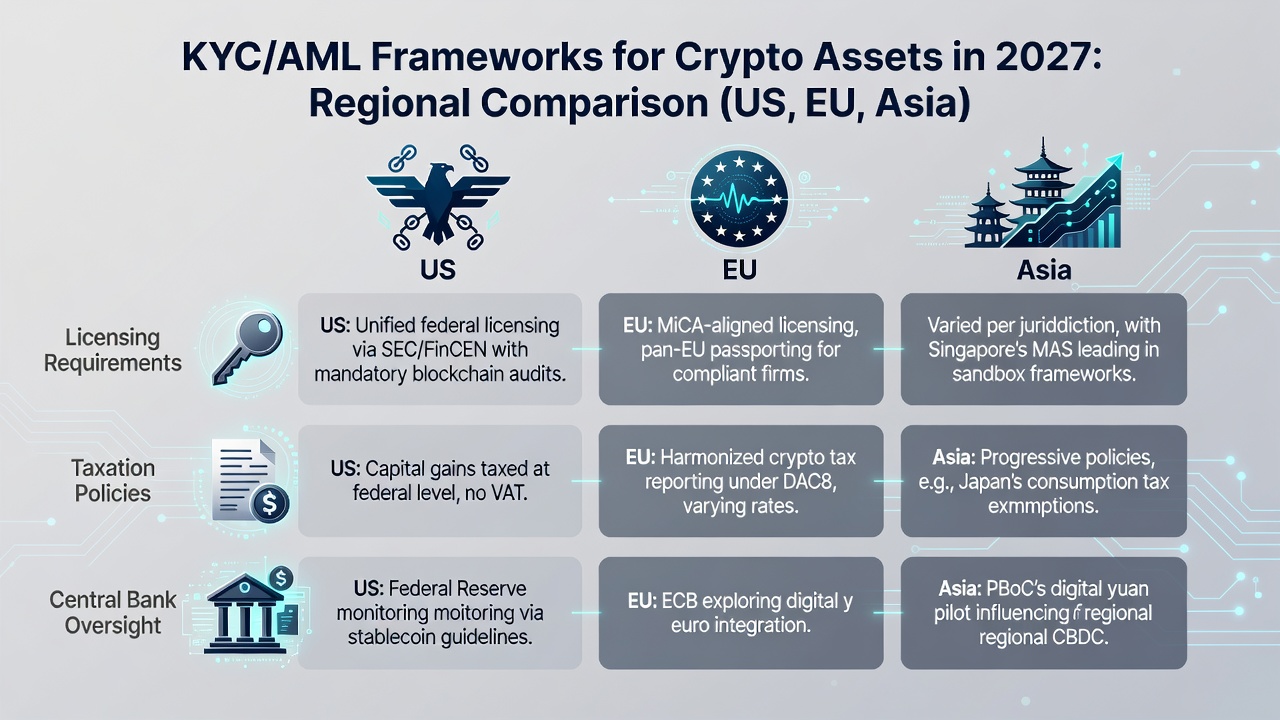
Regulatory evolution varies significantly by region, reflecting differing priorities around consumer protection, financial stability, and technological innovation. In the United States, agencies such as the SEC and CFTC continue to clarify enforcement priorities around decentralized finance platforms, stablecoin issuers, and unregistered exchanges. Recent guidance emphasizes transparent disclosure of risks associated with yield-generating products. The European Union’s Markets in Crypto-Assets (MiCA) framework reaches full implementation across member states, establishing a unified licensing regime for crypto-asset service providers and stablecoin issuers. This creates a single market for digital assets while imposing strict capital and governance standards. Meanwhile, Asian jurisdictions like Singapore and Japan maintain innovation-friendly rules paired with rigorous anti-money laundering safeguards, encouraging licensed exchanges and token projects. Singapore’s Monetary Authority has expanded its sandbox programs to include tokenized securities and cross-border payment solutions. In contrast, China maintains a comprehensive ban on crypto trading and mining activities, pushing activity underground or offshore. Central bank policy alignments are also critical in 2027, as many institutions advance CBDC pilots that directly influence how traditional finance intersects with crypto markets. For example, the European Central Bank’s digital euro project and the Federal Reserve’s ongoing research into a potential US CBDC shape liquidity dynamics and settlement practices.
Comparing Compliance Approaches Across Regions
US regulators focus heavily on investor protection through detailed disclosure rules and enforcement actions against misleading marketing. The EU prioritizes market integrity via comprehensive licensing regimes and ongoing supervision of service providers. Asian approaches offer a spectrum, ranging from Hong Kong’s progressive sandbox models that allow controlled testing of new products to stricter controls in mainland China. Investors and projects benefit from understanding these differences when expanding operations internationally, as a one-size-fits-all compliance strategy rarely succeeds. SEC resources provide ongoing guidance on enforcement trends, while European Commission updates detail MiCA rollout timelines and national implementation variations. Comparing these frameworks reveals that regions with clear, predictable rules tend to attract more institutional capital and foster sustainable project growth.
Updated KYC/AML Frameworks and Taxation Shifts
KYC/AML requirements are tightening globally, with enhanced due diligence mandated for high-risk transactions, decentralized finance protocols, and cross-border transfers above certain thresholds. Projects must integrate robust identity verification tools, transaction monitoring systems, and risk-based screening to avoid significant penalties. Many jurisdictions now require crypto service providers to implement travel rule compliance, sharing originator and beneficiary information for transfers. Taxation shifts include broader reporting obligations for exchanges and clearer guidelines on staking rewards, NFT sales, and decentralized protocol revenue. In several OECD countries, automatic exchange of information between tax authorities and platforms is becoming standard. Practical examples show that projects adopting early compliance measures, such as embedding on-chain analytics tools, reduce audit risks and build user trust. Common steps include implementing automated transaction monitoring, partnering with licensed custodians for asset segregation, tracking jurisdictional tax residency for users, and preparing for real-time reporting mandates. Failure to adapt can result in license revocation or exclusion from major markets.
Market Impacts and Real-World Case Studies
Regulatory clarity often correlates with increased institutional adoption, yet abrupt or poorly communicated changes can trigger short-term volatility and capital flight. Case studies from 2025-2026 illustrate how compliant projects gained market share while non-compliant ones faced delistings, fines, or forced restructuring. One prominent exchange that invested early in MiCA licensing saw a 40 percent increase in European user activity after full implementation. Another DeFi protocol that ignored updated KYC rules in the US lost access to major liquidity providers and experienced a sharp decline in total value locked. Risk assessment examples highlight the importance of scenario planning for sudden policy announcements, such as new stablecoin reserve requirements or taxation on unrealized gains. Market participants who model multiple regulatory outcomes are better positioned to adjust strategies quickly and maintain operational resilience.
Practical Steps for Investors and Projects
To stay compliant in 2027, both investors and projects should follow a structured approach. First, conduct regular legal audits with jurisdiction-specific experts who understand local nuances. Second, adopt privacy-preserving compliance technologies that allow verification without compromising user data. Third, monitor central bank digital currency developments closely, as they influence monetary policy and settlement infrastructure. Fourth, build flexible governance structures that can accommodate new rules without major overhauls. Additional recommendations include maintaining detailed records of all transactions, engaging with regulatory sandboxes where available, and educating team members on evolving obligations. Investors should diversify across regulated platforms and maintain clear documentation of their holdings and activities. These steps help reduce exposure to enforcement actions while supporting long-term growth in a maturing market.
Risk Assessment and Trend Forecasting
Key risks include enforcement actions against unregistered platforms, fragmentation of global standards that increases operational complexity, and potential liquidity shocks from sudden policy shifts. Opportunities arise in compliant DeFi applications, tokenized real-world assets, and institutional-grade custody solutions. Trend forecasting suggests continued focus on consumer protection, cross-border cooperation, and integration of environmental, social, and governance considerations into crypto operations. IMF publications and Federal Reserve analyses offer valuable macroeconomic context for understanding how broader financial policies intersect with crypto markets. Projects that treat compliance as a core competitive advantage rather than a burden tend to outperform peers over multi-year horizons.
FAQ: Navigating Regulatory Uncertainty in 2027
How will MiCA affect non-EU projects? Projects targeting EU users must obtain licensing or partner with authorized entities to avoid service restrictions and potential fines.
What taxation changes are expected? Expanded reporting for digital asset transactions is anticipated across OECD countries, with many platforms required to share user data automatically with tax authorities.
How can investors mitigate compliance risks? Diversify across regulated platforms, maintain detailed transaction records, and consult tax professionals familiar with digital asset rules in relevant jurisdictions.
Are CBDCs a threat to crypto? They are more likely to coexist with decentralized assets, driving hybrid financial products and new use cases rather than displacing existing cryptocurrencies.
What are the biggest compliance mistakes to avoid? Ignoring jurisdictional differences, underinvesting in monitoring tools, and failing to update policies after new guidance is released can lead to severe penalties.
Staying informed through authoritative sources and proactive legal counsel remains essential for success amid 2027 crypto trends. Regular engagement with regulatory developments allows participants to turn uncertainty into strategic advantage.
Conclusion
The 2027 regulatory environment presents both hurdles and pathways for growth in cryptocurrency markets. By understanding key developments, comparing regional approaches, implementing robust KYC/AML and tax measures, and following practical compliance steps, investors and projects can position themselves for sustainable success. Continuous monitoring, scenario planning, and collaboration with experts will be vital as the landscape matures.


No comments yet. Be the first!