 CryptoChain Blog

Introduction to Zero-Knowledge Proofs in 2026 Cryptocurrency Markets
Zero-knowledge proofs (ZKPs) have emerged as a transformative technology in the cryptocurrency space, enabling secure verification without revealing underlying data. As blockchain networks scale toward mainstream adoption in 2026, ZKPs address critical challenges in privacy and efficiency that have long limited decentralized systems. This analysis examines how ZK technology fuels scalability and privacy enhancements across major networks, compares it to traditional encryption methods, and highlights real-world applications in DeFi protocols, Layer 2 solutions, and compliance tools. Investors seeking forward-looking insights will find practical guidance on evaluating ZK-enabled tokens amid evolving market dynamics, including detailed steps, project examples, and considerations for long-term positioning.
The growing importance of ZKPs stems from their ability to solve the blockchain trilemma of scalability, security, and decentralization simultaneously. In practice, this means networks can process more transactions privately while maintaining trustless verification, opening doors for institutional participation and complex financial applications that were previously impractical on public ledgers.
Understanding Zero-Knowledge Proofs: Core Mechanics and Benefits
Zero-knowledge proofs allow one party to prove knowledge of a value without disclosing the value itself. This cryptographic method relies on mathematical protocols such as zk-SNARKs and zk-STARKs, which generate succinct proofs verifiable in milliseconds. Unlike traditional encryption methods that require data decryption for verification, ZKPs maintain confidentiality throughout the process, reducing exposure risks in decentralized environments. Key benefits include reduced computational overhead for verifiers, enhanced user privacy, and support for complex computations on hidden data states.
In blockchain contexts, ZKPs enhance transaction throughput while preserving user anonymity. For instance, they enable private transfers on public ledgers, a feature increasingly vital as regulatory scrutiny intensifies and users demand greater control over personal financial information.
Comparing ZK Proofs to Traditional Encryption Methods
Traditional symmetric and asymmetric encryption, such as AES or RSA, focus on data confidentiality through keys but often necessitate full decryption for validation. ZKPs differ fundamentally by separating proof from revelation. This distinction provides superior privacy in multi-party computations common in crypto networks. While encryption secures data at rest or in transit, ZKPs facilitate verifiable computations on encrypted or hidden states, offering efficiency gains in resource-constrained blockchain environments. Additionally, ZKPs reduce the attack surface since no sensitive data is ever exposed during verification processes.
ZK Technology Driving Scalability and Privacy in Blockchain
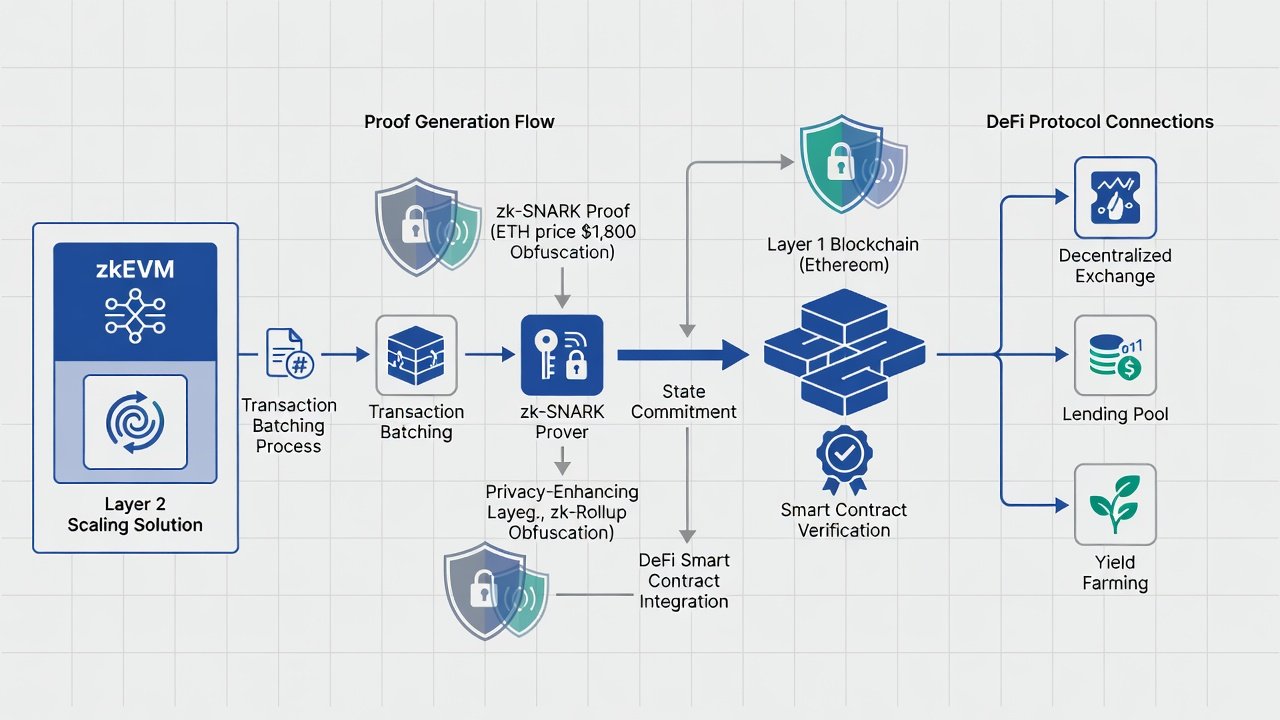
Scalability remains a bottleneck for networks like Ethereum. ZK-rollups batch thousands of transactions into single proofs, drastically reducing on-chain data requirements. Privacy benefits arise as transaction details stay off-chain yet remain verifiable. By 2026, broader ZK integration supports higher TPS rates across major chains, fostering more complex decentralized applications. This technology also enables recursive proofs that allow for infinite scalability in theory, as proofs can verify other proofs in nested structures.
Real-World Use Cases in DeFi Protocols
DeFi platforms leverage ZKPs for private lending and trading. Protocols can verify collateral without exposing positions, mitigating front-running and MEV attacks. Examples include zk-based mixers and confidential AMMs that maintain compliance while protecting user data. Specific implementations allow for hidden order books in decentralized exchanges, enabling traders to execute strategies without revealing intentions to competitors. These features are particularly valuable in high-frequency trading environments where information asymmetry creates unfair advantages.
Layer 2 Solutions and zkEVM Implementations
Layer 2 scaling solutions like those from Polygon and zkSync utilize zkEVMs to execute Ethereum-compatible smart contracts with zero-knowledge validity proofs. These implementations allow seamless migration of existing dApps while achieving near-instant finality and reduced fees. Specific projects demonstrate how zkEVMs enable complex DeFi interactions at scale without compromising security. For example, developers can deploy existing Solidity code directly onto zkEVM environments, benefiting from both compatibility and the privacy-preserving properties of ZK proofs. Ethereum Foundation resources provide foundational details on these advancements, while Polygon documentation outlines practical deployment strategies for zkEVM-based applications.
Regulatory Compliance Tools Powered by ZK
ZKPs support regulatory needs by enabling selective disclosure. Institutions can prove adherence to KYC or AML rules without sharing full customer datasets. This balance between privacy and oversight positions ZK as a key enabler for institutional crypto adoption in 2026. Tools built on this technology allow auditors to verify transaction legitimacy while users retain control over personal identifiers, reducing the risk of data breaches common in centralized compliance systems.
2026 Market Analysis and Trend Forecasting
The ZK sector continues expanding with new protocol launches and ecosystem integrations. Forward-looking analysis suggests sustained growth in ZK token utility as networks prioritize verifiable privacy. Market participants should monitor adoption metrics from leading Layer 2 projects to gauge long-term viability. Emerging trends include integration with AI-driven analytics for on-chain risk assessment and cross-chain ZK bridges that enhance interoperability without sacrificing privacy.
Practical Steps for Investors to Evaluate ZK-Enabled Tokens
Follow these steps for informed decisions:
- Assess the project's zk implementation maturity through audit reports and testnet performance metrics, focusing on proof generation times and verification costs.
- Review tokenomics for utility in governance and fee distribution within ZK ecosystems, ensuring alignment with network usage growth.
- Analyze partnerships with established Layer 2 or DeFi platforms to identify real adoption signals beyond marketing claims.
- Monitor on-chain activity and developer engagement via public explorers, tracking metrics such as daily active users and proof submission volumes.
- Consider regulatory developments impacting privacy-focused technologies, including potential changes in global data protection laws.
- Evaluate team expertise in cryptography and track record of delivering secure implementations through previous project audits.
- Compare competitive positioning against alternative scaling solutions like optimistic rollups to understand unique value propositions.
Challenges, Limitations, and How to Mitigate Them
Despite advantages, ZK technology faces hurdles such as high initial setup costs for proof generation hardware and the complexity of writing secure ZK circuits. Developers often encounter steep learning curves when transitioning from standard smart contract coding. Mitigation strategies include leveraging open-source libraries and participating in community audits. Investors should watch for projects that prioritize user-friendly tooling and transparent roadmaps addressing these issues.
Common Misconceptions Addressed in FAQ
Are zero-knowledge proofs completely anonymous?
ZKPs provide strong privacy but depend on protocol design; full anonymity requires additional measures like mixing or decentralized identity solutions layered on top.
Do ZK solutions replace all encryption in crypto?
No, they complement encryption by enabling verification without exposure, often layered with other cryptographic tools for comprehensive security.
Are zkEVMs only for Ethereum?
While Ethereum-centric, zkEVM concepts extend to compatible chains seeking scalability, including sidechains and alternative L1 networks adopting similar virtual machine designs.
How do ZKPs impact transaction speeds in practice?
Proof generation can add slight delays initially, but verification is extremely fast, leading to overall network throughput improvements once optimized.
Conclusion
Zero-knowledge proofs stand at the forefront of 2026 crypto innovation, delivering unmatched scalability and privacy. By understanding their applications, evaluation criteria, and potential limitations, investors can navigate this evolving landscape with confidence. Continued advancements promise broader integration across blockchain ecosystems, shaping the future of decentralized finance and beyond.

No comments yet. Be the first!