 CryptoChain Blog

Introduction to AI-Powered DeFi Strategies
Decentralized finance continues to evolve rapidly in 2026, with advanced users turning to artificial intelligence and machine learning to gain edges beyond manual analysis. This guide explores integrating AI into DeFi for accurate yield prediction and proactive risk management across lending protocols, perpetual futures, and liquidity pools. Traditional approaches often rely on historical averages or basic indicators, but ML models trained on on-chain data can uncover subtle patterns in volatility, liquidity shifts, and protocol health. By the end of this article, you will understand how to select platforms, train models, generate real-time signals, and evaluate results against conventional methods. The shift toward data-driven DeFi is driven by increasing market complexity, where human intuition alone struggles to process the volume of transactions and external factors influencing asset performance.
Top AI Platforms for On-Chain Analytics
Several specialized platforms combine blockchain data with machine learning capabilities. DefiLlama provides comprehensive yield and TVL datasets that serve as foundational inputs for models. Other options include tools built on Ethereum.org infrastructure that expose GraphQL endpoints for historical protocol metrics. Additional platforms worth exploring include those leveraging The Graph protocol for indexed on-chain events and services that integrate with Chainlink oracles for real-time price and volatility feeds. When choosing a platform, evaluate factors such as data freshness, API reliability, multi-chain support, and the availability of pre-built ML templates. For instance, platforms focused on lending markets often provide built-in features for simulating utilization curves, while perp-focused tools emphasize funding rate predictions. Users should prioritize open-source options when possible to allow customization and avoid vendor lock-in.
Key platforms to consider include:
- Platforms offering pre-trained models for DeFi metrics such as Aave and Compound risk scoring.
- Custom solutions using libraries like TensorFlow or PyTorch connected to The Graph subgraphs.
- Enterprise-grade services that aggregate data from multiple chains with built-in anomaly detection.
- Hybrid tools that combine on-chain telemetry with off-chain sentiment analysis from social and news sources.
When evaluating platforms, prioritize those with transparent data pipelines and regular updates to reflect protocol upgrades.
Training Models on Historical Protocol Data
Effective yield and risk models begin with clean, labeled datasets. Start by pulling historical data from lending markets, including borrow rates, utilization ratios, and liquidation events. Use time-series techniques such as LSTM networks or Transformer-based architectures to capture temporal dependencies. Feature engineering plays a critical role; incorporate variables like token velocity, governance proposal outcomes, and cross-protocol correlations to improve predictive power. A practical step-by-step example involves first authenticating with a data provider, then querying for specific events over an 18-month window. Preprocess the data by handling missing values through interpolation and normalizing scales across different chains. Train separate models for regression tasks like future APY estimation and classification tasks like predicting liquidation probability within the next hour. Validate performance using metrics such as mean absolute error for yields and precision-recall curves for risk events. Always backtest across multiple market regimes, including the 2025 volatility spikes, to ensure robustness. Advanced practitioners may experiment with ensemble methods that combine gradient boosting with neural networks for better generalization.
Real-Time Signal Generation for Lending and Perps
Once models are trained, deploy them for live inference. Integrate streaming data feeds to generate signals for adjusting collateral ratios or entering perp positions. For lending, an ML model might predict utilization spikes 30–60 minutes ahead, allowing proactive supply adjustments. For perpetual futures, reinforcement learning agents can optimize entry and exit based on funding rate forecasts. Combine these signals with on-chain oracles to reduce latency and improve execution quality. Monitoring infrastructure should include automated alerts when model confidence falls below predefined thresholds. 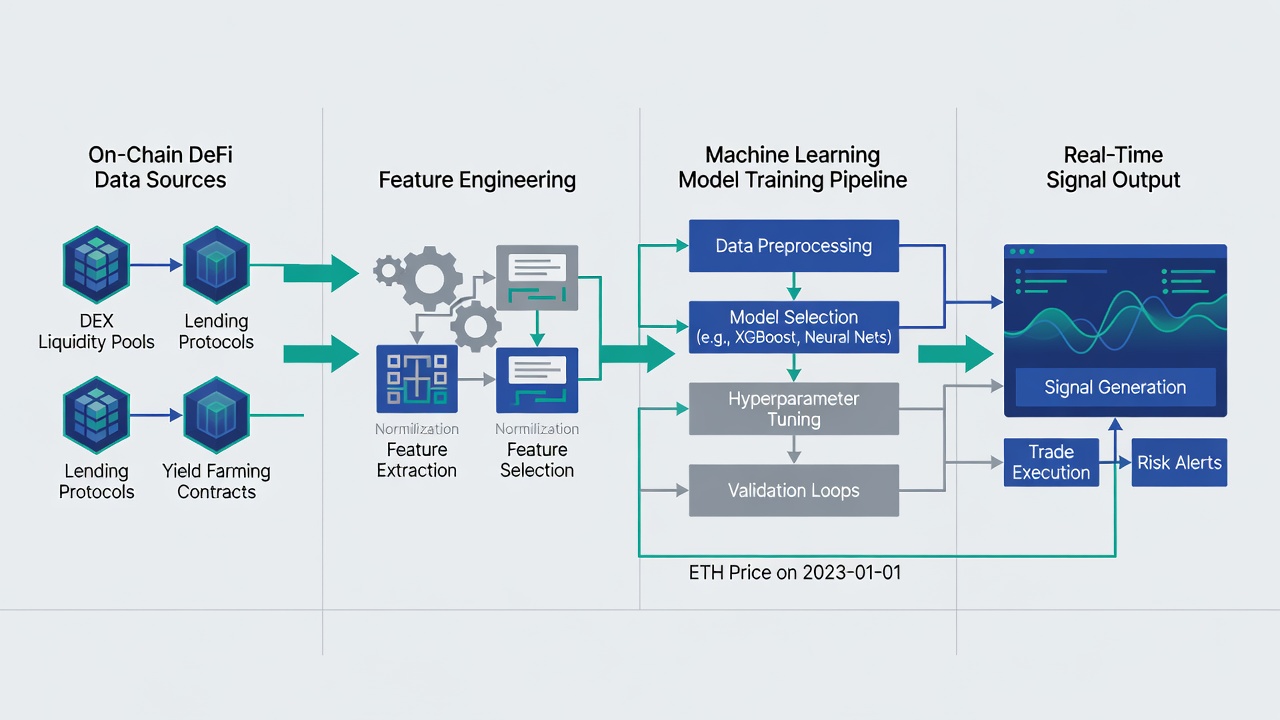
Case Studies: AI-Assisted vs Traditional Approaches
Consider a 2026 case study involving a major stablecoin lending pool. The traditional strategy using moving averages achieved an average APY of 4.8% with a 12% drawdown during stress periods. An AI-assisted approach using ensemble models improved APY to 6.9% while cutting maximum drawdown to 7%, demonstrating clear outperformance in both yield capture and downside protection. Another example in perp trading showed ML signals reducing liquidation frequency by 35% compared to rule-based strategies over a six-month period. A third case study on a DEX liquidity provision strategy revealed that reinforcement learning agents outperformed static rebalancing by maintaining higher capital efficiency during low-volatility periods while quickly exiting positions ahead of major price swings. These comparisons highlight how AI excels at handling non-linear relationships and adapting to regime changes that static rules miss.
Step-by-Step Setup Examples with Popular Tools
Follow this workflow using open-source stacks: Connect to a data provider and authenticate API keys. Build a Jupyter notebook environment with pandas and scikit-learn for initial exploration. Deploy models via Docker containers on a cloud instance with GPU support. Monitor performance using dashboards that track prediction accuracy and portfolio metrics. Include fallback mechanisms that revert to conservative parameters if model confidence drops below a threshold. For a concrete example with Aave data, begin by pulling reserve snapshots, engineer features around utilization trends, train an XGBoost classifier for risk, and serve predictions through a FastAPI endpoint integrated with a wallet monitoring script. Test the pipeline on testnet before mainnet deployment to validate gas cost estimates and signal reliability.
Risk Caveats and Best Practices
AI models are not infallible. Overfitting to past data, sudden protocol changes, and oracle failures remain significant risks. Always maintain diversified positions and implement circuit breakers. Regularly retrain models with fresh data and audit code for smart contract interactions. Users should also consider regulatory developments around automated trading in DeFi jurisdictions. Additional best practices include maintaining version control for all model artifacts, conducting periodic stress tests with synthetic data, and documenting assumptions made during feature selection. Diversification across multiple models and chains further mitigates single-point failures.
Frequently Asked Questions
How much historical data is needed for reliable models?
At minimum 12–18 months covering both bull and bear markets provides a solid foundation, though more data generally improves generalization.
Can beginners implement these integrations?
Advanced coding knowledge is required. Beginners should start with no-code platforms before progressing to custom ML pipelines.
What are common integration challenges?
Data quality issues, API rate limits, and model drift top the list. Solutions include rigorous validation pipelines and continuous monitoring.
How do I handle model drift in live environments?
Implement automated retraining schedules triggered by performance degradation metrics and maintain shadow models that run in parallel for comparison.
Are there open-source repositories recommended for DeFi ML starters?
Yes, several GitHub repositories provide starter notebooks for Aave and Compound data pipelines that can be adapted quickly.
Conclusion
Integrating AI and machine learning into DeFi strategies offers substantial advantages for yield optimization and risk control in 2026. By following the structured approach outlined above, advanced users can build data-driven systems that outperform traditional methods while remaining aware of inherent limitations and continuously refining their implementations.
No comments yet. Be the first!