 CryptoChain Blog

Introduction to DeFi Backtesting in 2026
DeFi backtesting allows traders and yield farmers to validate strategies using historical on-chain data before committing real assets. This approach minimizes risk while optimizing tactics for lending, arbitrage, and liquidity provision on protocols like Aave and Uniswap. As DeFi ecosystems evolve rapidly with new Layer-2 solutions and cross-chain bridges, reliable simulation tools have become essential for participants seeking data-driven decisions in volatile markets.
Backtesting replicates past market conditions to measure performance metrics such as returns, drawdowns, and risk-adjusted ratios. In 2026, on-chain simulators provide granular data from Ethereum and Layer-2 networks, enabling precise modeling of impermanent loss, gas fee impacts, and oracle price fluctuations. Users can simulate thousands of scenarios in minutes, turning raw blockchain logs into actionable insights without exposing capital to smart contract or market risks.
Why Backtesting Matters for DeFi Strategies
Without testing, yield farming or arbitrage can lead to unexpected losses from volatility or smart contract interactions. Backtesting reveals how strategies perform across bull, bear, and sideways markets. It also highlights issues like slippage in low-liquidity pools or liquidation thresholds in lending protocols that only appear under stress conditions.
Key benefits include identifying overfitting risks, where strategies excel on historical data but fail live, and refining parameters for better robustness. Participants can iterate quickly using forked environments that mirror mainnet conditions exactly. This practice has grown essential as DeFi total value locked fluctuates dramatically, making pre-deployment validation a competitive advantage for both retail users and institutional players.
Selecting Reliable Simulation Platforms
Choose platforms that integrate real blockchain data feeds and support custom strategy scripting. Popular options include Tenderly for transaction simulation and Foundry for local fork testing. These tools allow replaying historical blocks while adjusting variables like interest rates or token prices in real time.
Ensure the platform supports multiple chains and provides APIs for importing data from sources such as Ethereum. Free tiers often suffice for basic tests of simple lending strategies, while premium plans unlock advanced analytics, parallel simulations, and higher historical depth. Consider integration with popular development environments like Hardhat to streamline workflow from code to results. Always verify that the chosen simulator pulls from verified archival nodes to maintain data integrity across test runs.
Defining Success Metrics
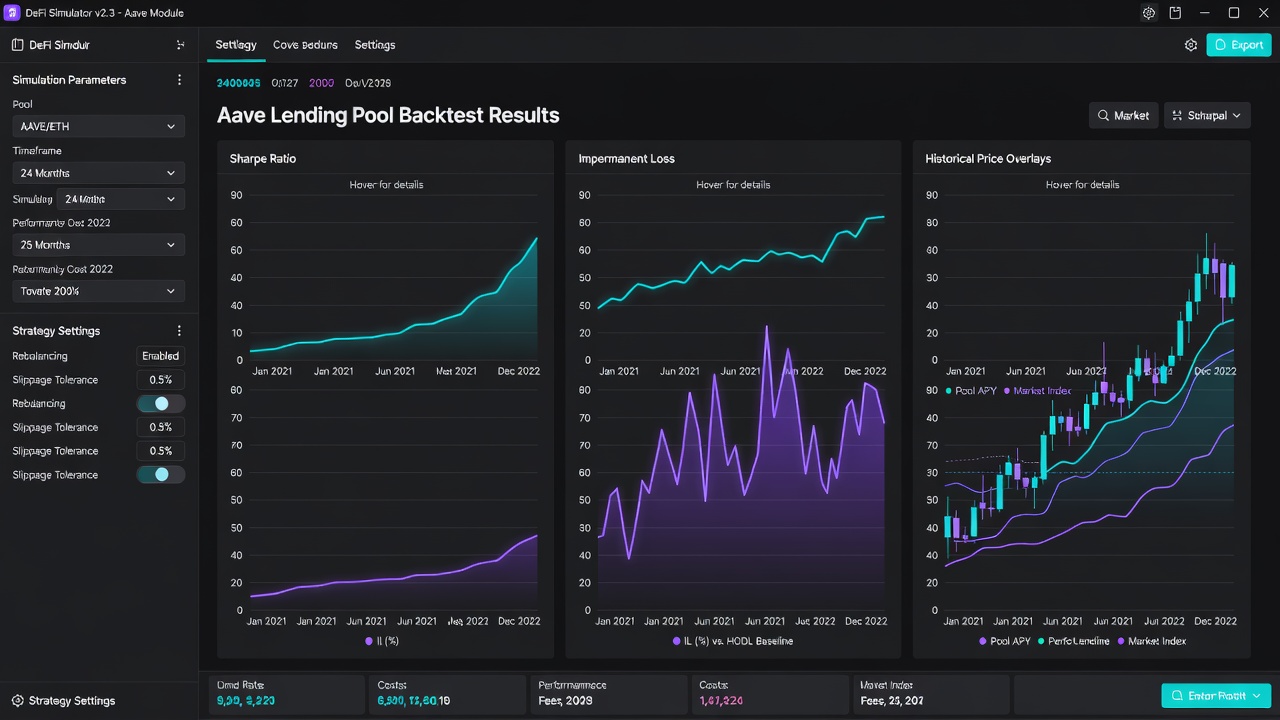
Effective backtesting relies on quantitative metrics beyond simple ROI. The Sharpe ratio measures risk-adjusted returns by comparing excess returns to volatility. A ratio above 1.0 typically indicates acceptable performance for DeFi strategies, helping users distinguish between high-return high-risk approaches and truly efficient ones.
Impermanent loss calculation is critical for liquidity providers on automated market makers. Track divergence between holding assets versus providing liquidity, factoring in trading fees earned over time. Additional metrics include maximum drawdown to assess worst-case scenarios, win rate for trade consistency, and profit factor to evaluate overall edge. Users should also monitor metrics like borrow utilization rates on lending platforms and gas cost per trade to build realistic profitability models.
Step-by-Step Setup on Aave and Uniswap Forks
Begin by forking the mainnet state using tools like Hardhat or Anvil. Connect to historical data archives to simulate conditions from specific dates in 2025 or earlier. This creates an isolated environment where every transaction behaves exactly as it did on the live chain.
- Install the simulation framework and configure RPC endpoints for archival nodes.
- Deploy forked instances of Aave lending pools or Uniswap V3 positions with accurate starting liquidity and interest rates.
- Input strategy parameters such as collateral ratios, borrow amounts, or swap routes while logging every variable change.
- Run simulations across multiple market scenarios including sudden price drops and network congestion events.
- Analyze outputs for metrics like Sharpe ratio and impermanent loss, then export detailed reports for further review.
- Validate results by comparing against known historical outcomes from public dashboards.
Repeat tests with varied initial conditions to avoid bias from single data points. Document all assumptions for reproducibility and future audits.
Free Versus Premium Tools Comparison
Free simulators provide core functionality for basic yield farming tests but often limit historical depth or concurrent runs. Premium subscriptions add real-time oracle integration, automated reporting, and team collaboration features. Evaluate based on your testing frequency and need for enterprise-grade accuracy when scaling to complex multi-protocol strategies.
Real Case Studies: Optimized vs. Live Results
One 2025 case study optimized an Aave lending strategy through backtesting, achieving a 34% higher Sharpe ratio than live deployment by adjusting liquidation buffers and monitoring utilization curves. The simulated version avoided two major liquidation events that occurred in the actual market. Another Uniswap arbitrage tactic reduced impermanent loss exposure by 22% after simulating gas spikes during network congestion periods, leading to refined route selection that improved net returns when executed live.
These examples demonstrate how iterative testing translates to measurable improvements when moving from simulation to mainnet execution, particularly when strategies incorporate dynamic rebalancing rules derived from backtest insights.
Common Mistakes to Avoid in DeFi Backtesting
Many users overlook transaction costs or assume perfect liquidity, leading to overly optimistic results. Another frequent error is failing to account for oracle delays or front-running risks that appear only in live environments. Always incorporate realistic slippage models and test across at least three distinct market regimes to prevent overfitting to a single historical period.
Actionable Checklist for 2026 DeFi Participants
- Verify data source accuracy from multiple oracles before starting tests.
- Include transaction fees, slippage, and oracle latency in all simulations.
- Test across at least three market regimes (bullish, bearish, neutral).
- Monitor for overfitting by validating on out-of-sample data segments.
- Document code versions and parameter sets for audit trails.
- Compare results against benchmarks like DeFiLlama yields.
- Run sensitivity analysis on key variables such as gas prices and asset correlations.
- Plan a gradual transition from backtest to small live positions for final validation.
Frequently Asked Questions
How accurate is historical on-chain data for backtesting?
Archival nodes provide high-fidelity records, but minor discrepancies can arise from reorgs or oracle delays. Cross-reference multiple providers and include buffer periods to enhance reliability of long-term simulations.
What are common overfitting risks in DeFi strategies?
Overfitting occurs when parameters are tuned too closely to past events. Mitigate by using walk-forward optimization and reserving recent data for validation only, ensuring the strategy remains adaptable to new conditions.
Can backtesting fully eliminate risk when deploying to mainnet?
No method removes all risk, but thorough backtesting significantly reduces exposure by revealing weaknesses before capital is committed. Combine simulations with ongoing monitoring once live.
Conclusion
Mastering DeFi backtesting empowers participants to refine yield farming, lending, and arbitrage approaches confidently. By leveraging simulators, precise metrics, expanded checklists, and structured validation processes, users can transition from theory to live execution with reduced downside exposure. Start with small-scale forks today to build expertise for 2026 market conditions and beyond.
No comments yet. Be the first!