 CryptoChain Blog

Introduction to Basis Trading in Decentralized Finance
Basis trading has emerged as a sophisticated strategy for DeFi participants seeking consistent returns beyond typical yield farming. In 2026, cash-and-carry approaches allow traders to exploit price discrepancies between spot and perpetual futures markets while maintaining a market-neutral position. This method involves buying the underlying asset in the spot market and simultaneously shorting it in the perpetual contract, capturing the basis while earning or paying funding rates. The strategy appeals to advanced users because it reduces directional risk compared to outright speculation. By focusing on funding rate dynamics and basis convergence, traders can generate yields that are less dependent on volatile token prices. Unlike simple liquidity provision or staking, basis trading requires active monitoring and precise execution across multiple protocols and chains.
Market conditions in 2026 have created frequent opportunities due to increased institutional participation in decentralized perpetuals and evolving liquidity pools. Sophisticated users often combine this approach with other yield sources such as options overlays or lending protocols to enhance overall portfolio returns while keeping net exposure low.
Identifying Basis Discrepancies Across Spot and Perpetual Markets
Successful basis trading begins with monitoring the difference between spot prices and perpetual contract prices. Positive basis occurs when perpetual prices trade above spot, often leading to positive funding rates where shorts pay longs. Negative basis presents the opposite scenario. Traders use on-chain analytics tools and decentralized exchange dashboards to scan for opportunities across chains like Arbitrum, Optimism, and Base. Key indicators include historical funding rate averages, open interest levels, and liquidity depth in both markets. Multi-chain opportunities arise because basis levels vary significantly between ecosystems. Ethereum mainnet may show tighter spreads due to higher liquidity, while emerging Layer 2s or alternative chains can offer wider discrepancies suitable for cash-and-carry entries.
Advanced scanners aggregate data from multiple oracles and order books to highlight mispricings in real time. Users should also track implied volatility and correlation between assets to avoid false signals caused by temporary liquidity shocks. For example, during high-volume events, basis can widen rapidly on lower-liquidity chains before converging within hours or days.
Executing Cash-and-Carry Positions with Low-Risk Protocols
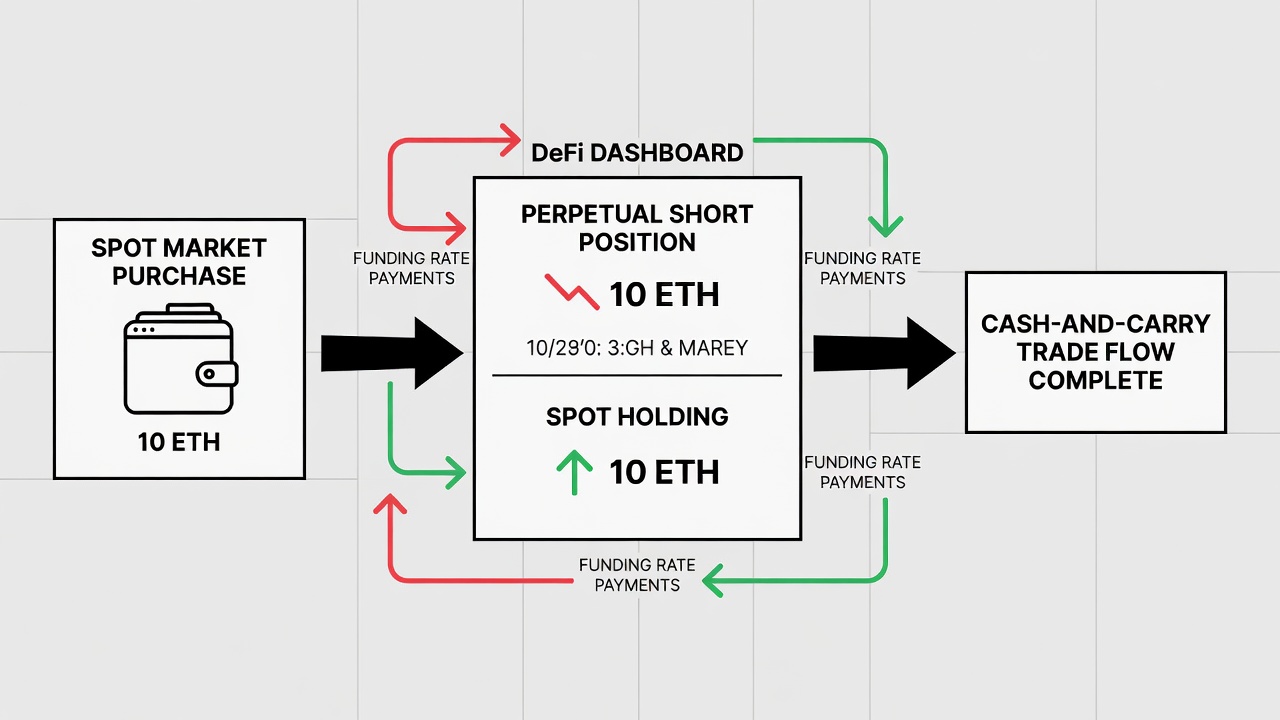
Setting up a cash-and-carry trade involves selecting reliable decentralized perpetual platforms. Popular GMX alternatives include protocols offering deep liquidity, low slippage, and transparent oracle pricing. The process starts with acquiring the spot asset, often stablecoins or blue-chip tokens, then opening an opposing perpetual short position sized to match the notional value. Step-by-step execution includes connecting a wallet to the chosen DEX, depositing collateral into the spot position, opening the perpetual short with appropriate leverage, and monitoring the combined position for funding accruals. Low-risk protocols emphasize over-collateralization and built-in liquidation buffers to protect against sudden volatility spikes. DeFiLlama provides useful TVL and protocol metrics that help traders evaluate platform stability before committing capital.
Traders frequently rotate between chains to optimize for the best basis and lowest transaction costs. When bridging assets, it is essential to account for settlement times and potential temporary unhedged exposure. Many protocols now support native cross-chain perpetuals that reduce these frictions compared to earlier bridge-dependent workflows.
Managing Funding Rate Fluctuations
Funding rates represent the core yield driver in basis trades. Positive rates benefit shorts in cash-and-carry setups, but rates can flip rapidly during market stress. Effective management requires setting alerts for rate thresholds and maintaining flexibility to close or roll positions. Traders calculate expected returns by factoring average funding rates over the holding period against potential basis convergence. Risk calculations should incorporate worst-case scenarios, such as extended periods of negative funding that erode profits. In practice, maintaining a diversified set of positions across three or more assets helps smooth out funding volatility and reduces reliance on any single market regime.
Risk Calculations with Practical Examples
Consider a hypothetical position where a trader buys 10 ETH in spot and shorts an equivalent perpetual contract. If the initial basis is 2% and average daily funding yields 0.05%, the projected monthly return requires subtracting fees and any adverse basis movements. Position sizing remains critical to avoid liquidation thresholds during sharp price swings. Another example involves stablecoin pairs where basis tends to be narrower but more predictable, allowing for larger position sizes with lower volatility. Common risk metrics include liquidation price distance, funding rate volatility, and correlation between spot and perpetual order books. Diversifying across multiple assets and chains further mitigates single-protocol exposure.
Users should also model tail events such as oracle failures or extreme funding spikes. Stress testing with historical data from past market cycles provides a clearer picture of maximum drawdowns and recovery times. This quantitative approach separates consistent performers from those who rely on luck during favorable funding environments.
Multi-Chain Opportunity Comparison
Comparing opportunities across chains reveals meaningful differences in execution quality. Arbitrum often provides the deepest liquidity for major assets, resulting in tighter bid-ask spreads but smaller average basis. Optimism and Base may present wider discrepancies that reward patient traders willing to hold positions longer. Arbitrum documentation highlights its growing ecosystem of perpetual protocols that support advanced order types useful for basis strategies. When evaluating chains, traders review gas fee trends, oracle reliability, and historical funding rate distributions to determine the best venue for each trade.
Practical Checklists for DeFi Basis Traders
- Verify protocol smart contract audits and total value locked before committing capital.
- Calculate break-even funding rates required to cover gas and trading fees.
- Monitor liquidation thresholds daily and maintain excess collateral buffers.
- Track multi-chain gas costs and bridge times when rotating positions.
- Document tax events for each funding payment and position close.
- Review historical basis convergence patterns for the specific asset pair.
- Set automated alerts for funding rate sign changes and margin health.
Common Pitfalls to Avoid
Many traders overlook oracle manipulation risks or underestimate the speed of funding rate reversals. Over-leveraging the perpetual leg can trigger cascading liquidations even when the overall basis trade remains theoretically sound. Another frequent mistake involves ignoring cross-chain settlement delays that can leave positions unhedged temporarily. Failing to account for cumulative trading fees across entry, funding accruals, and exit can turn an apparently profitable setup into a net loss. Additionally, some users neglect to rebalance positions when spot and perpetual prices diverge due to differing liquidity profiles on each venue.
FAQ on Tax Implications and Liquidation Thresholds
How are funding payments taxed in DeFi basis trades?
Tax treatment varies by jurisdiction but generally classifies funding receipts as ordinary income. Traders should maintain detailed records of each payment timestamp and USD value at receipt. Consulting a tax professional familiar with digital asset regulations is strongly recommended before scaling positions.
What typical liquidation thresholds apply to cash-and-carry positions?
Most perpetual platforms trigger liquidation when maintenance margin falls below 1-5% depending on asset volatility. Conservative positioning with 2x or lower effective leverage helps maintain distance from these levels. Regular margin top-ups and position monitoring are essential during periods of elevated market volatility.
Are there additional risks when using GMX alternatives?
Yes, alternatives may differ in oracle design, insurance fund size, and maximum leverage caps. Reviewing each protocol's risk parameters and historical incident reports helps traders select venues aligned with their risk tolerance.
Conclusion
Basis trading offers a disciplined path to DeFi yields in 2026 when executed with rigorous risk controls. By combining careful market monitoring, protocol selection, and ongoing position management, sophisticated users can capture cash-and-carry opportunities across multiple chains while navigating funding dynamics effectively. Continuous education and backtesting remain vital as market structures continue to evolve.

No comments yet. Be the first!