 CryptoChain Blog

Introduction to DeFi Composability in 2026
DeFi composability allows protocols to interconnect like building blocks, enabling advanced financial products that isolated platforms cannot achieve. This guide examines how modular smart contracts power these interactions, with practical examples from lending, derivatives, and oracles. Readers will discover strategies for identifying synergy, step-by-step walkthroughs on leading networks, and risk mitigation for complex setups under 2026 market conditions. Composability transforms DeFi from a collection of standalone tools into a dynamic ecosystem where capital flows seamlessly between applications, unlocking efficiency and innovation that was previously impossible.
Understanding Core Concepts of Modular Smart Contract Interactions
At its foundation, composability relies on standardized interfaces that let one protocol call functions in another without custom integrations. Smart contracts act as reusable components, where a lending protocol can supply collateral directly to a derivatives platform. This modularity reduces development friction and amplifies capital efficiency across ecosystems like Ethereum and Layer-2 networks. Developers leverage open standards such as ERC-20 for tokens and ERC-4626 for vaults to ensure compatibility. Atomic transactions execute multiple steps simultaneously, ensuring either full completion or complete reversion if any part fails. Oracles provide reliable external data feeds, bridging on-chain logic with real-world prices and enabling conditional logic based on market movements. Together, these create seamless flows where users deposit assets once and access layered products, from automated yield farming to structured derivatives.
Another critical element is permission management through token approvals and proxy contracts, which allows protocols to interact securely while users retain control. In 2026, advancements in account abstraction further simplify these interactions by enabling gasless transactions and batched operations across multiple protocols.
Real-World Examples: Combining Lending, Derivatives, and Oracles
One prominent setup involves using a lending protocol to borrow stablecoins, then deploying them as collateral in a perpetual futures platform while an oracle secures accurate pricing. For instance, users can loop assets through yield aggregators and options protocols to generate leveraged exposure without leaving the ecosystem. Another example integrates decentralized exchanges with automated market makers and insurance protocols, creating synthetic assets backed by on-chain reserves. These combinations have driven efficiency gains by allowing capital to serve multiple purposes simultaneously, such as earning lending interest while hedging with derivatives. A third case combines flash loans from liquidity pools with oracle-fed arbitrage bots to exploit temporary price discrepancies across exchanges, all executed in a single block. These examples illustrate how composability turns simple positions into sophisticated strategies that adapt to volatile 2026 market dynamics.
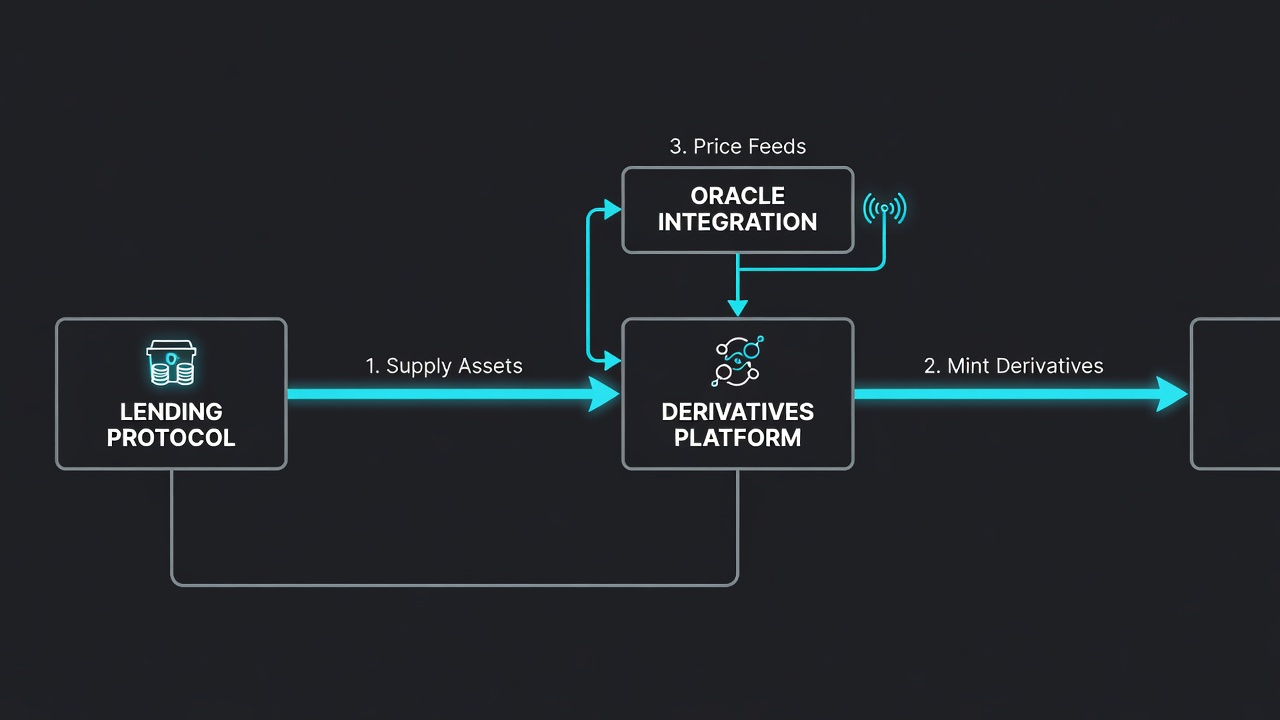
Step-by-Step Walkthrough: Building Sample Composable Flows
Start by connecting a wallet to a leading network such as Ethereum. Select a lending protocol and deposit assets to mint collateral tokens. Next, approve those tokens for use in a derivatives platform via a single transaction. Finally, route the position through an oracle-integrated vault to automate rebalancing based on market signals. Repeat the process on Layer-2 solutions for lower fees, ensuring all approvals follow security best practices like using permit signatures where available. For a more advanced flow, begin with a stablecoin deposit into a money market, borrow against it to enter a options position on a derivatives exchange, then wrap the resulting exposure in a structured product vault that automatically rolls positions at expiry. Test each step in a simulation environment first, monitoring for slippage and gas costs. Always verify contract addresses from official sources before interacting.
Strategies for Identifying High-Synergy Opportunities
High-synergy opportunities arise when protocols share liquidity pools, use compatible oracles, and offer complementary risk profiles. Analyze total value locked metrics and integration histories on dashboards to spot protocols with existing bridges. Look for combinations where one protocol's output directly serves as input for another, such as yield-bearing tokens usable as collateral elsewhere. Monitor governance proposals for upcoming integrations that could create new composable pathways in 2026.
Risk Mitigation Techniques for Complex Setups
Always audit smart contract permissions and monitor for liquidation cascades across interconnected protocols. Diversify across networks to avoid single-point failures and use simulation tools to test flows under volatile scenarios. Implement position sizing limits and maintain emergency exit paths through multi-signature controls. Additional techniques include setting up alerts for oracle deviations, maintaining separate wallets for different strategy layers, and regularly reviewing protocol audits from independent firms. In complex setups, consider using insurance wrappers to cover potential smart contract exploits.
Practical Comparisons: Efficiency Gains vs Isolated Protocol Use
Isolated protocols limit users to basic deposit-and-earn models. Composability unlocks multiplicative yields by stacking strategies, often improving capital utilization by 2-3x in optimized setups. Case studies from 2026 show reduced slippage and faster execution when protocols share liquidity pools. Isolated use typically incurs higher opportunity costs due to idle capital, whereas composable flows keep assets productive across multiple layers simultaneously.
Actionable Checklists and FAQs on Auditing Composable Positions
- Verify oracle data integrity and fallback mechanisms.
- Review all contract approvals for expiration dates.
- Simulate full transaction paths including edge cases.
- Monitor gas costs and network congestion in real time.
- Cross-check integration points for recent code changes.
- Document position sizes and expected yields for ongoing review.
FAQ 1: How do I safely audit a composable position? Begin with open-source contract reviews and third-party security firms.
FAQ 2: What scalability considerations apply in 2026? Focus on Layer-2 adoption and cross-chain bridges with proven security records.
FAQ 3: Can composability work across different blockchains? Yes, through secure bridges that maintain atomicity where possible.
For authoritative resources, consult Ethereum Foundation documentation, Chainlink oracle network, and DeFiLlama analytics platform.
Conclusion
DeFi composability in 2026 represents a mature evolution of money legos, offering powerful tools for sophisticated financial engineering when approached with caution and preparation. By mastering the concepts, examples, and strategies outlined here, users can build resilient, high-performing positions across protocols.


No comments yet. Be the first!