 CryptoChain Blog

Introduction to DeFi Keeper Automation in 2026
DeFi keeper automation has evolved into a cornerstone of passive yield generation. As protocols mature, custom bots handle repetitive tasks like rebalancing positions and capturing arbitrage opportunities without constant manual oversight. This approach leverages keeper networks to execute on-chain actions triggered by predefined conditions, maximizing returns while minimizing gas waste. In 2026, the landscape emphasizes scalability across Layer 2 networks, where keepers ensure strategies remain active 24/7 and adapt dynamically to market volatility through reliable automated execution. Investors and developers alike benefit from reduced emotional decision-making and consistent compounding of yields across lending platforms, liquidity pools, and derivatives protocols.
The core advantage lies in offloading routine operations to decentralized networks that compete on speed and cost efficiency. This frees users to focus on strategy design rather than constant monitoring. With increasing adoption of cross-chain bridges and modular blockchain architectures, keeper bots now handle multi-hop transactions that were previously too complex for manual management.
Understanding Keeper Networks: Gelato and Keep3r
Keeper networks function as decentralized executors that monitor smart contracts and perform actions when specific conditions are met. Gelato offers infrastructure supporting task automation across multiple chains with features like time-based triggers and event-driven executions. Keep3r operates on a marketplace model where independent keepers bid to fulfill jobs, providing strong incentives for reliable performance in complex yield strategies. Both platforms integrate directly with major DeFi protocols, enabling seamless interactions with lending markets, decentralized exchanges, and yield aggregators. Developers appreciate Gelato for its user-friendly SDKs while Keep3r appeals to those seeking competitive execution pricing through its open marketplace.
Choosing between them often depends on the required execution frequency and desired level of decentralization. Gelato excels in scheduled tasks, whereas Keep3r shines when multiple keepers can compete for high-value arbitrage jobs.
Setting Up Automated Rebalancing and Arbitrage Bots
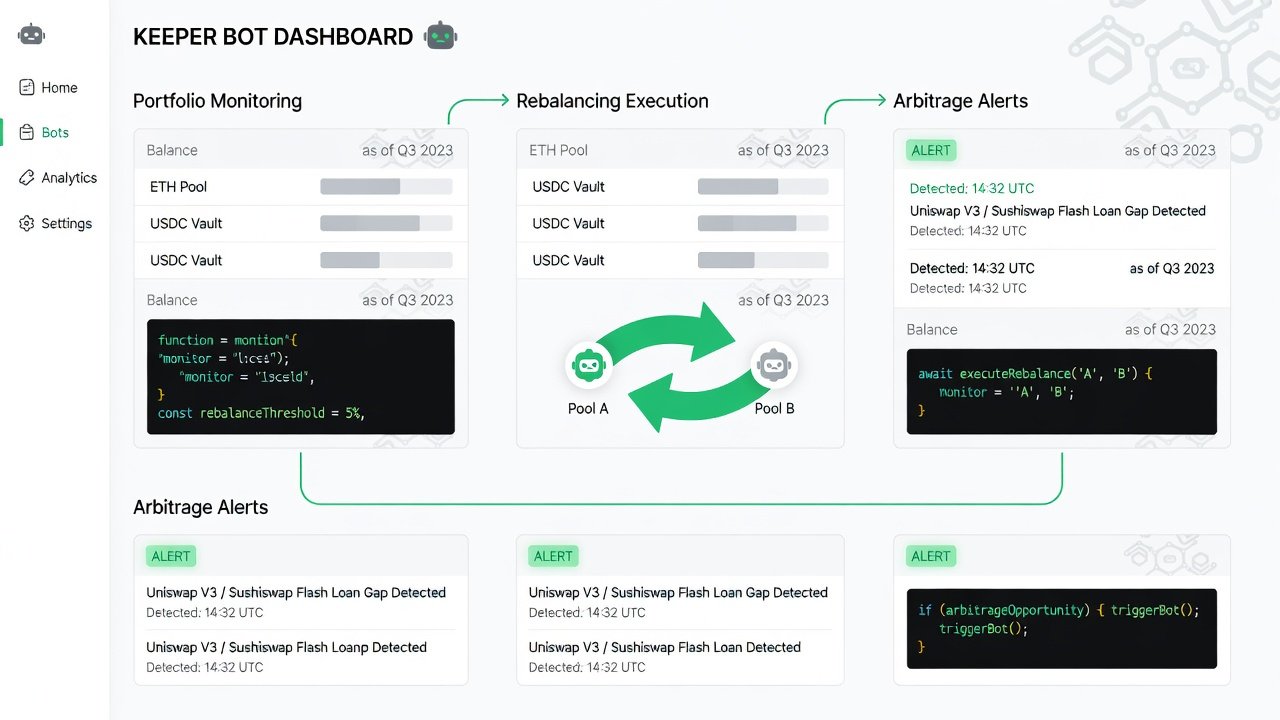
Real-world implementations frequently target lending protocols for automated collateral adjustments. A bot can continuously monitor health factors and trigger rebalances or partial liquidations when thresholds are crossed, protecting positions from sudden price drops. Arbitrage bots scan multiple DEXes for price discrepancies across chains and execute swaps via flash loans when profitable spreads appear. These strategies combine off-chain monitoring scripts with on-chain verification to minimize failed transactions and wasted gas.
Additional examples include automated compounding of farming rewards into principal positions or dynamic allocation shifts between stablecoin pools based on yield rate changes. In practice, a keeper monitoring an Aave position might rebalance every four hours if utilization rates exceed a set threshold, while an arbitrage keeper on Uniswap and Sushiswap could capture fleeting opportunities lasting only seconds.
Implementing Risk Controls with Circuit Breakers
Safety remains paramount when designing keepers. Circuit breakers automatically pause operations during extreme volatility or when anomalies such as oracle failures are detected. Developers commonly implement multi-signature approvals for updating critical parameters and introduce time-locked upgrades to block unauthorized modifications. Further protections include maximum transaction limits per time interval and fallback modes that allow manual intervention when automated execution encounters repeated errors.
Best practices also recommend isolating keeper wallets from main treasury funds and maintaining separate monitoring dashboards that alert operators via Discord or Telegram when thresholds are breached. These layered controls help safeguard capital against cascading failures that have historically affected DeFi protocols during black swan events.
Gas Cost Comparisons Across Layer 2 Networks
Selecting the appropriate L2 has a direct impact on long-term bot profitability. Optimistic rollups such as Arbitrum and Optimism typically deliver lower costs for complex keeper calls involving multiple contract interactions compared to certain zk-rollups under high-throughput conditions. Developers routinely benchmark execution expenses by simulating repeated keeper jobs across networks, measuring both base fees and priority fees to determine the most efficient environment for their specific yield strategy. Factors like sequencer uptime, data availability costs, and congestion patterns should all factor into the final network selection.
Step-by-Step Tutorial: Deploying a Simple Keeper Bot
- Connect to the chosen keeper network dashboard and create a new task by providing your target contract address and ABI.
- Define precise trigger conditions using JavaScript or Solidity logic, for instance checking token balances or health factors every five minutes.
- Implement the core execution function responsible for performing the yield action, such as swapping assets, supplying liquidity, or adjusting collateral ratios.
- Deploy the keeper contract on your selected chain and register it with the network, ensuring the wallet holds adequate native tokens to cover gas across multiple executions.
- Conduct thorough testnet validation before mainnet activation, carefully reviewing execution logs for successful completions and adjusting parameters as needed.
Here is an expanded code snippet illustrating a basic trigger check with added safety logic:
function shouldExecute() public view returns (bool) {
  if (paused) return false;
  return (block.timestamp - lastExecution) > interval && getHealthFactor() < threshold;
}
Monitoring Checklists for Keeper Bots
- Verify keeper wallet balances daily to prevent gas shortages that could halt operations.
- Review execution logs for failed transactions and refine trigger conditions or add retry mechanisms accordingly.
- Monitor protocol health factors and external price oracles for accuracy and timeliness of data feeds.
- Update bot parameters quarterly in response to evolving market conditions and protocol upgrades.
- Run periodic simulated attacks or stress tests on keeper logic to identify vulnerabilities before they impact live positions.
- Track overall yield performance against manual benchmarks to confirm the automation delivers measurable advantages.
Common Mistakes to Avoid When Building Keepers
Many new developers overlook the importance of robust error handling, leading to repeated failed transactions that drain gas reserves. Another frequent error is hard-coding oracle addresses without fallback options, which can cause bots to act on stale data during network issues. Failing to implement circuit breakers often results in overexposure during flash crashes. Always separate development, staging, and production environments, and never deploy untested logic directly on mainnet.
FAQs on Common Keeper Failure Modes
What causes keeper transactions to fail repeatedly?
Common culprits include insufficient gas allocation, outdated contract ABIs after protocol upgrades, or delays in oracle data updates. Incorporate retry logic with exponential backoff and maintain comprehensive error logging to diagnose issues quickly.
How do I handle network congestion effectively?
Configure priority fee settings within keeper parameters and prioritize L2s with stable gas markets. Some networks allow dynamic fee estimation that adjusts automatically based on recent block data.
Can keepers operate in a fully decentralized manner?
While the underlying networks promote decentralization, custom bots frequently rely on off-chain monitoring components, resulting in hybrid architectures that balance reliability with autonomy.
What happens if a keeper runs out of funds mid-execution?
Most networks pause the task until the wallet is topped up. Setting automated alerts for low balances helps prevent unexpected downtime.
Conclusion
Custom keeper bots offer a powerful pathway to sustainable passive yield in DeFi. Mastering integrations with Gelato and Keep3r, embedding strong risk controls, and optimizing across multiple L2 environments enables developers to construct resilient automation systems that perform efficiently throughout 2026 and future cycles.

No comments yet. Be the first!