 CryptoChain Blog

Introduction to DeFi Options in 2026
Decentralized finance continues to evolve rapidly, offering sophisticated tools beyond basic yield farming and lending. In 2026, DeFi options have emerged as powerful instruments for both hedging portfolio risks and engaging in speculation within decentralized finance ecosystems. These on-chain derivatives allow users to manage volatility in decentralized markets with greater precision than traditional perpetual futures or simple spot trading. Traders seeking defi guides and defi strategies now turn to options for nuanced control over their positions, enabling them to protect against downside while participating in upside moves without directly holding large amounts of volatile assets.
Options in DeFi provide the right, but not the obligation, to buy or sell an asset at a predetermined price before expiration. This flexibility makes them ideal for protecting gains or capitalizing on market movements. As decentralized finance matures, options trading integrates seamlessly with other protocols, creating opportunities for complex strategies that were once limited to centralized exchanges.
Understanding Option Mechanics in DeFi
DeFi options operate similarly to centralized counterparts but leverage smart contracts for transparency and accessibility. Key components include strike price, expiration date, premiums paid in crypto, and settlement methods that can be cash or physically delivered via tokens. Unlike traditional finance, everything settles on-chain, reducing counterparty risk but introducing smart contract vulnerabilities that users must evaluate carefully.
Traders must understand Greeks such as delta for directional exposure and theta for time decay effects, which influence position management in volatile crypto environments. Automated market makers and order books on protocols facilitate liquidity without intermediaries. Implied volatility plays a central role, as it directly impacts premium costs and potential profitability. For example, during periods of high market uncertainty, elevated implied volatility increases option premiums, making selling strategies more attractive for income generation while buying strategies become costlier. Settlement can occur automatically at expiration through oracle price feeds, ensuring fair execution across global participants in the defi space.
Selecting the Right Protocols: Opyn, Dopex, and Lyra
Choosing a protocol depends on factors like liquidity, supported assets, and fee structures. Opyn focuses on customizable options for Ethereum-based assets, allowing users to create tailored positions for advanced defi strategies. Dopex emphasizes decentralized options with unique rebate mechanisms that reward liquidity providers and option sellers. Lyra stands out for its focus on options trading on layer-2 networks with efficient pricing models that reduce gas costs and improve execution speed.
Users should evaluate current on-chain metrics via platforms such as DefiLlama before committing capital. Additional considerations include protocol audits, community governance participation, and historical performance during market stress events. Each platform offers distinct advantages for hedging or speculation depending on the trader's risk tolerance and preferred blockchain network.
| Protocol | Key Features | Best For |
|---|---|---|
| Opyn | American-style options, multi-asset support | Complex hedging strategies |
| Dopex | SSOV vaults, liquidity incentives | Yield-enhanced speculation |
| Lyra | AMM-based pricing, L2 optimization | High-frequency trading |
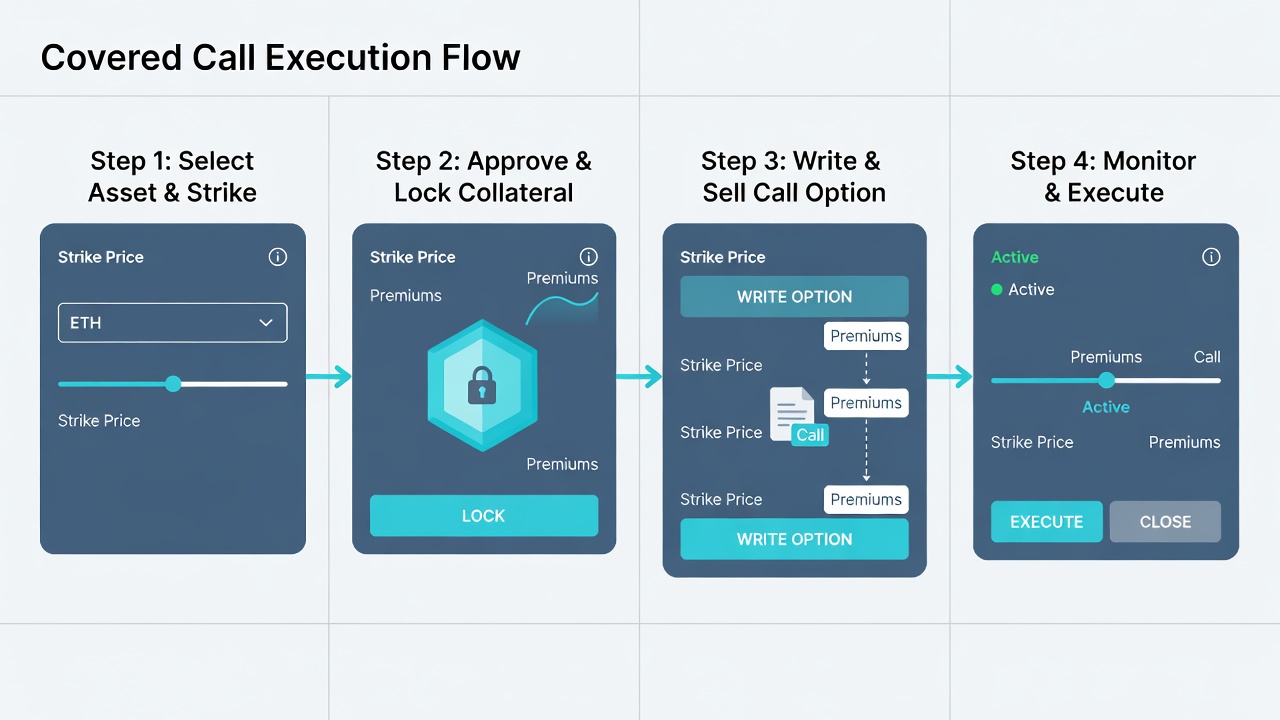
Executing Covered Calls: Step-by-Step Example
A covered call involves holding the underlying asset while selling call options to generate premium income. This strategy suits mildly bullish or neutral outlooks in decentralized finance markets. To execute effectively, traders must first ensure sufficient collateral and understand the implications of assignment if the asset price exceeds the strike.
- Acquire the base asset, such as ETH, in your wallet and confirm you hold enough for collateral requirements.
- Connect to the chosen protocol like Dopex and select the appropriate vault or option series that matches your market view.
- Deposit collateral and specify strike price above current market levels along with the desired expiration timeframe.
- Monitor the position through expiration and decide whether to close early, roll to a new strike, or allow settlement based on price action.
- Track premium received and factor it into overall portfolio yield calculations for accurate performance measurement.
Always verify smart contract approvals and use hardware wallets for security when dealing with larger positions in defi strategies.
Implementing Protective Puts for Hedging
Protective puts act as insurance against downside moves. Traders buy put options while maintaining long positions in the spot market. This approach is particularly valuable during uncertain macroeconomic periods or before major protocol upgrades that could trigger volatility.
Step-by-step: Assess portfolio beta to determine appropriate hedge ratio, choose out-of-the-money puts with suitable expiration aligned to your risk horizon, pay the premium via the protocol interface, and set alerts for exercise conditions. This approach limits losses during market corrections while preserving upside potential. For instance, a portfolio heavily weighted in ETH might purchase puts struck 15% below spot to cap drawdowns at that level, allowing continued participation in any rallies.
Risk Comparisons: DeFi Options vs Perpetual Futures
Unlike perpetual futures that require ongoing funding rate management and can lead to liquidation cascades, options cap maximum loss at the premium paid. However, options suffer from decay over time and lower liquidity in certain strikes. Perps offer leverage but expose users to unlimited downside in theory. In practice, options provide asymmetric payoff profiles that suit both conservative hedging and targeted speculation within defi guides.
- Options: Defined risk, premium cost upfront, no liquidation risk, beneficial for tail hedging
- Perps: Continuous funding payments, potential for higher returns but liquidation risks during sharp moves
- Options excel when volatility spikes unexpectedly, while perps may perform better in strong trending markets with stable funding rates
Portfolio Integration Tactics and Checklists
Integrate options by allocating 10-20% of portfolio to derivatives sleeves for balanced exposure. Rebalance quarterly based on volatility regimes and correlation shifts across assets. Successful integration requires ongoing education and testing of new strategies in simulated environments before live deployment.
Actionable checklist for defi strategies: Review protocol audits from independent firms, simulate positions in testnets to understand slippage and gas costs, diversify across multiple strikes and expirations, track impermanent loss if providing liquidity alongside options positions, and maintain separate wallets for options trading to isolate risks from core holdings.
Real-World Case Studies
In early 2026 market swings, a DeFi fund using Lyra protective puts successfully hedged against a 25% ETH drawdown, preserving capital for redeployment at lower levels. Another trader on Opyn executed covered calls on stablecoin pairs to boost yields amid sideways trading conditions. A third example involved a Dopex user combining options with liquidity provision vaults, generating additional rebates that offset premium costs during a low-volatility period, demonstrating how layered defi strategies can enhance overall returns while managing downside exposure.
Common Pitfalls and How to Avoid Them
Many participants overlook liquidity differences between strikes, leading to unfavorable exit prices. Others neglect to account for theta decay when holding long options positions. To mitigate these issues, always analyze order book depth before entry, use limit orders for precision, and maintain a trading journal documenting rationale and outcomes for continuous improvement in decentralized finance trading.
FAQ: Addressing Common Pitfalls
How volatile are DeFi options premiums? Premiums fluctuate with implied volatility; monitor on-chain oracles to avoid overpaying during extreme events.
What about smart contract risks? Always review audits from reputable firms and consider insurance wrappers available on leading DeFi platforms to add an extra layer of protection.
Can beginners start with these strategies? Start with small test positions on established protocols and educate via resources like Ethereum.org documentation before scaling up.
How do options compare to other hedging tools in defi? Options offer defined risk unlike leveraged perps, making them preferable for precise portfolio protection without margin calls.
What role does liquidity play in execution? Thin liquidity on certain strikes can widen spreads, so prioritize protocols with deep order books for better fills on larger trades.
Conclusion
DeFi options strategies in 2026 empower sophisticated participants to hedge effectively and speculate with precision. By mastering protocol selection, execution mechanics, and risk controls, traders can enhance portfolio resilience in decentralized markets while navigating the unique opportunities and challenges of on-chain derivatives.


No comments yet. Be the first!