 CryptoChain Blog

Introduction to DeFi Privacy in 2026
On-chain surveillance has intensified dramatically as blockchain analytics firms and regulatory bodies deploy advanced monitoring tools. DeFi users seeking financial autonomy now face heightened risks of transaction tracing, wallet clustering, and data leaks. This comprehensive guide explains how to shield transactions using zero-knowledge proofs and complementary technologies. We cover zk-SNARKs fundamentals, mixer protocols, stealth addresses, and practical implementation strategies tailored for 2026. Whether you are a yield farmer protecting portfolio details or a trader avoiding front-running, understanding these tools is essential for maintaining confidentiality without sacrificing usability.
Understanding Core Privacy Technologies
zk-SNARKs Explained in Depth
Zero-knowledge succinct non-interactive arguments of knowledge, commonly called zk-SNARKs, allow one party to prove possession of certain information without revealing the information itself. In DeFi, this enables verification of transaction validity on public blockchains while hiding sender, receiver, and amount details. The technology relies on elliptic curve cryptography and polynomial commitments. Developers integrate zk-SNARKs into smart contracts to create shielded pools where deposits and withdrawals appear unlinkable. For example, a user can prove they deposited 10 ETH into a private vault without exposing the exact amount or timing to external observers. This protects against MEV bots and surveillance dashboards that track large movements in real time.
Mixers and Their Evolution
Mixers aggregate multiple users' funds into a shared pool and redistribute them using cryptographic mixing techniques. Early implementations relied on simple coinjoin methods, but 2026 versions incorporate zk-proofs for stronger guarantees. Users deposit assets and receive equivalent outputs from unrelated deposits after a delay period. Modern mixers add compliance toggles such as optional deposit notes for regulatory audits. They operate across Ethereum, Arbitrum, and Base, supporting stablecoins and major tokens. The evolution emphasizes decentralization, with no single operator controlling funds, reducing single points of failure.
Stealth Addresses for Enhanced Protection
Stealth addresses generate one-time recipient addresses derived from a recipient's public key using elliptic curve Diffie-Hellman. Each incoming transaction uses a unique address, breaking the linkability that occurs when addresses are reused. In practice, a DeFi protocol can send yield directly to a fresh stealth address controlled by the user. This prevents blockchain explorers from clustering activity to a single identity. Combined with zk-SNARKs, stealth addresses provide layered privacy that withstands sophisticated chain analysis.
Regulatory Considerations for 2026
Privacy tools exist in a complex regulatory environment. Users must understand reporting obligations in their jurisdiction while leveraging available protections. Agencies continue to refine rules around mixers and zk-enabled protocols, often requiring transaction logs for tax purposes. Balancing privacy with compliance involves maintaining encrypted personal records and using tools that offer selective disclosure features. Resources from official bodies provide guidance on evolving standards. Consult SEC.gov and FinCEN.gov regularly for updates on decentralized finance oversight.
Step-by-Step Wallet Setup for Private DeFi
Setting up a privacy-focused wallet requires careful configuration. Follow these detailed steps to establish a secure foundation:
- Select a wallet with native zk-SNARK and stealth address support, such as those built on Zcash or Railgun frameworks. Verify open-source code and recent audits.
- Generate a new seed phrase offline and enable advanced privacy modules during initial setup. Create stealth key pairs for receiving funds.
- Configure network preferences to prioritize privacy chains and enable Tor integration or VPN routing for all connections.
- Bridge assets through privacy-preserving entry points that support shielded deposits, starting with small test amounts under 0.1 ETH equivalent.
- Verify transaction history remains hidden on public explorers before proceeding to larger positions. Regularly update wallet software to patch vulnerabilities.
This process typically takes under 30 minutes but significantly reduces exposure risks from day one.
Protocol Comparisons: Tornado Cash Alternatives vs Railgun
Choosing the right protocol depends on your threat model and use case. Tornado Cash alternatives emphasize fully decentralized mixing with optional compliance modules and support for multiple EVM chains. They excel at simple one-time private transfers but offer limited smart contract interaction. Railgun, by contrast, embeds privacy directly into smart contracts, enabling private swaps, lending, and yield strategies without exiting the shielded environment. Key comparison factors include gas efficiency, supported assets, audit coverage, and resistance to timing attacks. Railgun generally provides superior functionality for active DeFi participants, while alternatives suit users focused solely on transfers. Explore foundational documentation at Ethereum.org to understand underlying architecture before committing funds.
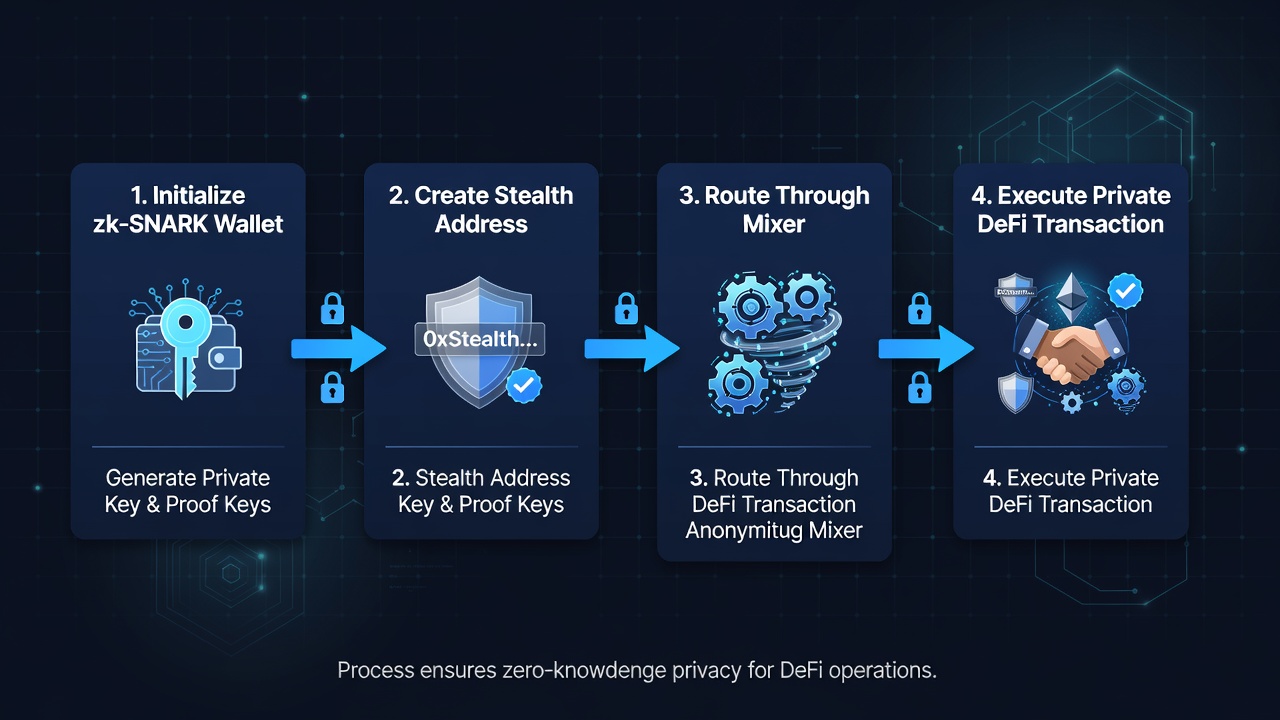
Practical Example: Private Yield Farming Flow
Consider a user farming stablecoin yields privately. Begin by depositing USDC into a zk-enabled vault via a shielded wallet. The protocol issues an encrypted note proving deposit ownership. Next, allocate the position to a private lending pool that automatically compounds interest using zk-proofs for balance updates. When harvesting rewards, withdraw to a fresh stealth address after a randomized delay to avoid timing correlation. Monitor performance through an encrypted dashboard that decrypts only locally. This flow keeps entry amounts, yield rates, and withdrawal destinations confidential from public view. Repeat the cycle across multiple protocols to diversify risk while maintaining full privacy. Test the entire sequence on testnets first to identify any metadata leaks in your specific setup.
Risk Mitigation Tactics and Deanonymization Checklist
Even advanced tools can fail if basic opsec is neglected. Implement these tactics consistently:
- Never reuse addresses or notes across unrelated sessions to prevent clustering.
- Route all traffic through VPNs or Tor and avoid logging into centralized exchanges immediately before or after private transactions.
- Verify protocol smart contract audits from independent firms before depositing meaningful capital.
- Limit individual transaction sizes and introduce random delays to disrupt pattern recognition algorithms.
- Cross-reference implementation details with established references at Z.cash for ongoing best practices.
- Maintain separate wallets for public and private activities to create clear boundaries.
Common Pitfalls to Avoid
Many users inadvertently compromise privacy through metadata leaks such as browser fingerprinting or reusing IP addresses. Failing to update wallet firmware or ignoring smart contract upgrade risks can expose shielded funds. Another frequent mistake involves sharing encrypted notes or screenshots that contain identifiable information. Always simulate complete flows in isolated test environments before live deployment.
Conclusion
Privacy in DeFi requires combining zk-proofs, mixers, and stealth addresses with disciplined operational security. By following the setups and comparisons outlined here, users can confidently navigate 2026's surveillance landscape while participating in yield opportunities.
FAQ
How does tax reporting work with privacy tools?
Record all transactions privately but maintain detailed encrypted logs for compliance. Many jurisdictions require reporting of gains regardless of privacy measures. Consult official tax resources such as IRS.gov for jurisdiction-specific guidance and consider professional advice to structure records appropriately.
Are zk-proofs completely anonymous?
They provide strong cryptographic privacy when implemented correctly, yet side-channel attacks and poor user practices can still reduce effectiveness. Proper wallet configuration and network hygiene remain critical for full protection.
What misconceptions exist about mixers?
Many assume mixers guarantee total anonymity, but they primarily reduce traceability rather than eliminate it entirely. Combining mixers with zk-proofs and stealth addresses offers substantially stronger results than relying on any single tool.

No comments yet. Be the first!