 CryptoChain Blog
Introduction to Decentralized Oracles in DeFi 2026
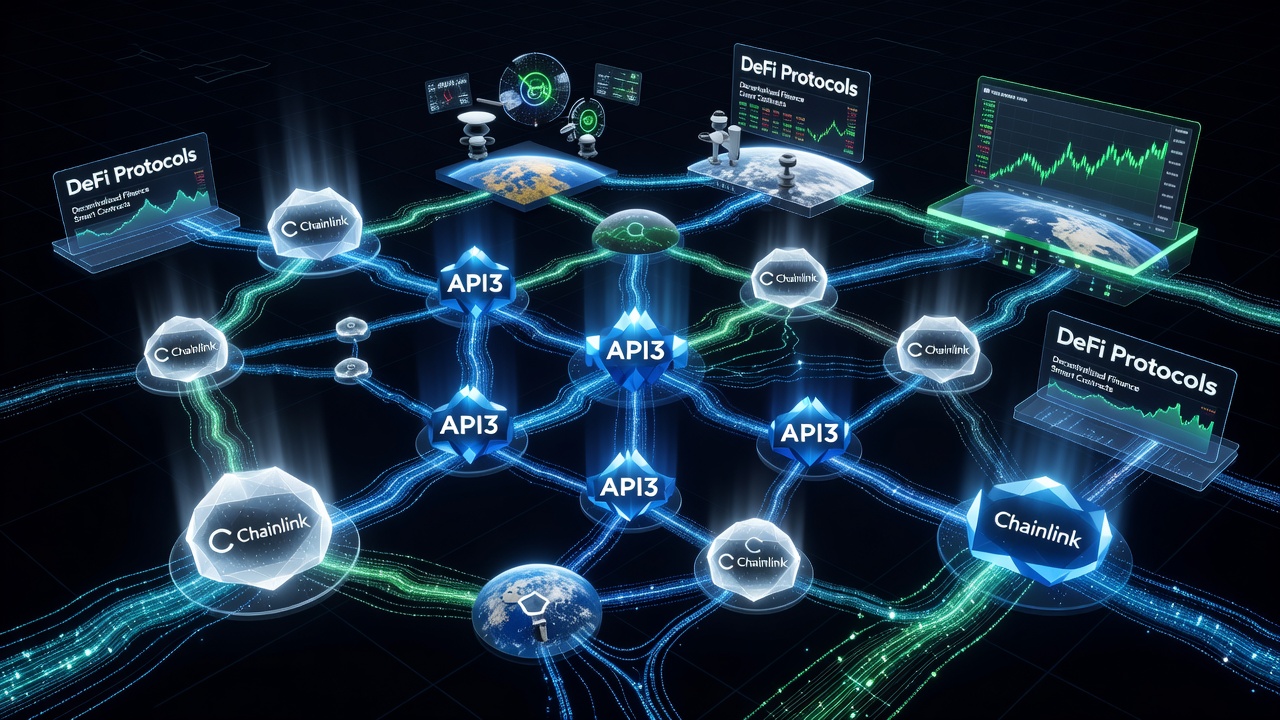
Decentralized oracle networks remain essential infrastructure for DeFi protocols in 2026. They bridge on-chain smart contracts with off-chain data such as asset prices, interest rates, and real-world events. Without reliable oracles, lending platforms and derivatives exchanges cannot accurately liquidate positions or settle contracts. This guide examines oracle selection criteria, manipulation risks, and practical integration steps for advanced developers building robust strategies. In an ecosystem where billions flow through automated markets, the accuracy and security of price feeds directly influence protocol solvency and user trust. Developers must understand not only how oracles aggregate data but also how economic incentives and cryptographic guarantees prevent tampering at scale.
Understanding Oracle Selection Criteria
When evaluating oracles, developers prioritize security, latency, cost efficiency, and decentralization. Key criteria include node diversity, cryptographic proofs, and historical uptime. For lending protocols, sub-second latency matters during volatility spikes because delayed prices can trigger unnecessary liquidations or allow under-collateralized borrowing. Derivatives platforms require high-frequency updates and tamper-proof aggregation to support complex instruments like perpetual futures and options. Additional factors encompass the oracle's economic security model, such as staked collateral that can be slashed for misbehavior, resistance to single points of failure through geographic and operator diversity, and transparent audit histories. Teams should also review data-source provenance, deviation thresholds, and fallback mechanisms before committing to a primary feed. Real-world testing on testnets reveals performance nuances that documentation alone cannot capture.
Chainlink V3 Architecture and Features
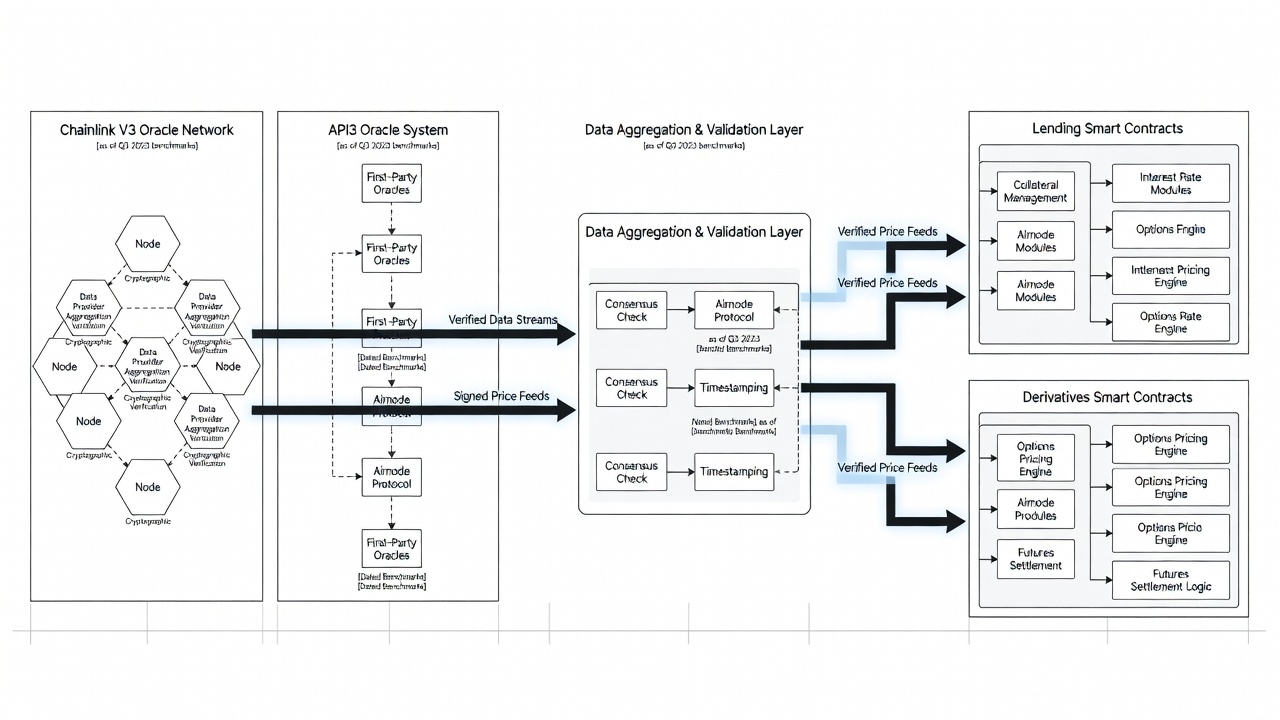
Chainlink V3 introduces enhanced data feeds with improved aggregation and on-chain verification. It supports multiple data sources and uses decentralized reputation scoring to weight contributions from high-performing nodes. Developers can query feeds for ETH/USD or BTC/USD with built-in deviation thresholds that trigger updates only when prices move beyond preset percentages, conserving gas while maintaining accuracy. The network's DON (Decentralized Oracle Network) model distributes data requests across independent nodes, each running the same computation independently before consensus is reached. Additional capabilities include support for off-chain computation via Chainlink Functions and verifiable random functions for gaming and lottery applications. Integration typically involves importing the Chainlink interface and configuring job IDs that specify the exact data source and aggregation logic.
API3 Data Strategies and Airnode
API3 focuses on first-party oracles where data providers operate their own nodes. Airnode enables direct API connectivity without intermediaries, allowing providers to push signed data on-chain at regular intervals. This approach reduces latency and fees while increasing transparency because each data point carries cryptographic proof of origin. In 2026, API3 emphasizes dAPI (decentralized APIs) for seamless integration with Web3 applications requiring authenticated data streams. Protocols can subscribe to continuously updated feeds for equities, commodities, or forex rates. The insurance-backed model provides additional recourse if a provider's node reports incorrect values, creating financial accountability that many second-party oracle designs lack.
Practical Comparison: Chainlink V3 vs API3 vs Emerging Networks
- Security Model: Chainlink relies on staked LINK tokens and node reputation scoring; API3 uses provider-operated nodes protected by insurance pools that compensate affected protocols.
- Latency: API3 often achieves faster updates for high-frequency trading pairs; Chainlink excels in broad asset coverage across hundreds of markets.
- Cost Structure: Both networks have optimized fee models that scale with usage, though emerging networks like Pyth deliver competitive pricing for specific high-velocity assets.
- Decentralization Level: Chainlink maintains higher node counts distributed across continents, reducing correlated failure risk.
- Developer Experience: Chainlink offers extensive documentation and community tooling; API3 provides simpler direct integration for teams already working with traditional APIs.
Emerging networks focus on niche use cases such as real-time volatility indices and cross-chain price verification, often complementing rather than replacing established providers.
Real-World Oracle Failures and Mitigation Tactics
Past incidents, such as flash-loan attacks exploiting stale price feeds on smaller lending platforms, highlight the need for multi-oracle redundancy. One notable case involved a low-liquidity token whose price was manipulated on a single exchange, causing cascading liquidations across protocols that relied on that lone data source. Mitigation strategies include using fallback oracles that activate when primary feeds exceed deviation thresholds, implementing circuit breakers that pause sensitive operations during detected anomalies, and monitoring deviation alerts through off-chain dashboards. Protocols should combine Chainlink and API3 feeds for critical assets to reduce single-network risk. Additional tactics encompass time-weighted average prices over multiple blocks, multi-source median calculations, and regular third-party audits of oracle consumer contracts. These layered defenses have proven effective at preserving protocol integrity even when individual data providers experience temporary issues.
Integration Steps for Lending and Derivatives Platforms
Follow these detailed steps to integrate oracles securely:
- Identify required data feeds, desired update frequency, and acceptable deviation parameters based on the protocol's risk model.
- Deploy a consumer contract that inherits from the chosen oracle interface and registers the necessary job specifications.
- Implement request functions that pass parameters such as asset symbols and callback addresses to the oracle network.
- Handle callback functions that receive verified data and perform sanity checks before updating internal state variables.
- Build deviation checks and multi-source validation logic that cross-references primary and secondary oracles.
- Conduct extensive testnet simulations that replicate flash crashes and extreme volatility scenarios.
- Deploy monitoring infrastructure that alerts the team when node performance degrades or prices diverge beyond thresholds.
Example Solidity snippet for a basic Chainlink query with added validation:
function requestPrice() public returns (bytes32 requestId) {
    Chainlink.Request memory req = buildChainlinkRequest(jobId, address(this), this.fulfill.selector);
    req.add("get", "https://min-api.cryptocompare.com/data/price?fsym=ETH&tsyms=USD");
    req.add("path", "USD");
    return sendChainlinkRequest(req, fee);
}

function fulfill(bytes32 _requestId, uint256 _price) public recordChainlinkFulfillment(_requestId) {
    require(_price > 0, "Invalid price");
    latestPrice = _price;
}
Building Robust Data-Secure Strategies
Advanced users combine oracle data with on-chain analytics for comprehensive risk management. Monitor node performance via public dashboards and set automated alerts for unusual latency or divergence. Test integrations thoroughly on testnets before mainnet deployment, including stress tests that simulate coordinated attacks. Always review the latest documentation from Chainlink and API3. Incorporate governance mechanisms that allow the community to vote on adding or removing data sources as market conditions evolve. Finally, maintain an incident-response playbook that outlines rapid response procedures when oracle anomalies are detected.
Conclusion
Selecting and integrating the right oracle network is foundational to secure DeFi operations in 2026. By understanding architectural differences, implementing redundancy, and following rigorous testing practices, developers can build protocols that withstand both technical failures and economic attacks. Continuous monitoring and layered defenses remain the most reliable path to long-term resilience.
FAQ
How do oracles prevent price manipulation?
They aggregate multiple independent sources, apply cryptographic proofs, and rely on economic incentives that penalize dishonest reporting through slashing mechanisms.
Which network is better for derivatives protocols?
Chainlink offers wider coverage and proven uptime across many assets while API3 provides lower latency for specific high-frequency pairs; many mature protocols use both in parallel.
What happens during temporary network outages?
Well-designed protocols include fallback mechanisms, time-weighted averages, and pause functions that protect user funds until reliable data resumes.
Can I use multiple oracles simultaneously?
Yes, redundancy across Chainlink, API3, and emerging providers strengthens data integrity and reduces reliance on any single network.
How often should oracle feeds be audited?
Leading teams conduct quarterly security reviews and maintain continuous on-chain monitoring to detect anomalies in real time.
No comments yet. Be the first!