 CryptoChain Blog

Introduction to DeFi Pair Trading in 2026
Statistical arbitrage through pair trading remains a powerful strategy in decentralized finance. By identifying cointegrated asset pairs and executing mean-reversion trades, traders can exploit temporary price divergences while maintaining market-neutral exposure. This approach has evolved with improved on-chain data availability and sophisticated analytics platforms. In 2026, DeFi pair trading combines traditional quantitative finance techniques with blockchain transparency, allowing participants to build resilient strategies that adapt to volatile crypto markets. This guide explores practical methods for selecting assets, running tests with on-chain tools, defining entry and exit rules, and automating execution on leading DEXes such as Uniswap and Curve. Readers will gain actionable insights into risk management and automation that go beyond basic overviews.
Selecting Correlated Assets for Pair Trades
Successful pair trading begins with assets that exhibit strong historical relationships. Focus on tokens within the same sector, such as stablecoin pairs like USDC and USDT or correlated DeFi protocols including ETH and liquid staking derivatives like wstETH. Traders should analyze correlation coefficients over multiple timeframes, from 30 days to one year, to ensure robustness. Liquidity metrics and trading volume serve as critical filters, prioritizing pairs with sufficient depth on automated market makers to minimize slippage during execution. For example, pairing assets from the same ecosystem, such as tokens on Ethereum mainnet versus Layer-2 solutions, can reveal opportunities when temporary dislocations occur due to bridging delays. Always verify that both assets maintain consistent on-chain activity and avoid low-float tokens prone to manipulation.
Running Cointegration Tests via Dune and Nansen
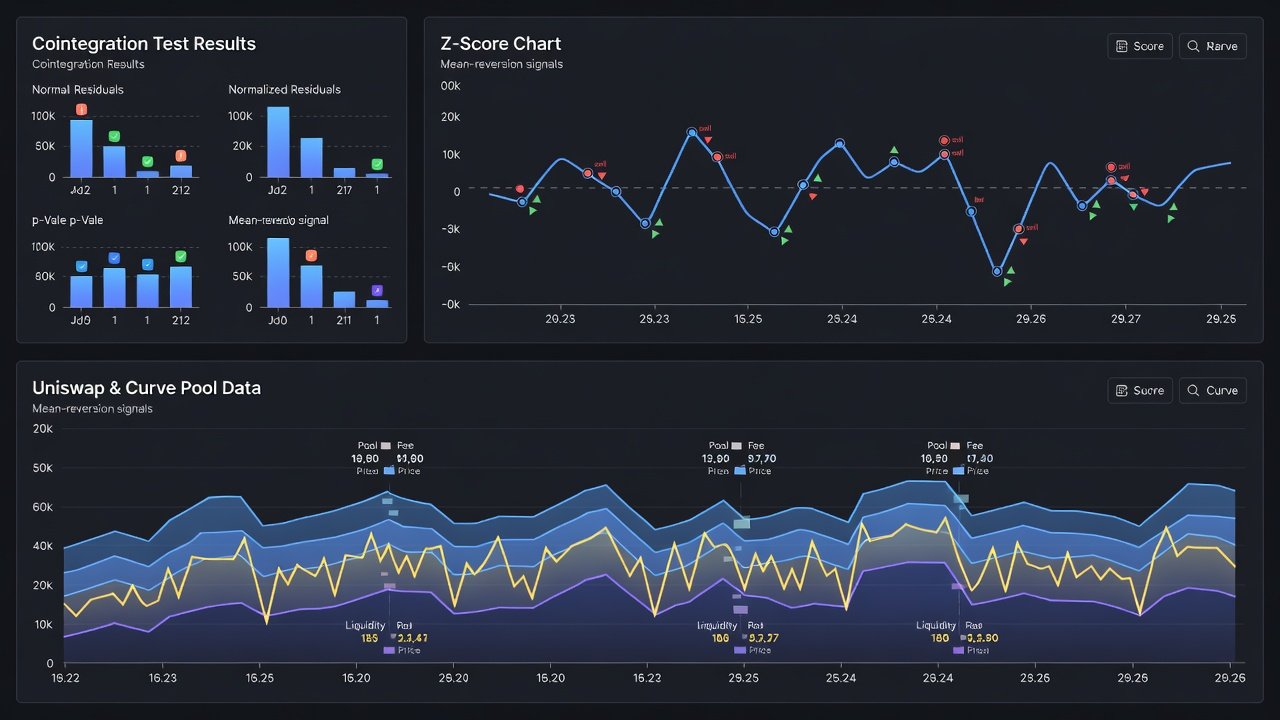
Cointegration testing confirms whether two price series move together over time despite short-term deviations. Unlike simple correlation, cointegration accounts for long-term equilibrium relationships. Platforms like Dune allow users to query on-chain price data from DEX pools and apply statistical models such as the Engle-Granger test directly in SQL dashboards. Users can construct queries that pull historical swap data, calculate spreads, and run augmented Dickey-Fuller tests for stationarity. Nansen provides labeled wallet flows and advanced analytics to validate relationships across multiple timeframes, including smart money tracking that highlights institutional participation. Compare results from both tools to reduce false positives from noisy data. A practical example involves querying 90-day price feeds for a candidate pair, differencing the series, and confirming the residual is stationary before proceeding to live trading.
Setting Mean-Reversion Entry and Exit Rules
Once cointegration is confirmed, define rules based on z-scores of the spread. Enter long-short positions when the z-score exceeds 2 standard deviations and exit when it reverts below 0.5. Incorporate half-life calculations to estimate expected holding periods and adjust thresholds dynamically during volatile market regimes. Traders often layer additional filters, such as requiring volume confirmation or avoiding entries during major news events. In practice, backtest these rules on historical on-chain data to determine optimal parameters. For instance, a pair showing a half-life of 4 hours might warrant tighter z-score bands compared to slower-moving assets with longer reversion times. Document all parameters clearly and implement them consistently across automated systems.
Step-by-Step Execution on Uniswap and Curve
On Uniswap, swap the underperforming leg of the pair while simultaneously opening the opposing position on Curve for lower-fee stablecoin pairs. Begin by approving token allowances via the wallet interface, then execute the first swap on Uniswap v3 concentrated liquidity pools, selecting the appropriate fee tier based on volatility. Monitor pool reserves in real time and route orders through aggregators when necessary to optimize pricing. On Curve, utilize stable swap pools for assets like USDC-DAI-USDT to reduce slippage on larger sizes. Test the full flow on testnets before committing capital, simulating gas costs and confirming that both legs execute within acceptable price impact limits. Always record transaction hashes for post-trade analysis.
Comparing On-Chain and Off-Chain Data Tools
On-chain analytics deliver transparent, immutable price histories but suffer from latency and gas costs. Off-chain sources offer faster signals yet introduce trust assumptions. Combine both by using on-chain oracles for final execution while relying on off-chain platforms for initial screening and alert generation. This hybrid approach balances speed with verifiability. For deeper exploration, consider how oracle networks feed real-time prices into smart contracts versus centralized databases that aggregate exchange data. The choice depends on whether the strategy prioritizes immediacy or auditability.
Risk Controls: Stop-Loss and Position Sizing
Implement hard stop-losses at 3 standard deviations to protect against regime shifts. Size positions according to volatility-adjusted metrics, allocating no more than 5% of portfolio risk per pair. Rebalance periodically and maintain separate collateral buffers for each leg to handle asymmetric liquidations. Additional safeguards include maximum drawdown limits per strategy and diversification across multiple uncorrelated pairs. Review position sizing formulas regularly, incorporating updated volatility estimates from recent market data.
Automating Alerts with Custom Bots
Deploy serverless bots that poll Dune queries or Nansen alerts via webhooks. Trigger trade execution through smart contract interfaces when predefined z-score thresholds are met. Include circuit breakers that pause activity during extreme network congestion or oracle failures. Integration with wallet signing services allows seamless on-chain actions while maintaining user control over private keys. Test bot logic extensively in simulated environments to ensure reliability before live deployment.
Common Pitfalls and How to Avoid Them
- Regime shifts: Continuously retest cointegration on rolling windows rather than static historical periods.
- Overfitting: Validate strategies on out-of-sample data from multiple market cycles.
- Liquidity shocks: Avoid low-depth pools and simulate slippage before live deployment.
- Gas and fee erosion: Batch transactions and monitor cumulative costs relative to expected reversion profits.
- Ignoring smart contract risks: Audit any custom contracts and prefer established protocols with battle-tested security.
Frequently Asked Questions
How does slippage affect pair trades?
Slippage widens spreads during execution and can turn theoretically profitable trades negative. Route through multiple pools or use limit orders where supported to control impact. Real-time monitoring tools help quantify expected slippage before confirming transactions.
What are typical fees in DeFi pair trading?
Trading fees vary by DEX and pool tier, while gas costs depend on network congestion. Always calculate break-even thresholds inclusive of all costs before entering positions. Aggregators and optimized routing can help reduce overall expenses.
What capital is required to start?
Capital needs depend on desired position size and risk tolerance. Begin with amounts sufficient to cover minimum liquidity requirements and potential drawdowns across both legs of the trade. Start small to validate the full workflow.
How do regime shifts impact cointegration?
Market structure changes can break previously stable relationships. Regular retesting and adaptive thresholds help strategies remain effective during transitions between bull, bear, and sideways regimes.
Conclusion
DeFi pair trading in 2026 rewards disciplined application of cointegration analysis, robust risk management, and thoughtful automation. By combining on-chain transparency with proven statistical methods, traders can build resilient strategies that adapt to evolving market conditions while controlling downside exposure.


No comments yet. Be the first!