 CryptoChain Blog

Introduction to DeFi Restaking in 2026
DeFi restaking has emerged as a powerful technique for users looking to maximize returns on their staked assets beyond traditional staking methods. In 2026, protocols like EigenLayer continue to lead this innovation by allowing Ethereum stakers to extend their security contributions to additional services. This guide provides a comprehensive walkthrough of restaking strategies, focusing on practical implementation, risk management, and optimization tactics. Restaking addresses the growing demand for capital-efficient yield generation in a maturing DeFi landscape where basic staking yields have stabilized.
Restaking builds on the foundation of proof-of-stake networks, where assets secure the blockchain while simultaneously supporting other decentralized applications. By 2026, this approach has matured, offering sophisticated yield opportunities across multiple chains while introducing new considerations around security and slashing. Users who previously relied solely on Ethereum staking can now leverage their positions to back oracles, data availability layers, and cross-chain bridges, creating compounded returns through layered validation roles.
Understanding the Core Mechanics of Restaking
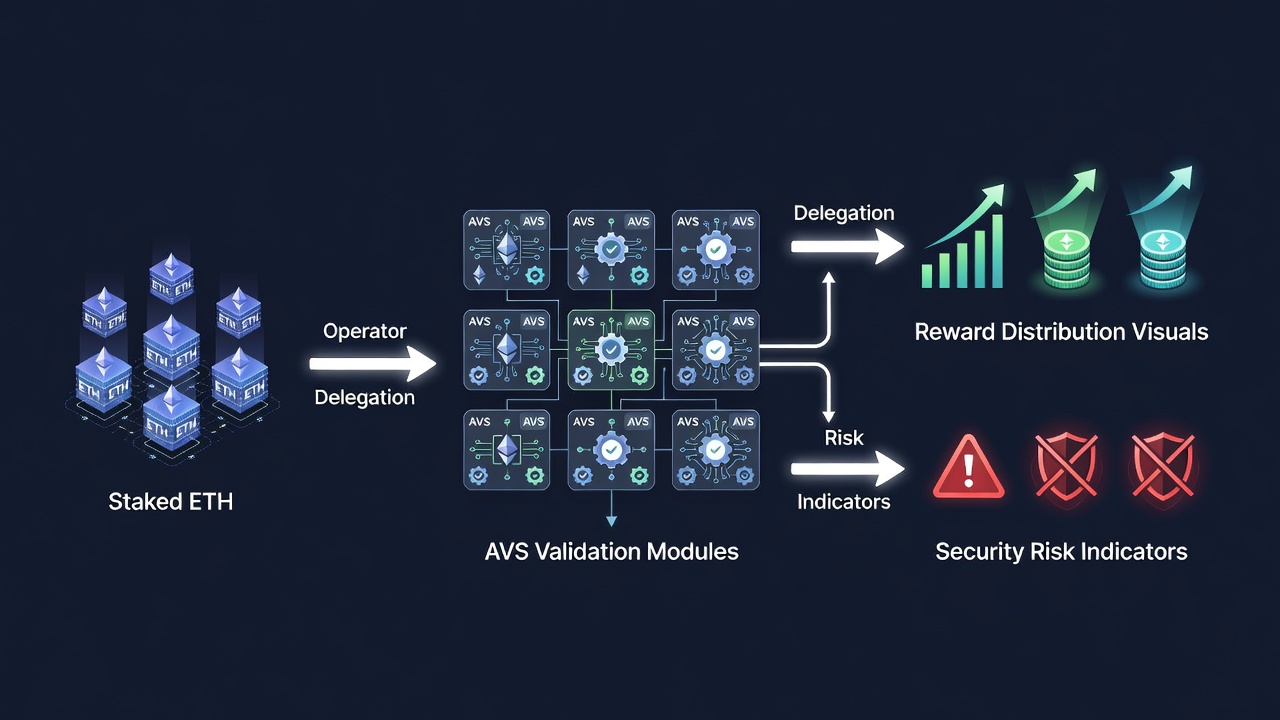
At its heart, restaking involves reusing staked ETH or liquid staking tokens to secure additional networks known as Actively Validated Services (AVSs). EigenLayer acts as the middleware layer that facilitates this process, enabling stakers to opt into validating tasks for these services without unstaking their original assets. The system relies on economic incentives where operators earn fees from AVSs and pass a portion to restakers after deducting their own margins.
The mechanism works through smart contracts that enforce operator responsibilities. Stakers delegate their stake to operators who perform validation work for AVSs. In return, participants earn additional rewards from the AVSs on top of their base staking yields. This dual-purpose staking increases capital efficiency but requires careful evaluation of each AVS's risk profile. For example, an AVS focused on decentralized oracle networks might demand frequent price feed updates, while a data availability service could penalize latency in block propagation.
Participants must understand that restaking does not alter the underlying Ethereum consensus but adds optional modules. Operators run specialized software to handle AVS duties, and any failure triggers predefined slashing conditions embedded in the EigenLayer contracts.
Step-by-Step Guide to Setting Up EigenLayer Restaking
Getting started with restaking requires a systematic approach. Follow these steps for a secure setup:
- Acquire and stake ETH on the Ethereum beacon chain using a trusted staking provider or run your own validator. Ensure your node meets hardware requirements and maintains high uptime from the start.
- Wrap your staked ETH into liquid staking tokens if desired for flexibility, then bridge them to EigenLayer. This step allows easier management without locking funds indefinitely.
- Choose and delegate to reputable operators who support the AVSs you wish to secure. Research operator performance history, including past slashing incidents and fee structures.
- Review and opt into specific AVSs through the EigenLayer dashboard, confirming slashing conditions for each. Start with lower-risk services that have proven track records before expanding.
- Monitor performance regularly and adjust delegations based on reward rates and risk metrics. Use on-chain analytics tools to track validator effectiveness and AVS health indicators over time.
Always begin with small test amounts to familiarize yourself with the interface and transaction flows before committing larger positions. Consider gas optimization techniques during high network congestion periods to reduce costs.
Security Considerations and Risk Comparisons
Restaking introduces layered risks compared to basic staking. While traditional staking primarily faces network-level slashing for downtime or double-signing, restaking adds exposure to AVS-specific penalties. Users must assess the economic security of each service and the operator's track record. Historical examples from early restaking implementations show that correlated failures across AVSs can amplify losses beyond single-protocol events.
Key risks include correlated slashing events across multiple AVSs and smart contract vulnerabilities in the restaking middleware. Mitigation strategies involve diversifying across operators and AVSs, maintaining conservative allocation sizes, and staying updated on protocol audits. In contrast to vanilla staking, restaking offers higher potential returns but demands active oversight. Participants should compare these approaches using frameworks from established resources like Ethereum.org.
Additional safeguards include using multi-signature setups for delegation keys and participating in testnet simulations before mainnet deployment. Understanding the slashing severity for each AVS helps in portfolio construction.
Real-World Yield Strategies Across Chains
Effective restaking strategies often span multiple ecosystems. On Ethereum mainnet, users focus on high-security AVSs with stable reward streams. Cross-chain extensions allow restaked assets to support services on layer-2 networks, amplifying exposure while managing liquidity. Practical examples include allocating 40 percent of stake to established data availability AVSs, 30 percent to oracle services, and the remainder to emerging cross-chain messaging protocols.
Actionable approaches include allocating portions of stake to emerging AVSs in data availability or oracle services, rebalancing quarterly, and combining restaking with other DeFi primitives like lending protocols for compounded effects. Diversification across chains reduces single-point failures and captures varied yield opportunities. Users on Polygon or Arbitrum can explore restaking integrations that mirror EigenLayer's model for broader coverage.
Common Pitfalls to Avoid
Many participants encounter setbacks due to overlooking operator centralization or ignoring evolving slashing parameters. Another frequent mistake is over-allocating to new AVSs without sufficient due diligence on their economic models. For instance, chasing unproven services with high advertised rewards often leads to unexpected penalties during network upgrades.
Always verify contract addresses, use hardware wallets for large stakes, and participate in community governance discussions. Avoid chasing maximal yields without understanding the underlying security assumptions. Regular education through official documentation and forums helps stay ahead of protocol changes.
Protocol Comparison and Actionable Checklist
When evaluating restaking options, compare factors such as supported AVS variety, operator reputation, and withdrawal flexibility. EigenLayer stands out for its robust Ethereum integration and growing AVS ecosystem, but alternatives may suit specific risk appetites. Key comparison points include audit frequency, community size, and integration depth with existing DeFi tools.
- Review all slashing conditions before delegation.
- Track real-time performance metrics via on-chain dashboards.
- Maintain liquidity buffers for potential unstaking needs.
- Reassess allocations every 30-60 days based on market conditions.
- Document all delegation decisions for tax and performance review purposes.
FAQ on Slashing Risks and Reward Optimization
What triggers slashing in restaking?
Slashing occurs when operators fail validation duties for AVSs or violate network rules, potentially affecting delegated stakes proportionally. Severity depends on the AVS parameters and the extent of the violation.
How can rewards be optimized?
Optimization involves selecting high-performing operators, balancing exposure across AVSs, and timing delegations around reward distribution cycles while maintaining risk controls. Combining restaking with liquid staking derivatives can further enhance liquidity without sacrificing yields.
Are there withdrawal delays in EigenLayer restaking?
Yes, some AVSs impose unbonding periods that can range from days to weeks, requiring careful planning for users needing quick access to capital.
Conclusion
DeFi restaking with EigenLayer represents an advanced frontier for yield generation in 2026. By mastering the mechanics, prioritizing security, and following structured strategies, users can enhance returns while navigating the associated complexities. Continuous education and prudent risk management remain essential for long-term success in this evolving space. Experiment gradually and always align restaking activities with your overall portfolio risk tolerance.
No comments yet. Be the first!