 CryptoChain Blog
Introduction to DeFi Tokenomics in 2026
Designing effective tokenomics remains central to DeFi protocol success in 2026. Sustainable incentives must balance user acquisition with long-term retention while avoiding mercenary capital that exits at the first sign of reduced rewards. Developers and strategists need detailed blueprints that incorporate token utility, distribution schedules, staking mechanisms, and governance features. This comprehensive guide draws from leading protocols to provide step-by-step frameworks, real-world case studies, and audit checklists that help avoid common pitfalls such as rapid emission inflation or misaligned community incentives.
Core Elements of Token Utility and Distribution
Token utility defines how holders interact with the protocol beyond mere speculation. In 2026, successful designs integrate multiple layers including fee discounts, collateral usage in lending pools, and direct governance voting power. Distribution schedules play an equally critical role. Rather than releasing large portions immediately, protocols implement vesting structures with initial cliffs of six months followed by linear releases over 24 to 48 months. This approach ensures team members and early investors remain committed during market volatility. For example, protocols that front-load allocations often experience sharp sell-offs once unlocks occur, eroding trust and token value. Strategic distribution also considers allocation buckets for liquidity mining, treasury reserves, community grants, and ecosystem development funds. Each bucket requires clear KPIs tied to on-chain metrics such as active addresses and total value locked.
Building Balanced Emission Curves
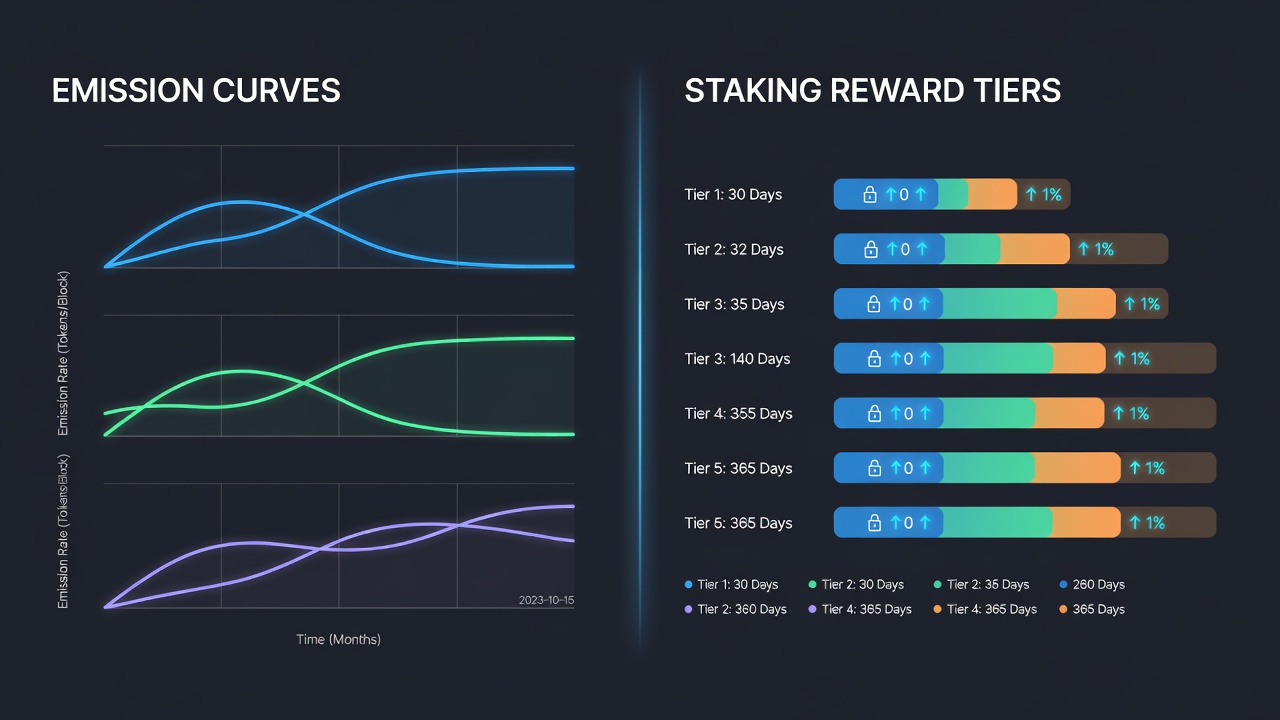
Emission curves determine the rate at which new tokens enter circulation. An effective step-by-step framework starts with forecasting total supply against projected user adoption curves derived from historical DeFi growth data. Developers then apply decay functions that gradually reduce daily emissions as total value locked stabilizes. Stress testing follows, simulating scenarios like sudden TVL drops or competitor launches. The final step involves embedding governance-controlled adjustment parameters so the community can fine-tune emissions without hard forks. This methodology prevents the hyperinflation seen in early DeFi projects where unchecked emissions quickly diluted holder value. Practical implementation often includes time-weighted average emission rates that reward consistent participation over short-term farming.
Inflationary Versus Deflationary Models Compared
Inflationary token models continuously reward liquidity providers but can lead to value erosion if supply growth outpaces demand. Deflationary designs counter this through revenue-funded buyback and burn programs that reduce circulating supply over time. Leading protocols in 2026 frequently adopt hybrid approaches. They begin with moderate inflation to bootstrap liquidity and transition to deflationary pressure once protocol revenue exceeds a defined threshold. Comparisons across multiple projects reveal that pure inflationary systems struggle during bear markets while rigid deflationary ones may lack sufficient incentives for new users. Hybrid models demonstrate superior retention rates because they adapt dynamically to market conditions and usage metrics. When evaluating either approach, teams should model long-term supply trajectories using on-chain analytics tools to ensure sustainability.
Staking Rewards and Retention Tactics
Staking rewards form the backbone of user retention strategies. Effective systems scale rewards according to lock-up duration, offering higher multipliers for longer commitments such as 90-day or 180-day periods. Dynamic APR adjustments based on real-time participation rates prevent over-issuance during high engagement periods. Some protocols incorporate boosted rewards for users who also participate in governance votes, creating a virtuous cycle of engagement. Retention improves further when staking interfaces provide transparent dashboards showing projected yields and penalty structures for early unstaking. These tactics reduce the appeal of mercenary capital by making short-term extraction less profitable than sustained involvement.
Governance Integration Best Practices
Integrating governance with tokenomics strengthens community ownership. Voting rights should directly influence treasury spending, parameter changes, and upgrade proposals. Best practices include minimum token holding thresholds for proposal submission, mandatory discussion periods before voting opens, and time delays between vote closure and execution. These safeguards mitigate risks of flash-loan attacks and governance capture by large holders. Protocols that publish detailed proposal impact assessments before votes enable more informed community decisions. Ethereum Foundation resources provide foundational guidance on decentralized governance patterns that many DeFi teams adapt for their own systems.
Real-World Case Studies from Leading Protocols
Aave has refined its staking model through safety module mechanisms that protect the protocol against shortfalls while distributing rewards proportionally to staked amounts. This design encourages long-term holding and has helped maintain liquidity during stress events. Uniswap demonstrates effective fee-switch governance where token holders vote to redirect a portion of trading fees to the treasury or stakers after reaching revenue milestones. Aave documentation and Uniswap governance portal illustrate how iterative adjustments based on on-chain data improve incentive alignment. Additional examples from protocols like MakerDAO show the value of stability-focused emission schedules that prioritize system resilience over aggressive growth.
Common Pitfalls and Avoiding Mercenary Capital
Mercenary capital arrives for high yields and departs immediately when rewards decline, damaging protocol health. To counter this, teams implement vesting requirements on reward tokens and introduce loyalty multipliers that increase over time. Another frequent mistake involves overly complex token utilities that confuse users and reduce adoption. Simplifying utility while maintaining clear value accrual paths leads to better outcomes. Teams should also monitor concentration metrics to detect whale dominance that could distort governance outcomes.
Checklist for Tokenomics Audits
- Model emission schedules against multiple user growth scenarios including worst-case market conditions
- Run simulations of mercenary capital inflows and outflows to test retention mechanisms
- Verify governance thresholds and time delays adequately prevent capture or rushed decisions
- Confirm that token utility creates measurable demand through actual protocol usage rather than speculation alone
- Review all vesting schedules for team, advisors, and investors to ensure alignment with long-term protocol success
- Assess regulatory exposure by documenting utility features and decentralization milestones
- Evaluate community communication plans including dashboards and regular reporting cadences
Regulatory Considerations and Community Alignment Tactics
Regulatory clarity continues to evolve in 2026. Protocols benefit from maintaining transparent records showing how tokens deliver utility and how governance remains decentralized. Clear separation between investment-like features and functional utility helps reduce classification risks. Community alignment tactics include publishing detailed tokenomics whitepapers, hosting monthly AMAs with on-chain data presentations, and implementing revenue-sharing programs that directly benefit active participants. These practices build trust and encourage holders to advocate for the protocol rather than treat it as a short-term trade.
Practical Steps for Implementation
Begin by defining core objectives such as target TVL growth and user retention rates. Next, prototype emission curves and staking multipliers in test environments using historical data. Engage external auditors early to review smart contract logic and economic assumptions. Launch with conservative parameters that can be adjusted through governance rather than aggressive initial rewards. Finally, establish ongoing monitoring systems that flag deviations from projected metrics so adjustments can occur promptly.
Conclusion
Successful DeFi tokenomics in 2026 requires precision across utility design, emission management, staking structures, and governance integration. By applying the frameworks, case studies, and checklists outlined above, protocol teams can create incentive systems that scale sustainably while fostering genuine community alignment. Continuous iteration based on on-chain feedback ensures long-term resilience against market shifts and competitive pressures.

No comments yet. Be the first!