 CryptoChain Blog

Understanding Impermanent Loss in Volatile DeFi Markets
Impermanent loss remains one of the most critical risks for liquidity providers in decentralized finance. It arises whenever the price ratio of assets in a pool diverges from their initial deposit ratio, causing the provider to end up with a portfolio worth less than simply holding the assets outside the pool. In 2026, with continued market swings driven by macroeconomic events and protocol upgrades, understanding and mitigating this loss is essential for anyone supplying liquidity on platforms such as Uniswap V4 and Balancer. This comprehensive guide walks through the mechanics, provides concrete 2026 examples, details step-by-step calculations, explores hedging with derivatives, compares mitigation approaches, and offers actionable rebalancing and monitoring frameworks suitable for both beginners and advanced strategists.
Mechanics of Impermanent Loss with 2026 Examples
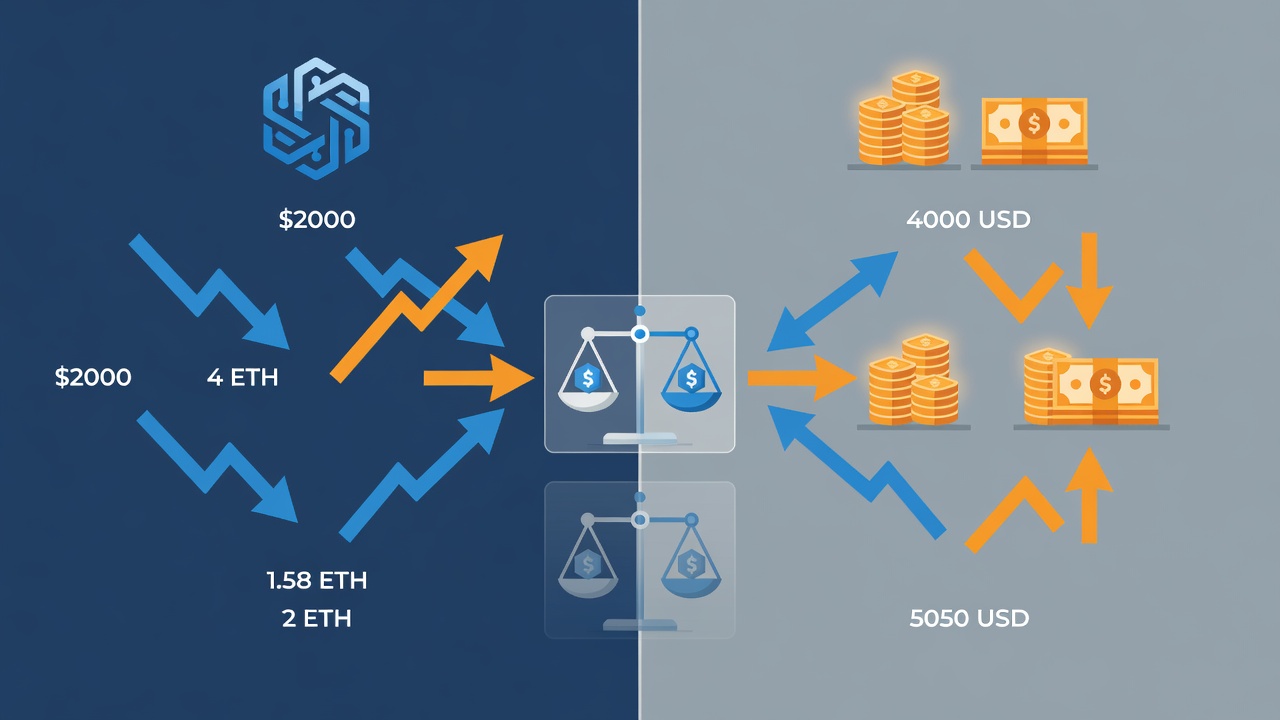
The core mechanism is automatic rebalancing within constant-product or weighted pools. When one asset appreciates or depreciates relative to the other, the smart contract sells the appreciating asset and buys the depreciating one to maintain the pool ratio. This leaves the liquidity provider with fewer units of the asset that rose in price. Consider a real-world Uniswap V4 ETH/USDC 50/50 pool observed in Q1 2026. A provider deposits 2 ETH and 4000 USDC when ETH trades at $2000. After a 60 percent ETH rally, the pool rebalances to roughly 1.58 ETH and 5050 USDC. The total value is lower than simply holding the original 2 ETH and 4000 USDC outside the pool. Balancer’s 80/20 weighted pools exhibit similar dynamics but with reduced magnitude because of the unequal weighting, which dampens rebalancing pressure on the dominant asset.
Step-by-Step Calculation Example
- Record initial deposit quantities and current market prices.
- Calculate the constant product or weighted invariant at deposit time.
- Apply the new price ratio to determine the new token quantities the pool holds.
- Subtract the new portfolio value from the hold value to quantify impermanent loss as a percentage.
- Factor in accumulated trading fees to determine net position performance.
A second example on Balancer in mid-2026 involved a WBTC/ETH pool during a Bitcoin halving-related volatility spike. Providers who stayed in the pool for 14 days experienced an 11.4 percent divergence before fees partially offset the gap.
Hedging Techniques Using Options and Derivatives
Options and perpetual futures allow providers to neutralize directional exposure. One effective approach is purchasing out-of-the-money put options on the volatile asset while remaining in the liquidity pool. In early 2026, protocols offering on-chain options enabled providers to buy weekly ETH puts that covered 70 percent of potential downside moves. Another technique involves shorting perpetual futures on centralized or decentralized exchanges in a ratio that matches the pool’s delta. This creates a market-neutral position where fee income continues to accrue while price risk is largely hedged. Advanced users combine both instruments in a collar strategy, selling calls to finance protective puts. Integration with Uniswap V4 hooks further allows automated hedging triggers based on on-chain price oracles.
Uniswap documentation provides detailed integration guides for V4 hooks that support custom hedging logic.
Comparing Mitigation Tools: Concentrated Liquidity vs Insurance Protocols
- Concentrated Liquidity Ranges: Uniswap V4 lets providers define narrow price bands around current market levels. Capital efficiency rises dramatically, yet the position must be actively adjusted when price exits the range. In 2026 tests, narrow-range positions reduced impermanent loss by up to 65 percent compared with full-range positions during moderate volatility but suffered larger drawdowns during flash crashes.
- Insurance Protocols: Decentralized insurance platforms issue parametric coverage for impermanent loss events. Premiums are paid in stablecoins and payouts trigger automatically when divergence exceeds a predefined threshold. This passive method suits providers unwilling to monitor positions daily, though coverage caps and waiting periods apply.
- Hybrid Approaches: Some users split capital between concentrated liquidity on Uniswap V4 and insured full-range positions on Balancer to balance yield and protection.
Choosing between tools depends on available time, capital size, and risk appetite. Concentrated liquidity rewards active management while insurance offers simplicity at an ongoing cost.
Practical Portfolio Rebalancing Steps
Rebalancing restores the original asset ratio and can be performed manually or via automated bots. Begin by tracking positions in a spreadsheet or dashboard. When divergence exceeds 5 percent, withdraw liquidity, execute a swap on a low-slippage venue to restore the target ratio, then redeposit. In 2026, gas-optimized Layer-2 networks reduced rebalancing costs significantly. A sample checklist includes: review oracle prices, calculate current impermanent loss ratio, estimate swap fees and gas, execute the rebalance during low-volatility windows, and log results for performance tracking. Providers managing multiple pools should stagger rebalances to avoid simultaneous large transactions that could move markets.
Key Risk Metrics to Monitor
Track divergence percentage daily, impermanent loss ratio weekly, and asset correlation coefficients monthly. Additional metrics include pool TVL trends, 30-day realized volatility of each paired asset, and net APR after subtracting estimated impermanent loss. Balancer’s analytics dashboard and third-party DeFi aggregators surface these figures in real time, allowing providers to set alerts when any metric crosses personal thresholds.
Balancer resources detail advanced analytics for weighted pools.
Tools and Platforms for Ongoing Monitoring
Popular interfaces aggregate data across Uniswap V4 and Balancer, displaying live impermanent loss estimates and fee projections. Combining these with on-chain alerting bots provides 24/7 oversight. Users should also consult Ethereum.org for protocol upgrade announcements that may alter pool mechanics.
Common Mistakes to Avoid
Many beginners ignore fees when calculating net performance, leading to overly pessimistic views of pool viability. Others set overly tight concentrated ranges that require constant adjustment, eroding returns through repeated gas costs. Failing to hedge during anticipated high-volatility events such as regulatory announcements is another frequent error. Finally, neglecting to diversify across multiple pools and chains concentrates risk unnecessarily.
FAQ: Common Scenarios for Beginners and Advanced Users
How does impermanent loss affect stablecoin pools?
Stablecoin pairs experience minimal divergence because price ratios remain near parity, making them attractive for conservative yield generation with very low impermanent loss exposure.
Can derivatives fully eliminate impermanent loss?
Derivatives can reduce net exposure to near zero but cannot remove the underlying rebalancing effect; residual basis risk and funding rates remain.
What rebalancing frequency works best in 2026 markets?
Bi-weekly reviews strike a practical balance between transaction costs and risk control for most mid-sized portfolios.
Are insurance premiums tax-deductible?
Tax treatment varies by jurisdiction; consult a qualified advisor familiar with DeFi activities in your region.
How do V4 hooks change hedging possibilities?
V4 hooks enable custom smart-contract logic that can automatically execute hedges when certain on-chain conditions are met, reducing manual intervention.
Conclusion
Impermanent loss need not deter participation in DeFi liquidity provision when addressed with disciplined strategies. By mastering calculations, deploying appropriate hedges, selecting suitable mitigation tools, and maintaining rigorous monitoring routines, providers can protect capital while capturing trading fees across Uniswap V4 and Balancer pools throughout 2026 and beyond. Begin with small test positions, document every decision, and iterate based on observed results.


No comments yet. Be the first!