 CryptoChain Blog

Introduction: Ethereum L2s and the Institutional Shift in 2026
As Ethereum continues to evolve, Layer 2 (L2) solutions are becoming the primary gateway for institutions seeking scalable, compliant access to the network. In 2026, banks, asset managers, and funds are leveraging these technologies to execute high-volume transactions while meeting strict regulatory standards. This article provides in-depth analysis of regulatory-compliant L2 features, real-world case studies, performance comparisons, and practical strategies for adoption. Institutions require solutions that balance speed, security, and oversight. Ethereum's L2 ecosystem, including optimistic and zero-knowledge rollups, addresses these needs by offloading computation from the main chain while inheriting its security guarantees. The maturation of these networks has opened doors for traditional finance players who previously viewed blockchain as too volatile or non-compliant for core operations. By 2026, L2 adoption has accelerated due to improved tooling and clearer regulatory pathways, allowing institutions to tokenize real-world assets, manage treasury operations, and explore yield-generating activities on a foundation that prioritizes both performance and accountability.
Key Regulatory-Compliant L2 Features for Institutions
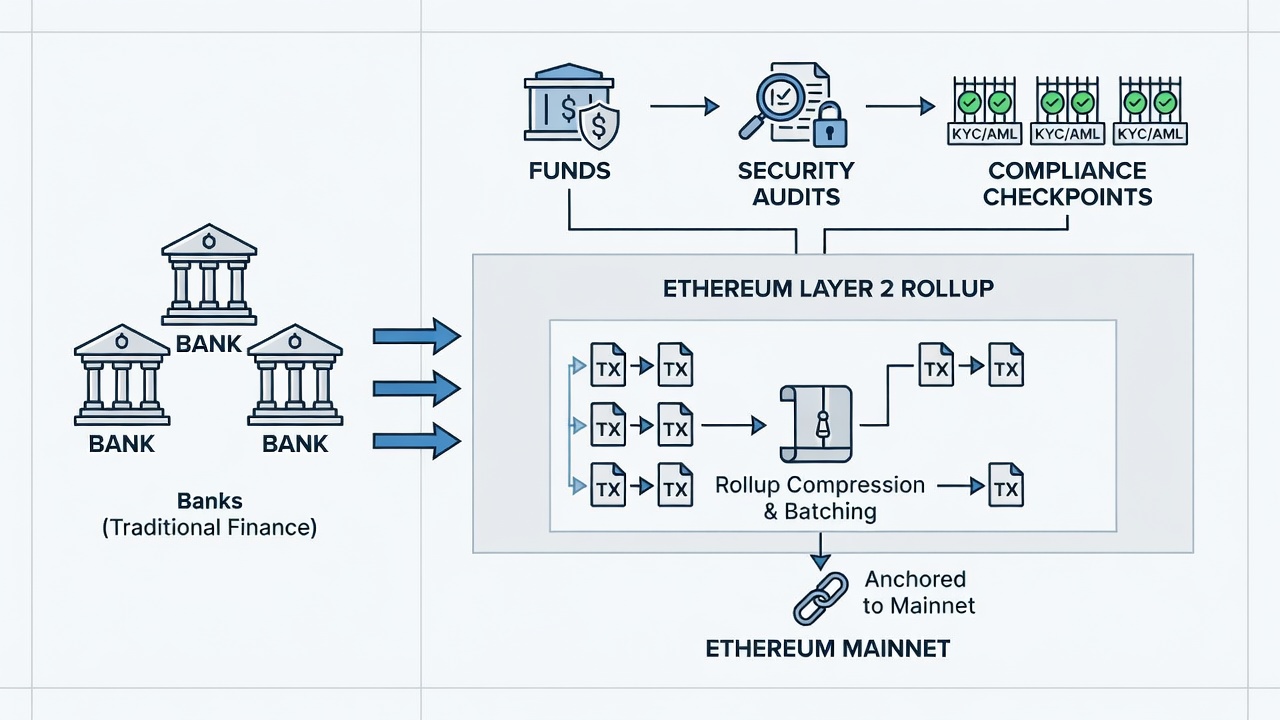
Modern L2 platforms incorporate built-in compliance tools such as permissioned access controls, KYC/AML integrations, and on-chain reporting mechanisms. These features allow institutions to operate within frameworks set by bodies like the SEC while benefiting from Ethereum's decentralization. Zero-knowledge proofs enable private transaction verification, reducing exposure of sensitive data. Many L2s now support programmable compliance, where smart contracts automatically enforce jurisdictional rules. Additional capabilities include role-based access for treasury teams, automated tax reporting modules, and integration with enterprise identity providers. These elements ensure that every transaction can be audited without compromising the efficiency gains that make L2s attractive in the first place. Institutions also value L2s that offer optional data availability layers tailored for regulated environments, enabling selective disclosure to auditors while keeping operational details private from the broader public.
Real-World Case Studies from Banks and Funds
Several major financial institutions have piloted Ethereum L2 deployments. For example, a leading European bank integrated an L2 solution to tokenize assets, achieving settlement times under two seconds with full audit trails. Similarly, a U.S.-based asset manager utilized L2 yield strategies to optimize institutional portfolios while maintaining transparency for regulators. Another case involves a global hedge fund that migrated its collateral management processes to an L2 platform, resulting in streamlined cross-border payments and reduced counterparty risk. A Canadian pension fund recently tested L2-based stablecoin issuance for internal liquidity management, demonstrating how these networks support high-frequency rebalancing without exposing positions publicly. These implementations demonstrate reduced operational costs and improved liquidity access without compromising on compliance, providing blueprints that other organizations can adapt to their specific mandates and risk profiles.
Performance Comparisons: L2 vs Layer 1
Compared to Ethereum Layer 1, L2 solutions offer dramatically higher throughput while maintaining near-identical security. Gas fees on L2s remain significantly lower, enabling frequent institutional trading and settlement activities that would be cost-prohibitive on the base layer. Security audits conducted by independent firms have consistently validated L2 robustness, with many platforms achieving top-tier ratings in 2026 assessments. Beyond raw speed, L2s provide better finality guarantees through fraud proofs or validity proofs, allowing institutions to finalize large transfers within minutes rather than waiting for multiple Layer 1 confirmations. Latency improvements also support real-time risk monitoring dashboards that pull on-chain data directly into enterprise systems. When benchmarked against Layer 1, L2 environments reduce congestion-related delays during peak market volatility, giving institutions more predictable execution windows for time-sensitive strategies.
Integration Roadmaps and Security Audits
Successful L2 integration follows a phased roadmap: initial pilot testing on testnets, followed by security audits from reputable firms, and gradual mainnet rollout with monitoring dashboards. Institutions should prioritize L2s that undergo quarterly audits and publish transparent vulnerability disclosures. Roadmaps typically begin with vendor selection based on compliance certifications, move through proof-of-concept environments that mirror production data flows, and conclude with live operations supported by 24/7 incident response teams. Security audits cover smart contract code, bridge implementations, and off-chain components such as sequencers and provers. Leading practices include engaging multiple audit firms for redundant reviews and incorporating formal verification methods for critical contracts. Continuous monitoring tools track anomaly detection and automatically flag transactions that deviate from pre-approved patterns.
Yield Opportunities Specific to Institutions
Institutional participants can access yield through compliant staking pools and liquidity provision on regulated L2 protocols. These opportunities emphasize risk-adjusted returns, often involving diversified strategies across multiple L2 environments. For instance, some institutions allocate portions of treasury reserves to L2-based lending markets that require over-collateralization and real-time liquidation protections. Others explore structured products that combine L2 yield farming with traditional fixed-income overlays. Key considerations include counterparty risk from protocol governance, smart contract exposure, and liquidity depth during stress scenarios. Institutions frequently employ multi-signature wallets and institutional custodians to safeguard assets while participating in these opportunities.
Step-by-Step Adoption Checklist
- Assess regulatory requirements for your jurisdiction and document all compliance obligations.
- Evaluate L2 platforms for compliance tooling, audit history, and enterprise support levels.
- Conduct internal security reviews and engage third-party auditors for independent validation.
- Develop integration roadmaps with phased testing, including stress scenarios and rollback procedures.
- Implement monitoring for on-chain activity and compliance reporting with automated alerts.
- Train teams on L2-specific risk mitigation techniques and maintain updated incident response playbooks.
- Establish governance frameworks that define approval thresholds for new L2 deployments.
Expert Quotes on Risk Mitigation
Industry leaders emphasize starting with small-scale deployments. One expert noted, "Institutions must prioritize audited L2s with proven compliance layers to mitigate both technical and regulatory risks." Another highlighted the importance of diversified L2 strategies to avoid single-point dependencies. A third specialist stressed the value of maintaining parallel relationships with multiple L2 providers so that operational continuity is preserved if one network experiences temporary issues. These perspectives underscore the need for a measured, well-documented approach that treats L2 adoption as a core component of institutional digital asset strategy rather than an experimental side project.
Common Mistakes to Avoid
Many institutions stumble by rushing into production without sufficient pilot testing or by selecting L2s based solely on headline throughput numbers rather than compliance maturity. Another frequent error is neglecting ongoing governance participation, which can leave organizations exposed when protocol parameters change. Failing to map internal accounting systems to on-chain data flows early in the process often creates reconciliation headaches later. Organizations should also avoid concentrating all activity on a single L2 without contingency plans for bridge failures or sequencer outages.
Conclusion
Ethereum L2 solutions in 2026 are reshaping institutional participation by combining scalability with regulatory alignment. By following structured adoption paths and leveraging proven case studies, organizations can confidently enter the ecosystem. For ongoing updates, refer to ethereum.org and l2beat.com. Additional regulatory context is available at sec.gov.
FAQ
How do L2 solutions ensure regulatory compliance?
Through integrated KYC tools, permissioned environments, and automated reporting features that align with global standards.
What scalability improvements do L2s provide over Layer 1?
L2s deliver orders-of-magnitude higher transaction capacity while preserving Ethereum's security model and enabling institutional-grade throughput.
Are there specific risks institutions should monitor?
Key risks include smart contract vulnerabilities, evolving regulations, and bridge security; regular audits and diversified strategies help mitigate these.
Which L2 types are most suitable for banks?
Both optimistic and zero-knowledge rollups are used, with ZK variants often preferred for privacy features and optimistic ones for simpler integration with existing EVM tooling.
How long does a typical institutional L2 pilot take?
Most organizations report three to six months from initial evaluation through successful testnet validation before moving to limited mainnet activity.


No comments yet. Be the first!